
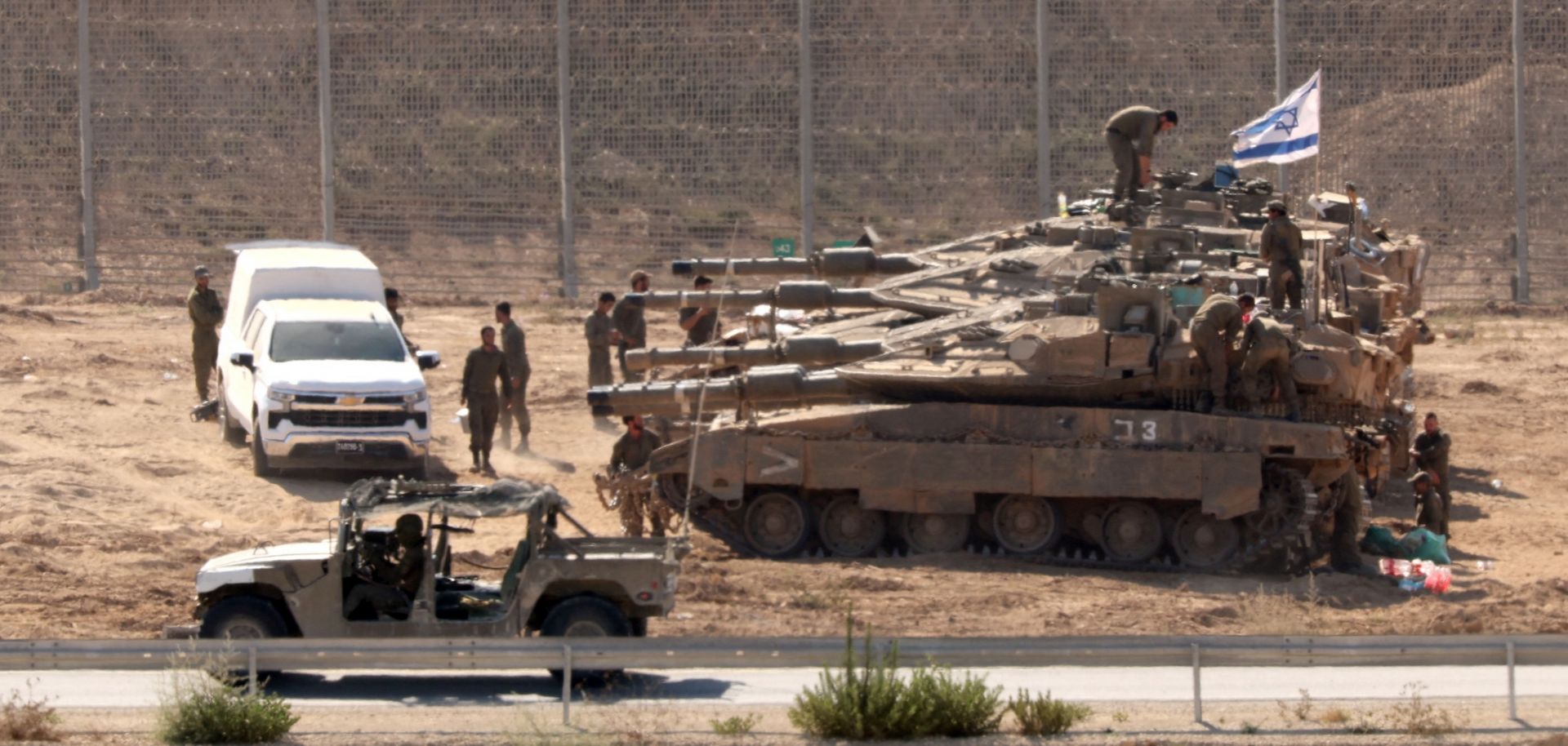
For Israel, reoccupying Gaza would be expensive, spur domestic backlash and deepen the country's diplomatic isolation, which would make the strategy politically difficult to sustain in the likely case that a new Israeli government is elected next year. On Aug. 5, Israeli media reported that the government of Prime Minister Benjamin Netanyahu is preparing to approve plans for a full-scale reoccupation of the Gaza Strip, taking control of approximately 25% of the territory that the Israeli military has not yet conquered in the course of the nearly two-year-long war against Hamas. The reports suggested that Netanyahu had given up on ceasefire talks with the Palestinian militant group and believes that a full-scale military reoccupation is necessary to end the conflict, even if it risks the lives of the roughly 20 Israeli hostages believed to still be in Gaza. The news quickly drew criticism from Israeli opposition leader and former prime minister Yair Lapid, who warned that a full-scale occupation would be expensive and result in significant losses of Israeli lives.
- Israel's government has deliberately maintained a degree of strategic ambiguity over its long-term plans for Gaza since the onset of the war in October 2023. Nominally, its goals are to return the hostages and destroy Hamas, but the government has been specifically mum on policies to achieve these, beyond open-ended military pressure and ceasefire negotiations. Despite the potential shift toward reoccupation, Israel has also reduced its forces in the Gaza Strip to allow them to re-equip and retrain.
- Significant war weariness has gripped the Israel Defense Forces, or IDF, as suicides among reservists and combat veterans have risen, and reservists have increasingly refused to comply with call-up orders.
- The IDF, including its head Eyal Zamir, also opposes reoccupying Gaza largely on security grounds as the Israeli military remains stretched thin. Israel continues to occupy territory in southern Lebanon and southern Syria, and maintains a high alert status due to the recent war with Iran and the potential for a further deterioration of security conditions in the West Bank.
Lessons Learned From Israel's Last Gaza Occupation
Israel occupied the Gaza Strip from 1967 until 2005. During that time, it fought through two major uprisings and faced recurrent harassment from militants, including Hamas, which resulted in the deaths of Israeli soldiers. A handful of Israeli settlements were also established inside Gaza during this time. However, as the Palestinian population in the Strip swelled in the 1990s and early 2000s, the government of then-Prime Minister Ariel Sharon decided to unilaterally withdraw from Gaza in an effort to limit Israel's security and economic liabilities of continued control over the enclave. Many Israelis have been unwilling to attempt to take control of the Strip since the disengagement in 2005, despite ongoing conflicts with Gaza's rulers, Hamas. Nonetheless, Israel's far-right, which provides political support necessary for Netanyahu's coalition to remain in power, views the Gaza Strip as integral to their concept of Greater Israel, which includes all territory of the former Mandate of Palestine.
To mitigate economic and military costs, Israel would likely only partially implement a Gaza reoccupation, allowing security vacuums to persist and humanitarian conditions to worsen amid the ongoing lack of a stable governing authority. To fully reoccupy Gaza and control the roughly two million Palestinians who still live there, Israel would need to deploy tens of thousands of combat soldiers to the enclave in an open-ended counterinsurgency with Hamas and Palestinian Islamic Jihad. Additionally, Israel would be responsible for the tens of billions of dollars needed to reconstruct Gaza and rebuild civilian infrastructure after nearly two years of conflict. To reduce these costs, the Netanyahu government, traditionally conservative in deploying military and economic resources for sustained periods, may authorize a full occupation without committing the full necessary resources. This strategy might involve rotating military divisions into active combat while support units control key roads, border crossings and populated areas. The Israeli military's goal would be to further corral the Palestinian civilian population into strips of terrain outside of IDF control, avoiding efforts to integrate Israeli military forces into Gaza's civilian security fabric (unlike in the West Bank, where IDF forces more routinely patrol and base in civilian areas). Israel is also likely to delay significant reconstruction efforts in Gaza. This means that even if Gaza is declared under full Israeli occupation, security and economic vacuums may persist, enabling Hamas to continue operations and attacks against Israeli forces, while the humanitarian crisis and famine grow worse.
- It is unclear how many troops the IDF would need to control Gaza. But the U.S. military has used a ratio of 20-25 soldiers per 1,000 civilians in a given operating area for counterinsurgency, which suggests the IDF might need up to 40,000-50,000 soldiers to control Gaza's civilian population. But more troops may be needed if Gazans launch a full-scale uprising akin to that of the First and Second Intifadas. The IDF has around 130,000 regular ground troops, most of whom have already done multiple tours in Gaza.
Apart from the United States, most countries are likely to oppose reoccupation, increasing Israel's diplomatic isolation while accelerating the global trend of nations recognizing Palestine. U.S. support for Israel's war strategy will likely remain steadfast under President Donald Trump, despite his occasional rhetorical criticism. However, countries like Canada, France and the United Kingdom, which have increasingly voiced criticism of Israel's Gaza strategy and have already taken steps toward recognizing Palestine, are expected to further this trend should the Netanyahu government pursue reoccuption. Countries that are more hesitant to recognize Palestinian sovereignty, such as Germany, may instead grow more critical of Israel's war policies and consider arms limitations to persuade Israel to abandon Gaza occupation. Meanwhile, Arab and Muslim states will likely strongly oppose any Israeli plans to reoccupy Gaza, with even friendly states like Saudi Arabia, Qatar and the United Arab Emirates refusing to provide economic aid for the Strip's reconstruction while it remains under Israel's control.
- Saudi Arabia has conditioned normalization with Israel on the establishment of a Palestinian state. The kingdom has also been reluctant to offer aid to Gaza, believing such assistance would support Israel's war strategy.
- Canada, France and the United Kingdom are widely expected to recognize a Palestinian state at the United Nations General Assembly in September — a move that might presage a shift toward a more critical stance of Israel's war strategy, and might eventually lead to sanctions or arms cut-offs. Germany, Israel's closest European partner, has been reluctant to recognize Palestine, but its government has been facing more public pressure to improve humanitarian conditions in Gaza as famine sets in due to Israel's aid strategy there.
Given the likely unpopularity of a Gaza reoccupation, whatever government emerges from Israel's 2026 elections may be compelled to alter its strategy, potentially leading to another withdrawal from the Strip. Current polls suggest Netanyahu's coalition will not secure a majority in next year's elections, and a costly open-ended Gaza occupation will likely only deepen the coalition's unpopularity. The 2026 ballot is thus widely expected to yield a new Israeli government. In the lead-up to the vote, different political leaders will propose their visions for ending the Gaza conflict. Some, like Lapid, will advocate for resuming the two-state solution to allow Israeli forces to withdraw from the Strip again, while others, like former Prime Minister Naftali Bennett, will favor more right-wing approaches to Gazan governance, such as a joint Israeli-Arab administration similar to that in the West Bank. Still, some far-right Israelis will likely continue to endorse the forced Palestinian depopulation and effective Israeli military takeover as solutions. The ideological makeup of Israel's next government remains uncertain, but as the post-war future of Gaza becomes an increasingly contested domestic political issue, Netanyahu's successor could significantly alter Israel's policy toward the Strip. These changes might range from prolonging open-ended occupation in an attempt to control Gaza and change its demographics and/or enable two-state negotiations, to a chaotic withdrawal that recreates the security conditions that initially led to Hamas's rise.
- Lapid has long favored a two-state solution with the Palestinians. As prime minister, he reaffirmed this position at the United Nations in 2022, despite its unpopularity among average Israelis.
