
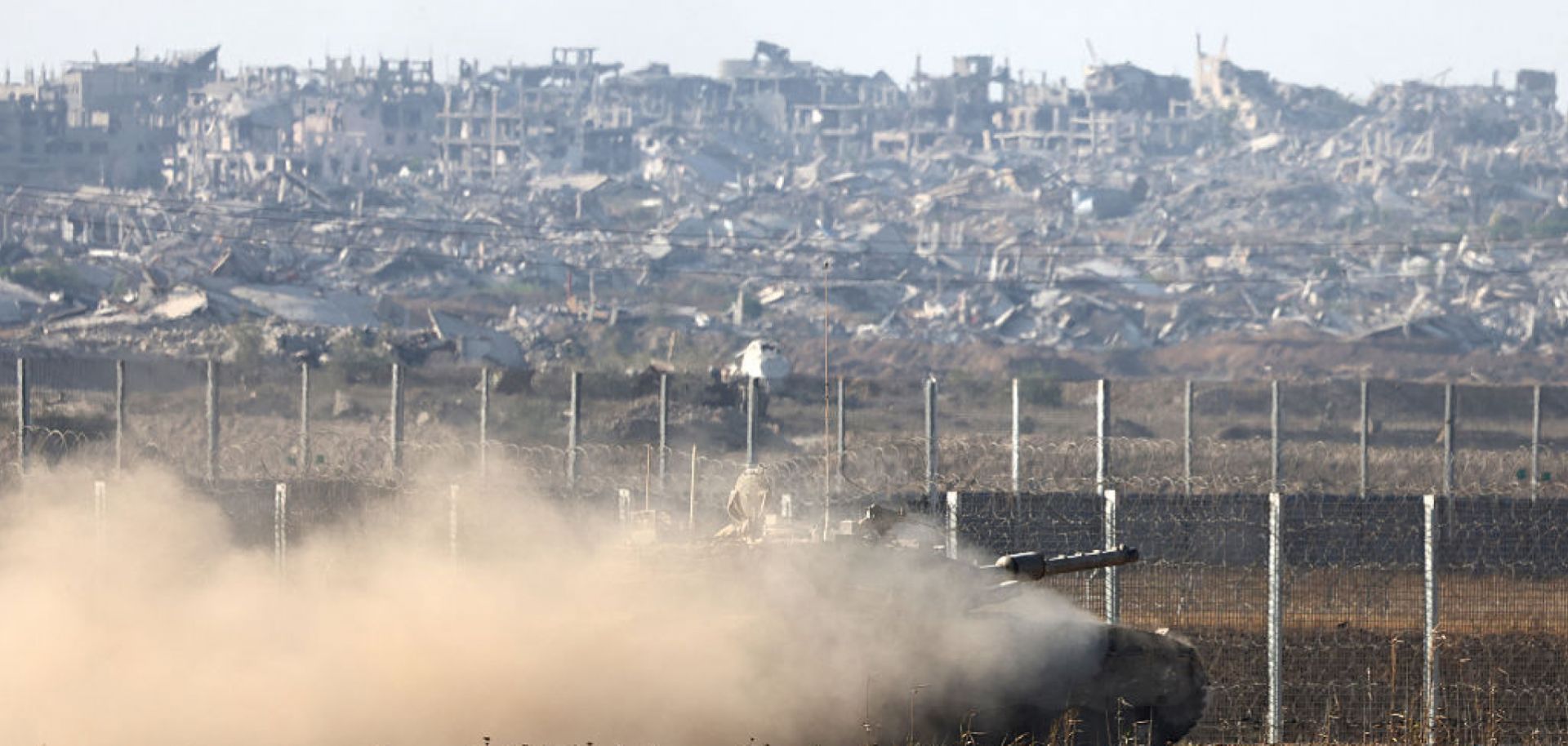
The absence of a coherent post-war governance plan for the Gaza Strip has raised questions about who will control the territory, the role of foreign actors, including the United States, and how reconstruction will be funded. Without a viable solution, these uncertainties increase the likelihood of a prolonged Israeli occupation and further empower far-right forces in Israel to push for annexation and more extensive population displacement.
Israel's Elusive Post-War Governance Plan
Israel's war strategy and goals have expanded since the conflict with Hamas began in October 2023. Initially focused on ending Hamas's control in the Gaza Strip and securing hostages, these goals now also include expanding Israeli control within the Gaza Strip. But all the while, Israel has failed to answer the question of who will govern Gaza once it eradicates Hamas.
Israeli Prime Minister Benjamin Netanyahu has intentionally kept the parameters for Gaza's future vague, ruling out both Hamas and Palestinian Authority leadership in the Strip after Israeli military operations end. This lack of clear post-war plans likely serves Netanyahu's efforts to avoid alienating far-right members of his coalition who support the forced displacement of Palestinians from Gaza, and more moderate members of his Likud party who want the war to end before Israel's next election cycle, scheduled for no later than October 2026. However, Netanyahu's ongoing ambiguity on the matter also sparked tensions with members of his government, including former war cabinet member Benny Gantz and former Defense Minister Yoav Gallant. In the absence of a clear Israeli plan, the United States and Gulf Arab countries have put forward several alternative proposals for post-war governance in Gaza, though these proposals continue to face gaps and criticism.
Gaza's Political History and Murky Future
The challenge of governing Gaza is not new. Control over the Strip has changed frequently throughout the 20th century and into the 21st century. Following the end of the British Mandate for Palestine and the 1948 Arab-Israeli War, Egypt took control of the Gaza Strip. Egypt then allowed the territory to function as the All-Palestine Protectorate, with its government primarily operating in exile from Cairo. Over time, however, the Arab League reduced this government's authority, seeking to bring Gaza more directly under Egyptian control. Israel then gained control of Gaza during the 1967 Arab-Israeli War, with Israeli troops subsequently occupying the Strip. It was not until the 1993 Oslo Accords that the newly formed Palestinian Authority was granted some limited authority over the Gaza Strip. Later, in 2005, Israel withdrew from the Strip and dismantled the existing settlements.
Hamas then rose to power in 2007 after unexpectedly winning the 2006 Palestinian legislative elections, which exacerbated tensions with rival Palestinian party Fatah and led to a political split that left Hamas in control of Gaza's government. Hamas has governed the Strip ever since, but its future control is now increasingly uncertain following the group's October 2023 assault on Israel, which has triggered a long and brutal war that has weakened its leadership and military capabilities, as well as its political standing in Gaza.
After more than a year and a half of war, Hamas now possesses limited weaponry, with its indigenous rocket-building capabilities largely depleted. Furthermore, Israel's assassination of several high-ranking officials — including Yahya Sinwar, a key architect of the Oct. 7 attack, and Ismail Haniyeh, the head of Hamas's Politburo — has weakened the group's leadership. In Gaza, Hamas also faces growing pressure from protesters demanding an end to the conflict due to deteriorating living conditions.
But despite these setbacks, Hamas will likely maintain its political resolve to continue fighting, at least until the Israeli elections, in the hopes of securing a more favorable ceasefire deal should a more moderate Israeli government come to power. Rising anti-Israeli sentiment in Gaza has also bolstered Hamas's recruitment efforts, which will likely provide the group with enough manpower to sustain its insurgency over the next year, even if intermittent, short-term ceasefires are agreed upon.
The resulting ongoing conflict in Gaza will, in turn, prolong Israel's military operations there, particularly as Israel has not mobilized reservists on the same scale as it did immediately after the Oct. 7 Hamas attack to quickly seize key areas of the Strip.

The Dim Prospect of a Palestinian Government
With the war unlikely to wind down anytime soon, a critical question remains: who will govern Gaza?
One option that is almost certainly off the table is another Hamas-led government. Israel vehemently opposes this. But the Palestinian militant group has nonetheless demonstrated some effective governance, even amidst widespread destruction in the Gaza Strip, by continuing to provide some public services. Despite facing growing pushback from Palestinians in the Gaza Strip, Hamas also retains a degree of legitimacy within the region. The Netanyahu government has armed certain clans with reported ties to jihadist factions in Gaza in an attempt to weaken Hamas. But without a plan in place for who would govern Gaza instead, these efforts risk plunging the Strip into further anarchy.
A government led by a reformed Palestinian Authority, which currently governs the West Bank, may be more palatable to the international community. But Palestinians have heavily criticized the Palestinian Authority for alleged corruption, inefficiency and collusion with the Israeli government. Palestinian President Mahmoud Abbas is also deeply unpopular among both Palestinians and Gulf Arab states, and his recently appointed deputy and potential successor, Hussein al-Sheikh, is expected to pursue similar policies, which are unlikely to be well-received by Palestinians as well.
Then there is the third option of a government led by Palestinians unaffiliated with either Hamas or the Palestinian Authority — an idea that Netanyahu himself has periodically floated. However, Palestinians in Gaza would likely view any Palestinian-led government working in cooperation with Israel as illegitimate, which would fuel domestic tensions and undermine the government's authority. Such a government would also likely be rife with corruption, especially when it comes to aid distribution. Furthermore, excluding Hamas and the Palestinian Authority would severely limit the pool of qualified professionals able to govern Gaza, as there would likely be few unaffiliated Palestinian individuals who would meet the requirements and even fewer with any public service background. Nevertheless, a Palestinian-led government would reduce Israel's role within the Gaza Strip to focus on maintaining security as opposed to leading daily operations.
However, there are no concrete plans in place for any Palestinian-led government to control the Gaza Strip. This means Israel's ongoing efforts to seize broader swaths of Gazan territory are most likely to result in a de facto Israeli occupation. Indeed, Israel has already taken on the task of distributing humanitarian aid in the Gaza Strip, compelled by growing international pressure to avert a famine in the war-torn territory (particularly from key allies like Germany and, to a lesser extent, the United States), and a distrust of international aid organizations. Aid distribution is still secondary to Israel's primary goals of defusing security threats in Gaza, eliminating Hamas, and recovering remaining hostages, dead or alive. But until a more sustainable governance plan is established, Israel will likely remain responsible for both securing the Gaza Strip and providing its residents with crucial humanitarian aid for the foreseeable future.
Potential U.S. Involvement
Additionally, there is the question of what role the United States will play in Gaza's political future. U.S. President Donald Trump has publicly expressed concern over living conditions in Gaza and the prolonged war with Hamas, reportedly pressuring Israel to accept at least a limited ceasefire agreement. But while some post-war governance plans floated by Israel have proposed a U.S.-backed or U.S.-led interim authority in the Gaza Strip, Washington is unlikely to accept such a role.
For one, Trump opposes long-term military presence in prolonged conflicts. In an interim government, there would likely be no end date to the U.S. participation, which will deter the White House from deploying troops in support of this. Furthermore, Hamas's continued insurgency and the threat from jihadist factions in the Gaza Strip would increase the risk of physical harm to U.S. troops. If American soldiers were killed as part of an interim Gazan government, Trump would likely face domestic backlash, including from his own supporters.
The U.S. experience with the Coalition Provisional Authority in Iraq will likely factor into the Trump administration's reticence as well. In 2003-2004, the United States assumed a temporary governing role in Iraq after Saddam Hussein's removal and prior to Iraqi elections. This period drew heavy criticism, with some Iraqi officials labeling it an occupation and attributing Iraq's worsening instability and security to U.S. policies, such as De-Baathification, which removed many experienced public officials. Given that several Iraq War veterans are part of Trump's cabinet, the checkered legacy of temporary U.S. governance in Iraq will probably further deter the White House from taking on a similar role in post-war Gaza.
The Question of Reconstruction Aid
Beyond the question of governance, Gaza faces the critical challenge of securing significant reconstruction aid. As fighting subsides, foreign nations will increasingly advocate for rebuilding the Strip and ensuring a basic standard of living to prevent starvation. Many international donors, particularly Gulf Arab countries, will likely condition major reconstruction aid on there being a viable path toward Palestinian statehood.
The election of a moderate Israeli government could facilitate reconstruction aid and alleviate the financial burden of rebuilding Gaza. Conversely, another right-wing Israeli government with far-right elements would likely seek to annex the Gaza Strip and displace Palestinians. In the absence of substantial international reconstruction commitments, the international community will look to Israel to improve conditions for Palestinians remaining in Gaza. However, after nearly two years of war, Israel's budget and economy are strained, making many Israelis, even moderates, resistant to large expenditures on rebuilding Gaza.
Consequently, Israel will probably offer only minimal reconstruction support, such as constructing some roads and basic infrastructure facilities, to address international concerns about living standards. But while this may reduce the threat of famine, Gaza will likely remain barely hospitable, with limited access to employment opportunities, healthcare and education.
Faced with this reality, a growing number of Gazans will likely voluntarily emigrate in the coming years, in the hopes of rebuilding their lives elsewhere. However, if Israel elects a right-wing or far-right government, the ongoing poor living conditions in Gaza could also fuel a push to remove Palestinians from the territory. Indeed, Israel has already established a department, led by far-right Israeli Minister Bezalel Smotrich, for voluntary Palestinian displacement. Palestinians would most likely relocate to the West Bank, as regional countries are unlikely to accept large numbers of displaced Gazan refugees.
This scenario could also fuel far-right ambitions to annex the Gaza Strip and encourage Israeli settlers to migrate to the territory, altering Gaza's demographics as the Palestinian population falls and the Israeli Jewish population grows. Such depopulation would only further intensify anti-Israeli sentiment among Palestinians in Gaza and the West Bank, as well as the Palestinian diaspora, which, over time, would likely strengthen pro-Palestinian militant movements or form new ones.
Looking Ahead
Without a clear governance strategy, Israel's expanding control of Gaza will lead to a de facto occupation in which Israel is responsible for security, basic services and humanitarian aid within the Strip. Hamas's ongoing insurgency will likely keep Israeli military forces in the territory for an extended period. Many nations, including the United States and Gulf Arab states, will probably be reluctant to offer substantial support for Gaza's governance due to security concerns and the unlikelihood of right-wing Israeli governments agreeing to conditions for Palestinian statehood.
Even if the next Israeli election doesn't result in a right-wing or far-right government, pressure from the far-right to annex the Gaza Strip and re-establish settlements will likely continue beyond the next government's term. As a result, Israel will have increasing control over the future of Gaza governance, further dimming the prospect of a Palestinian-led government, let alone Palestinian statehood.
