
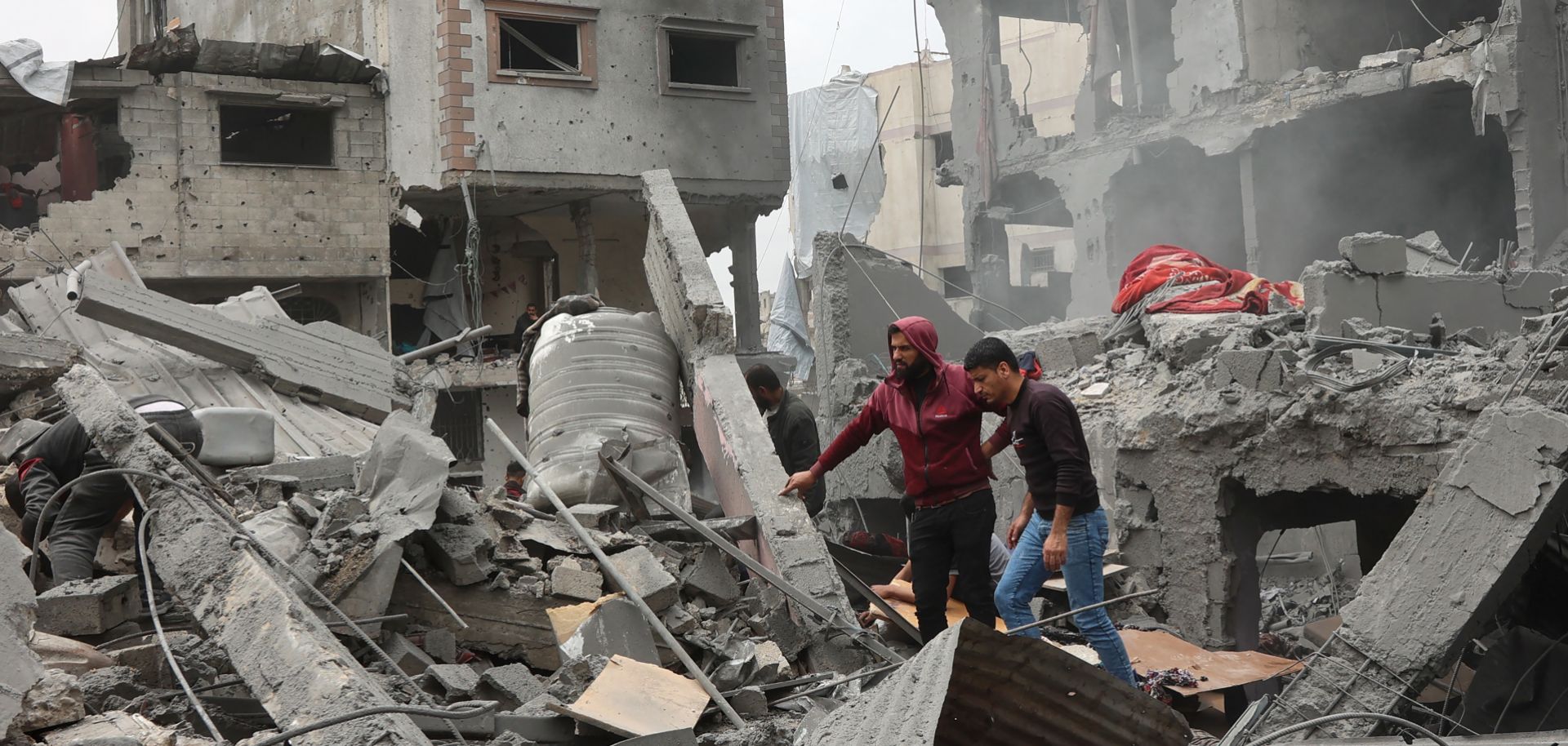
In Gaza, Israel will likely lean further towards population displacement and military occupation as a long-term strategic solution to the territory's security dilemma, but election timelines, domestic pressure and logistical problems will hamper this strategy and may even reverse it. On April 1, Israeli Defense Minister Israel Katz announced that the Israel Defense Forces (IDF) would conduct new military operations in Gaza with the intent to occupy significant new portions of the Strip, where fighting between Israel and the Palestinian militant group Hamas has recently resumed. Since the collapse of the ceasefire in mid-March, Israeli combat operations have resurged in Gaza, as Israel tries to pressure Hamas to release the remaining 59 hostages and lay down their arms as part of an agreement that would precede the militants' ultimate exit from the Strip. According to the Associated Press, the IDF now occupies half of the Gaza Strip, including areas in the south near the Egyptian border, between the cities of Rafah and Khan Younis, along the Israeli-Gaza border, and parts of central Gaza, where Israeli troops appear to be preparing for a long-term deployment by building entrenched positions. This is occurring against the backdrop of faltering negotiations between Israel and Hamas, which have been stalled over Israel's demand that Hamas end its role in Gaza, as well as Hamas' refusal to either disarm or go into exile.
- On March 16, Israel resumed combat operations in Gaza after Hamas failed to release new hostages to extend the strained ceasefire deal, which had technically entered its second phase but which had not been implemented. The second phase was meant to see Israeli forces steadily withdraw from Gaza, something Israel opposed so long as Hamas remained a force there.
- Since the start of the war in October 2023, Israeli officials have floated long-term plans to build buffer zones in Gaza, but most opposed a formal reoccupation of the territory due to the failure of the decades-long occupation that took place after 1967. The previous buffer zone plans largely focused on establishing a security corridor directly along the Gaza-Israeli border that avoided the cities and routes to the sea.
U.S. President Donald Trump's return to the White House has eliminated a key constraint on expansive Israeli military operations, enabling Israel to resume intense military and humanitarian pressure against Hamas and the Gaza civilian population. In the final year of his term, former U.S. President Joe Biden became increasingly critical of Israel's military operations in Gaza amid pressure from his more pro-Palestinian political base. This culminated in U.S. sanctions on some of Israel's far-right settler supporters and suspended shipments of U.S. heavy weaponry, including the 2,000-pound bombs Israel needed to destroy Hamas' underground infrastructure in Gaza. However, since Trump's return to the Oval Office in January, the United States has shifted to a more stridently pro-Israel stance, interpreting the Gaza conflict as something the Israelis must solve using whatever means they deem suitable to eliminate the security threat posed by Hamas. This has translated to the resumption of U.S. aid to the Israeli military. It has also seen Trump suggest moving millions of Palestinians out of the Gaza Strip (a proposal that initially appeared to back forced relocations, though he has since walked that back). Additionally, Trump has not indicated that his administration is particularly concerned about humanitarian conditions in Gaza, which has fed into Israel's strategy of preventing aid deliveries to the region as a way to pressure the civilian population into ending support for Hamas.
- As the ceasefire wobbled in early March, President Trump again urged Israel to ''finish the job'' to secure the remaining hostages and end the threat from Hamas, who he urged go into exile or ''there will be Hell to pay.''
- In another dramatic shift toward pro-Israeli policies, the Trump administration has also been deporting foreign students in the United States who have been associated with pro-Palestine protests, as the White House accuses them of antisemitism and supporting Hamas, a U.S.-designated terrorist group. In 2024, the student-led, pro-Palestine protest movement exerted significant political pressure that helped convince the Biden administration to sanction settlers and withhold weapons.
In addition to forcing Hamas into exile, Israel's military campaign in Gaza will likely increasingly focus on the demographic displacement of Palestinians, as Prime Minister Benjamin Netanyahu seeks to shore up support from his right-wing allies ahead of elections next year. Israel has already taken steps to facilitate voluntary transfers of Gazans out of the Strip, even as it continues to struggle to find official host countries for the more than two million people living in the war-torn territory. Despite this, many on Israel's right and far-right argue that permanently occupying Gaza and resettling Jews there is the only way to end the recurrent cycles of violence that have plagued the Strip following Israel's withdrawal in 2005. However, since the last Israeli occupation (1967-2005), Gaza's population has grown significantly, imposing serious constraints on Israel's ability to occupy and resettle Gazans effectively. As such, with the United States' tacit support, Israel will likely continue to escalate its military operations in Gaza in the hopes that the ongoing violence and social disruption will encourage more civilians there to relocate, thereby permanently reducing the population of the Strip and making Israel's control more viable. In addition, Netanyahu's government believes that long-term control of Gaza is more likely to achieve Israel's overarching strategic goal of permanently ridding the territory of Hamas and other militants — and, in turn, ending the cycle of Gaza-Israeli wars. From a political perspective, Netanyahu is also hoping this strategy will help keep his government in power by appeasing its right-wing members, some of whom have become increasingly skeptical of Netanyahu's current leadership. To that end, Netanyahu will likely present himself as the only leader capable of implementing such a sustained push to stabilize Gaza ahead of Israel's next election, which is now scheduled for October 2026.
- In 2005, Gaza's population was estimated at around 1.3 million, a number that the government of then-Prime Minister Ariel Sharon saw as too large for Israel to maintain the political will to continue occupation.
Without viable resettlement partners, Israel will likely move limited numbers of Gazans to the West Bank, where it will continue to face entrenched problems of militancy, as well as both international and domestic pressure to provide aid for civilians. No countries have yet expressed a willingness to accept Gazan migrants, fearing international backlash and the accompanying challenges of hosting a refugee population with which many potential host countries share few cultural or religious similarities. As a result, in its effort to seize control of Gaza and reduce the Palestinian population there, Israel will most likely try to transfer Gazans to the West Bank, where they can be placed into both existing and to-be-built refugee camps and build new ones. However, such efforts will face huge logistical hurdles, meaning that only a small fraction (perhaps only a few thousand Gazans) will likely be transferred. Moreover, the transfers will stoke significant diplomatic pressure from Israeli allies in Europe (albeit likely not the United States), harsh criticism from Arab states, and domestic protests from left-wing and centrist Israelis, as well as Arab-Israeli citizens. This strategy would also ultimately leave Israel responsible for the civil, military and humanitarian needs of these refugees in the West Bank, leading to sustained pressure on the Israeli government to govern and provide suitable living conditions for the people it relocated from Gaza.
- The United States has reportedly explored options to send Gazans to Somaliland (the splinter state in Somalia), Indonesia and Sudan, and has also floated the prospect of Jordan and Egypt as potential host countries. But none of these countries have confirmed they would take in Gazans.
- Resources in the West Bank are also strained, with regular water and housing shortages. But compared with Gaza, the territory has better access to supplies thanks to its proximity to Jordan and economic connections to Israel, making it a viable location for a limited number of refugees to have minimum standards of living met.
However, growing war-weariness within Israel will likely prevent Netanyahu's government from mustering the military power needed to displace a significant number of Gazans before next year's elections. There are signs that Israel's economy and society are already struggling to sustain the current pace of military operations after over a year and a half of conflict, with reservists reportedly refusing to report for duty, credit rating agencies preparing to downgrade Israel's rating due to ongoing combat operations, and regular protests pushing public opinion toward more limited war objectives (like the release of hostages) rather than the exile of Hamas through extended military engagements. Consequently, the Israeli government is unlikely to gain the public or military support necessary for significant troop mobilizations that would be required to relocate hundreds of thousands of Palestinians from the Gaza Strip. Instead, the IDF will likely focus on its continued ''voluntary'' displacement policy that allows Gazans to relocate on their own accord, a trend suggesting that only a few thousand may exit the Strip instead of the hundreds of thousands needed to demographically alter the security environment. This process will also likely take a long time, potentially lasting until Israeli elections next year, ultimately resulting in a partially realized strategy in which a symbolic number of Gazans are relocated to the West Bank, while Gaza continues to host significant numbers of Palestinian civilians. As a result, the demographic drivers of militancy will persist, ensuring ongoing Israeli-Palestinian violence in the Gaza Strip. Should the current Israeli government be defeated in the October 2026 election, its successor may decide to send relocated Palestinians back into Gaza, particularly if the next government prioritizes annexing the West Bank.
- Current polling suggests that Israel's next government will include both right-wing nationalists and centrists who would politically favor returning to the status quo ante with Gaza, leaving the Strip contained but not occupied or resettled.
