
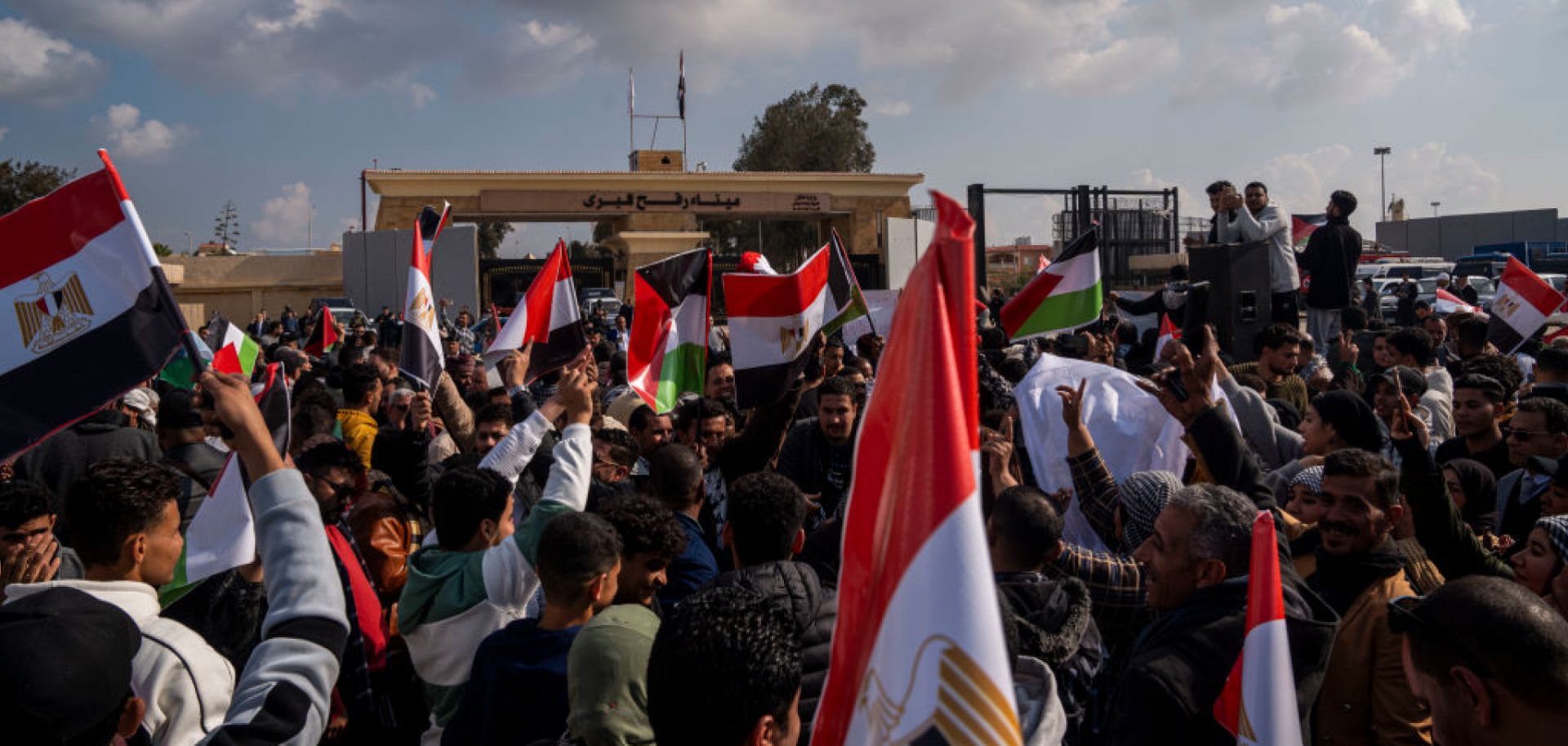
Pro-Palestinian protests will persist across North Africa amid allegations of Israeli ceasefire violations and the U.S. proposal to displace Gazans, but Morocco and Egypt's strategic priorities will likely result in expanded defense and energy cooperation with Israel despite some domestic backlash. On Jan. 31, thousands of Egyptians participated in government-approved protests of U.S. President Donald Trump's controversial proposal to resettle Palestinians from Gaza in Egypt and Jordan. On Feb. 14, organizations in Morocco also held a national ''day of rage'' against the mass resettlement plan. The protests come just weeks after celebratory marches and vigils were held throughout North Africa following the Jan. 15 announcement of the Israel-Hamas ceasefire, with some of the largest crowds gathering in the major Moroccan cities of Tangier, Rabat, Casablanca, Safi and Fez, as well as in Tunis, Tunisia. These developments reflect the rise of pro-Palestinian, anti-Israeli sentiment among North African populations since the Gaza war began in October 2023, which governments have responded to by criticizing Israeli military operations in the Gaza Strip and supporting humanitarian aid efforts there. However, neither Egypt nor Morocco — the two North African countries that have normalized relations with Israel — have indicated any desire to reassess their growing economic, security and energy cooperation with Israel, which could expose Rabat and especially Cairo to increased anti-government backlash and, in the most extreme case, destabilizing unrest, particularly if Trump follows through on his controversial displacement plan.
- On Jan. 25, Trump made comments in which he floated ''clearing out'' the Palestinian population from Gaza and expelling them to neighboring Egypt and Jordan, sparking outrage across the world and particularly in Arab countries.
- Protests in solidarity with Palestinians occurred throughout North Africa during the 16-month conflict in Gaza, particularly after mass casualty incidents or highly publicized Israeli attacks, in addition to weekly protests following Friday prayers at mosques.
- Since 2013, the Egyptian government has banned protests unless they are pre-approved. The government also has the authority to postpone or cancel any protests as it sees fit. Political parties closely aligned with Egyptian President Abdel-Fattah al-Sisi reportedly provided buses to send protesters on Jan. 31 to the Egypt-Gaza border area, where civilian presence is usually prohibited. This shows not only Cairo's rejection of Trump's resettlement proposal but also public disapproval.
Despite growing domestic pressure, Egypt and Morocco have not signaled any intent to reduce their expanding defense and energy cooperation with Israel. Egypt previously said that a mass displacement of Palestinians from Gaza into its territory — a major concern ahead of Israel's May 2024 advance into Rafah, which has since been resurrected by Trump's resettlement proposal — would be a ''red line'' that would risk upending the Egypt-Israel peace treaty. But Cairo has nonetheless maintained pragmatic relations with Israel throughout the conflict, which enabled Egypt to facilitate humanitarian aid inflows through the Rafah border crossing and broker the Hamas-Israel ceasefire deal. Egypt's government has framed this coordination with Israel as working to advance peace and provide aid to the Strip on behalf of the Palestinian cause, and also to mitigate spillover effects from the conflict into Egypt. Similarly, the Moroccan government has disregarded domestic calls to sever ties with Israel and has stressed that maintaining such ties enables Rabat to champion the Palestinian cause through increased dialogue with Israel. But perhaps more importantly, normalized relations with Israel have aligned closely with Morocco and Egypt's domestic priorities to produce weapons domestically and increase energy supplies, respectively. Morocco has been engaged in a growing arms race with Algeria in recent years, and has also sought to modernize its military and reduce its historic reliance on French weapons by diversifying its arms suppliers and boosting domestic production of military equipment, especially drones. Against this backdrop, Rabat has leveraged its normalized ties with Israel to expand its access to advanced Israeli defense and military technologies through contracts to acquire weapons and build production facilities within Morocco. Additionally, Morocco's growing ties with Israel have opened the door to arms deals with the United States, given the strong pro-Israeli stance of the Trump administration. Indeed, there are reports that Morocco will likely soon become the first Arab nation to acquire U.S. F-35 fighter jets, which would significantly strengthen the country's air force. Nevertheless, Moroccans have called on their government to sever ties with Israel, at times juxtaposing citizens' pro-Palestinian stance with the government's imperatives. Egypt has similarly benefited from its ties with Israel, namely in the form of increased security cooperation and, more recently, energy cooperation. In recent years, Egypt has faced worsening power shortages brought on by population growth, warmer temperatures and increased industrial demand. In October, Egypt began importing more Israeli natural gas, as part of the country's continued efforts to halt load-shedding power cuts that had stoked anti-government sentiment and disrupted business operations nationwide.
- The 1979 Egypt-Israel peace treaty, which took effect in 1980, made Egypt the first Arab state to recognize Israel. In the following decades, the two countries have developed pragmatic relations, including through energy, tourism, and security cooperation. In 2020, Morocco normalized relations with Israel as part of the U.S.-backed Abraham Accords. In exchange, both the United States and Israel recognized Moroccan sovereignty claims over the disputed Western Sahara territory. Since normalizing relations with Israel, bilateral trade and cooperation have grown for both Morocco and Egypt, largely aligning with the countries' political priorities and areas of growth, including the defense and military sectors for Morocco and security and energy for Egypt.
- In April, Israeli state-owned defense company BlueBird Aero Systems announced it would open an unmanned aerial manufacturing facility in Morocco. In July, the Moroccan government also inked a $1 billion deal to acquire a spy satellite from the state-owned Israel Aerospace Industries.
- Morocco and Israel have the fastest-growing trade relationship among the Abraham Accord countries, with the volume of trade having more than doubled annually from $56 million in 2022 to $116 million in 2023, according to the Israeli Central Bureau of Statistics. Even after the start of the Hamas-Israel war, bilateral trade has grown. In the first six months of 2024, Morocco-Israeli bilateral trade was valued at $53.2 million, a 64% increase from the first six months of 2023. Similarly, Egyptian-Israeli bilateral trade has also been growing, with trade volumes totaling $477 million in 2023, up from $306.1 million in 2022.
- In 2024, Egypt once more became a net importer of gas as its energy deficits widened following the decreasing domestic production, due in part to the natural decline of the Zohr gas field. To keep up with growing domestic energy demand, Egypt has increased liquified natural gas imports and signed contracts to lease floating storage regasification units. But increasing natural gas imports from Israel through the East Mediterranean Gas facilitates easier integration into Egypt's national grid since these imports do not require regasification technology.
Looking ahead, Egypt and Morocco will likely continue to tolerate some pro-Palestinian protests but will crack down against wider criticisms of their normalized relations with Israel. Morocco will likely continue to permit pro-Palestinian protests as it has done throughout the Israel-Hamas conflict since it is relatively tolerant of nonviolent protests. However, the Moroccan government, as well as the Egyptian government, will likely also continue to crack down on any criticisms of bilateral relations with Israel including on social media, out of concern that this could jeopardize their legitimacy and stoke broader anti-government protests. Egypt, in particular, will continue to leverage its role in brokering the Gaza ceasefire and monitoring the deal's implementation as evidence of Cairo championing the Palestinian cause. But if the ceasefire collapses or there are allegations of major Israeli violations, Egypt risks incurring domestic backlash over its perceived failure to fully enforce the deal. In the case of major violations, Cairo may approve some limited protests with a security presence, especially to internationally signal public disapproval of Israeli policies. If the United States and Israel take concrete steps toward implementing Trump's proposal to remove millions of Palestinians from Gaza, the Egyptian government would likely approve even larger protests to show the world how such a policy could destabilize Egypt. However, Cairo will have to tread carefully in backing pro-Palestinian protests, as such demonstrations could easily morph into a wider anti-government movement if protesters begin accusing Egyptian leaders of being complicit in the mass displacement of Palestinians.
- In March 2024, the Moroccan government arrested an activist after he criticized Israeli-Moroccan bilateral relations on social media; courts subsequently sentenced him to five years in prison on charges of incitement and insulting a constitutional institution.
- In late October 2023, just weeks after the start of the Hamas-Israel conflict, Egyptian police arrested more than 100 individuals for their role in pro-Palestinian protests. Though the Egyptian government had permitted some protests in pre-approved locations, some individuals walked into Tahrir Square — the center of Egypt's 2011 Arab Spring uprising — which was not among the approved sites and where all protests are banned. Later, in May 2024, Egyptian security forces arrested a student activist for sharing posts on social media in support of the Palestinian cause and the Boycott, Divestment and Sanctions movement against Israel.
However, the mass displacement of Palestinians from Gaza would cross a red line for Egypt and likely force Cairo to take a stronger political stance against Israel. Both Morocco and Egypt will remain wary of taking any economically punitive actions against Israel that could jeopardize their access to Israeli weapons and energy, respectively. But for Egypt, any efforts toward a mass displacement of Palestinians from Gaza into its territory would likely force Cairo to take more assertive measures against Israel, likely by downgrading diplomatic ties and reducing trade. Even with financial aid from the United States to potentially support resettling Palestinians in Egypt, the resulting surge in anti-government anger for allowing such a displacement to occur — combined with the added economic and resource strain from having to service a suddenly much larger Palestinian refugee population — could severely destabilize al-Sisi's government. In the worst-case scenario, Cairo may thus go so far as to fully sever diplomatic ties with Israel, in order to appease its pro-Palestinian population and pressure Israel and the United States to revert their efforts to relocate millions of Gazans to Egypt.
The governments of Tunisia, Libya and Algeria, meanwhile, will continue to fuel pro-Palestinian sentiment among their populations and even encourage some protests as a way to divert attention from domestic grievances. Popular anger over Trump's mass resettlement plan will also deepen these countries' opposition to normalizing ties with Israel. As they have done since the Israel-Hamas war broke out in October 2023, the Tunisian, Libyan and Algerian governments will likely continue to permit pro-Palestinian protests as a way of channeling domestic anger and deterring popular criticisms about other issues, such as high costs of living, sporadic power outages and slow economic growth. In fact, the de-escalation of fighting in Gaza as a result of the ceasefire will only further incentivize governments to gin up pro-Palestinian sentiment, in order to ensure peoples' anger remains focused on Israel (instead of domestic grievances). If there are allegations of major Israeli ceasefire violations or if the ceasefire deal collapses, pro-Palestinian protests in Tunisia, Libya and Algeria will thus likely expand in size and scope, likely with tacit government support. These governments' rhetoric will likely also further align with their pro-Palestinian populations, even if their material support for the Palestinian cause remains relatively low. Furthermore, with strong pro-Palestinian popular sentiment, Tunisia, Libya and Algeria will not make any major overtures toward normalizing relations with Israel, as this would risk escalating anti-government sentiment among populations already grappling with economic and standard-of-living grievances. As such, none of these countries will seriously pursue normalization, even if the Gaza ceasefire remains intact, since these countries will condition a path to normalization on Palestinian statehood.
- A 2023 meeting between Libyan and Israeli foreign ministers perceived to be part of normalization efforts sparked widespread government protests and criticism of Libya's internationally-recognized government.
- In the context of the Morocco-Algeria rivalry, the Algerian government will likely also leverage anti-Israel sentiment to stoke nationalist support and portray itself as a better advocate for the Palestinian cause, since the Moroccan government has normalized relations with Israel.
