
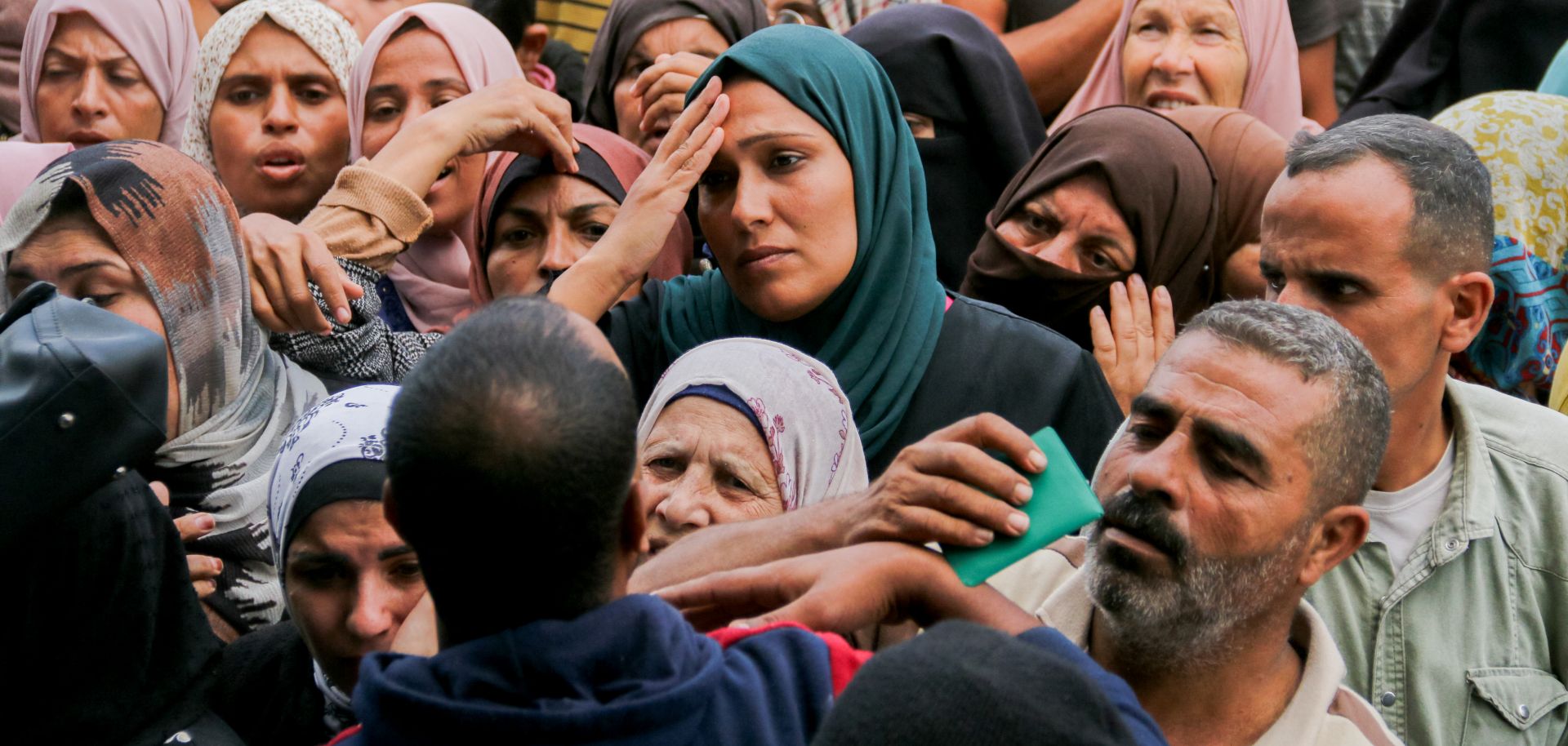
U.S. President Donald Trump's comments about taking control of the Gaza Strip and transferring its population elsewhere have sparked a firestorm of criticism. They were another example of how this particular president prefers to upend norms and approach longstanding problems with unorthodox solutions.
The Israeli-Palestinian conflict has confounded multiple U.S. presidents for a reason. Intractable demands from factions on both sides, combined with the increased partisan approach to Israel and Palestine in the United States itself, have made conventional diplomacy difficult. As a result, the traditional American approach of trying to solve the conflict with a two-state solution is functionally dead — and in its place, a default one-state approach has emerged.
For President Trump, this appears to be an Israeli-driven single-state solution that will rely upon one of the oldest tactics of statecraft to establish power and control over territory: population transfers. From the ancient Romans to the modern Russians, population transfers have been a means for governments to remove the blood from the soil they wish to control. But population transfers have become taboo for a reason, as they can create more problems than they solve (not to mention violate the letter and spirit of various international agreements). While there are intense constraints on actually carrying out Trump's plan, his proposal to relocate the Gazan population will nonetheless change the U.S. approach to the Palestinian-Israeli conflict. However, this new strategy is unlikely to solve the decades-old conflict and will instead fuel the erosion of post-World War II norms that have made population transfers rare, potentially setting the stage for future, generational conflicts as states steadily return to pushing civilians outside their borders.
A Brief History of Population Transfers
Our geopolitical model at RANE uses the seven pillars of geopolitics to ascribe state behavior: geography, politics, economics, security, society, history and technology. At the risk of oversimplification, these pillars hold up a state; a state that fails to attend to any one pillar risks instability.
When we think of population transfers geopolitically, we are essentially considering how states move a social pillar out of their way. The more homogenous a region's social pillar, the more the state that rules it can attend to the other pillars of geopolitics. A population unified through shared values, ethnicity, religion and even politics enables a state to focus on other geopolitical priorities like security, defense, the economy and even geographic expansion. Conversely, a divided population forces a state to expend political capital, wealth and sometimes even blood to address the division. In some cases, a state can find ways to repair the rift, as the United States eventually did after the Civil War when it reunited its northern and southern regions. In other cases, a state simply manages the division, as the United Kingdom is currently doing in Northern Ireland, where a tenuous peace process has led to relatively pacific security conditions but still sometimes tumultuous politics. For Israel, its long-standing occupation of Palestinian territories has forced it to manage Palestinian society, for which it has few means beyond force to address social divisions, as Israel, particularly under the Netanyahu government, has ruled out the formation of a Palestinian state. This has, in turn, resulted in recurrent Israeli military campaigns and raids in the same geographical area for over 76 years, along with numerous battles in the Gaza Strip in particular.
When they cannot manage a heterogeneous social pillar with anything but force, states have historically resorted to population transfers. To move a population from a geographical area is to end its influence over that geography — at least for a time. The United States did so with nearly all its Native American nations, sending them further and further westward until they were pushed onto reservations. The Romans did so across their empire, most famously by exiling the Jews after the second uprising against them in the second century A.D. More recently, Russia has displaced tens of thousands of Ukrainians from eastern Ukraine, while Azerbaijan has displaced Armenians from Azeri territory in the disputed Nagorno-Karabakh region.
Some counterinsurgency theorists refer to population transfers as ''draining the sea,'' a tactic in which civilians are removed from areas where there is an active insurgency. If, as the Chinese communist leader Mao Zedong said, guerrillas are fish that swim in the sea of the people, then one must drain the sea. Another saying takes this idea one step further: ''drain the sea by filling the graves.'' In other words, if a state cannot relocate a population to defeat an insurgency, it must instead resort to widespread violence. The net effect is the same: there are simply fewer civilians in a geography for a state to manage, thereby freeing up its power to focus on other geopolitical pillars. Often, particularly in the modern context, a state resettles its own nationals in the lands of the displaced, which is certainly the dream of Israel's far-right for Gaza.
For thousands of years, this was a traditional tactic of statecraft; one tribe, kingdom or empire would conquer a land and empty it of resistant residents, replacing them with their own settlers. But after World War II, international institutions, led by the United States and the Soviet Union, increasingly viewed population transfers as not only a moral abhorrence after the violence of the war but also as a strategic liability. India and Pakistan, for example, exchanged significant numbers of civilians after independence in 1947. But this did not repair their relationship and has instead fueled their competing claims for control of Kashmir as both feared displacement by the other. The same can be said for Turkey and Greece, where, shorn of the Ottoman Empire, both sides traded civilian populations, but neither gave up all ambitions to reclaim the lands those people fled to.
Of course, Israel and Palestine perhaps serve as prime examples of how population transfers are not effective conflict solvers. The original population transfer of Palestinians out of the mandate of Palestine in 1948 has fueled decades of revanchist claims from far-right Palestinian militants seeking to destroy Israel. And while that population transfer made the modern state of Israel possible, it also guaranteed the past 77 years of conflict.
Population Transfers in the Palestinian Context
Since 1993, the default American approach to the Israeli-Palestinian conflict has been a slow but steady move toward an independent Palestinian state living alongside Israel. However, the long-standing problem with this strategy is that both Israel and Palestine harbor far-right elements that have never fully accepted the population transfers of 1948 — the Palestinian far-right wants to return Palestinians to Israel by force, and the Israeli far-right believes the transfers did not go far enough by expelling all Palestinians from the former mandate. These groups have repeatedly sabotaged the process toward a two-state solution, and by 2014, the two-state solution had largely become frozen, as the United States, seeking to pivot to Asia, began to downplay the emphasis on resolving the conflict.
When President Trump first took office in 2017, he too did not prioritize the Israeli-Palestinian conflict in his appointments or his rhetoric. Instead, he allowed his son-in-law Jared Kushner to largely handle the Israeli-Palestinian issue and devise a creative solution to what seemed like an intractable problem. Kushner produced the Vision for Peace plan in 2020, which would have primarily given the Israelis control of the West Bank while relegating the Palestinians to reservation-style territorial enclaves. These enclaves would be held together by generous international investment aimed at boosting living standards while ensuring Palestinian demilitarization. The plan represented a significant shift away from the two-state solution and suggested that the Trump administration would prefer Israel to impose a one-state solution under its control. Moreover, with the creation of the Abraham Accords later that year, the White House's approach appeared validated: the United Arab Emirates, Bahrain, Sudan and Morocco were willing to normalize with Israel absent a Palestinian state, a major shift in regional alignments.
However, the issue with the one-state solution has always been clear. If Israel were to annex the West Bank and Gaza, Jewish Israelis would be outnumbered by Arab Palestinians, which in a democracy would guarantee political ascendancy for the Palestinians. Such political ascendancy would significantly alter the identity, political structure, and strategic orientation of Israel; it might not even stay named Israel in such an outcome. Therefore, those who advocate for a one-state solution have been faced with two options. One is a form of functional apartheid where Israelis enjoy full democratic rights while Palestinians do not, even as they live under the same laws and security structures. The other involves population transfers, in which Palestinians are relocated elsewhere to eliminate the social pillar that would otherwise jeopardize Israeli identity.
Trump's Vision for Peace plan, which had no written political plan for the rights of the Palestinians, implied that Israel would implement something akin to an apartheid system or reservation model, where Palestinians would theoretically receive generous economic privileges but almost certainly no political rights. After the Oct. 7, 2023, Hamas attack against Israel, it appears that the second Trump administration has concluded that even this formula would be unworkable. Instead, it is now proposing population transfers as a permanent solution to the social rift that has existed in Palestine since the early 20th century.
Relocating Palestinians, but to Where?
There are major logistical and legal hurdles to such a plan. Perhaps the most important issue is understanding where the two million Palestinians would go, even if we assumed they were interested in leaving the Gaza Strip — let alone what Hamas, an armed force, would do to prevent the displacement. The Arab world, broadly speaking, is wary of taking in large numbers of Palestinians, not only because it is highly unpopular among the public who have long backed a Palestinian state, but also because Palestinian refugees have been associated with political unrest. Palestinians' role in the Black September Uprising against the Jordanian monarchy in 1970 and the Lebanese Civil War in the 1970s serve as examples. Therefore, it's not only public opinion that drives the Arab world's reluctance to accept a new influx of Palestinian refugees; there is a significant concern that this population may bring political ideas that could destabilize their already fragile political economies.
This situation begs the question of whether Palestinians can be relocated further afield. While Europe has lost patience with migrants and refugees, the Trump administration and Israel may have luck finding new host countries in other regions, namely Africa, Latin America, Asia and possibly even Oceania. Relocating Palestinians would likely face unpopularity in these regions as well, but some governments might find U.S. aid — which Trump is otherwise set to cut across the board — too tempting to decline. This plan also becomes more feasible if the relocation involves only a few hundred or thousand Palestinians per country, which governments could downplay.
Thus, with enough willing host countries, it may be possible for Israelis and Americans to induce a further decrease in the Gazan population, which has already reportedly fallen by 6% due to war casualties, with around 100,000 Palestinians fleeing illegally to places like Egypt and Jordan to escape the conflict. There would still be a significant number of Palestinians left in Gaza, enabling Hamas to continue its operations there. But the pool of recruits would be smaller, and the threat of further population transfers would deter Hamas from attacking Israel.
However, even if host countries can be found, Trump's relocation plan still faces many constraints. For one, it would require a standing military force — presumably Israel's, as no Arab countries would provide troops to expel Palestinians — to enforce the order, which would risk reigniting conflict. Moreover, it is not clear how much money Israel and the United States would put toward implementing the relocations, which could cost billions of dollars that neither country is eager to spend, with recent military-backed deportations from the United States reportedly costing up to $10,000 a seat. There might also be aid and housing costs that Israel or the United States would have to pay, in addition to the transport costs of moving Palestinians out of Gaza. The Trump administration's desire to cut back aid, not increase it, will thus put an upper limit on how many Gazans will be relocated as part of the plan.
Then there are the legal hurdles. While the United States will bless the population transfer (which would block any retaliation at the U.N. Security Council), European countries and much of the Global South almost assuredly will not, and organizations that take part in the transfer will risk being exposed to legal charges or sanctions from big blocs like the European Union and individual countries like South Africa or Brazil, or organizations like the International Criminal Court and United Nations — all of which have been highly critical of Israel's campaign in Gaza. And then there is the inevitability of political change in Israel and the United States, which could bring to power governments that turn on the policy of population transfers and decide to charge those who took part in it with crimes against humanity. This is to say nothing of the diplomatic pushback by powers like Egypt, Jordan, Turkey and the Gulf Arab states, who will prove not only difficult to convince to resettle significant numbers of Palestinians but will also try to support one another against U.S. pressure.
The Wider Trend
In 1948, when Israel was established, the forced removal of Palestinians occurred against the backdrop of other massive population transfers in Europe and Asia in the aftermath of World War II. It was not an isolated event but part of a global trend. Following the tumult of a world war, the victorious allies aimed to move populations into more sustainable national borders to weaken the triggers to a possible third world war. Now, in 2025, as Israel and the United States pursue their plans to remove Gazans, this also occurs against a backdrop of resumed forced removals as a statecraft tactic — this time not because of fears of causing regional and world wars, but because states' have seen the constraints to population removals weaken. Countries like Russia, Azerbaijan and Turkey are considering or even implementing large-scale forced removals to remove obstinate populations, allowing their states to focus on other priorities.
Most Palestinians will reject Israel's offer to leave Gaza, at least in the near term. But how many ultimately agree to leave does not matter so much for the wider implications, as the very notion that Palestinians are being displaced at any scale further erodes the post-war principles against population transfers. That is because the Palestinian question is paramount in the perception of the power of post-war norms. Indeed, there is an entire U.N. agency — the United Nations Relief and Works Agency for Palestine Refugees in the Near East (UNRWA) — dedicated to resettling the Palestinian people on international principles, the same principles that inspired NATO's intervention in the Balkans during the 1990s to halt Serbia's genocidal campaigns in Bosnia and Kosovo. Many states will condemn the transfer of Palestinians out of Gaza, yet they will also recognize that the constraints against population transfers are weakening concurrently in ways that may benefit them. As international organizations like the International Criminal Court, designed to prevent acts such as population transfers, are undermined by leading countries like the United States — which on Feb. 6 sanctioned the ICC for investigating Israel's actions in the Gaza Strip — many states will see a growing opportunity to use force to reframe or strengthen their social structures. This will allow them to focus more freely on other crucial pillars of geopolitics.
It is not that transferring Palestinians out of Gaza will instantly normalize population transfers globally. Many countries, especially in Europe, retain the historical memory of the world wars and the accompanying genocides, and will have little desire — or, in many cases, need — to resort to such traditional statecraft anytime soon. However, in parts of the Global South, population transfers may become increasingly tempting as countries seek to manage the pressures arising from today's increasingly multipolar world, where norms are rapidly diminishing and international institutions are fraying.
Yet history demonstrates that population transfers do not provide a solution to all social problems. People who are displaced will long for a return home; the Jews of Europe never forgot what the Romans did, and the communal dream of rebuilding Israel eventually found tangible fulfillment. The Russians may expel many Ukrainians from the east, but this will only foster a future generation of Ukrainians who will dream of reclaiming lost lands. Azerbaijan may have expelled the Armenians from Nagorno-Karabakh, but Armenia is unlikely to ever truly relinquish that territory and may reignite conflict if a moment of weakness arises. For Israelis who seek to displace Palestinians, such tactics may alleviate some security issues in Gaza, but they may also foster a new Palestinian diaspora whose sole aim will be to restore themselves to their ancestral homes. In other words, while more population transfers may address the immediate problems of the day, without accompanying political resolutions to deep-seated conflicts, they lay the groundwork for future wars.
