
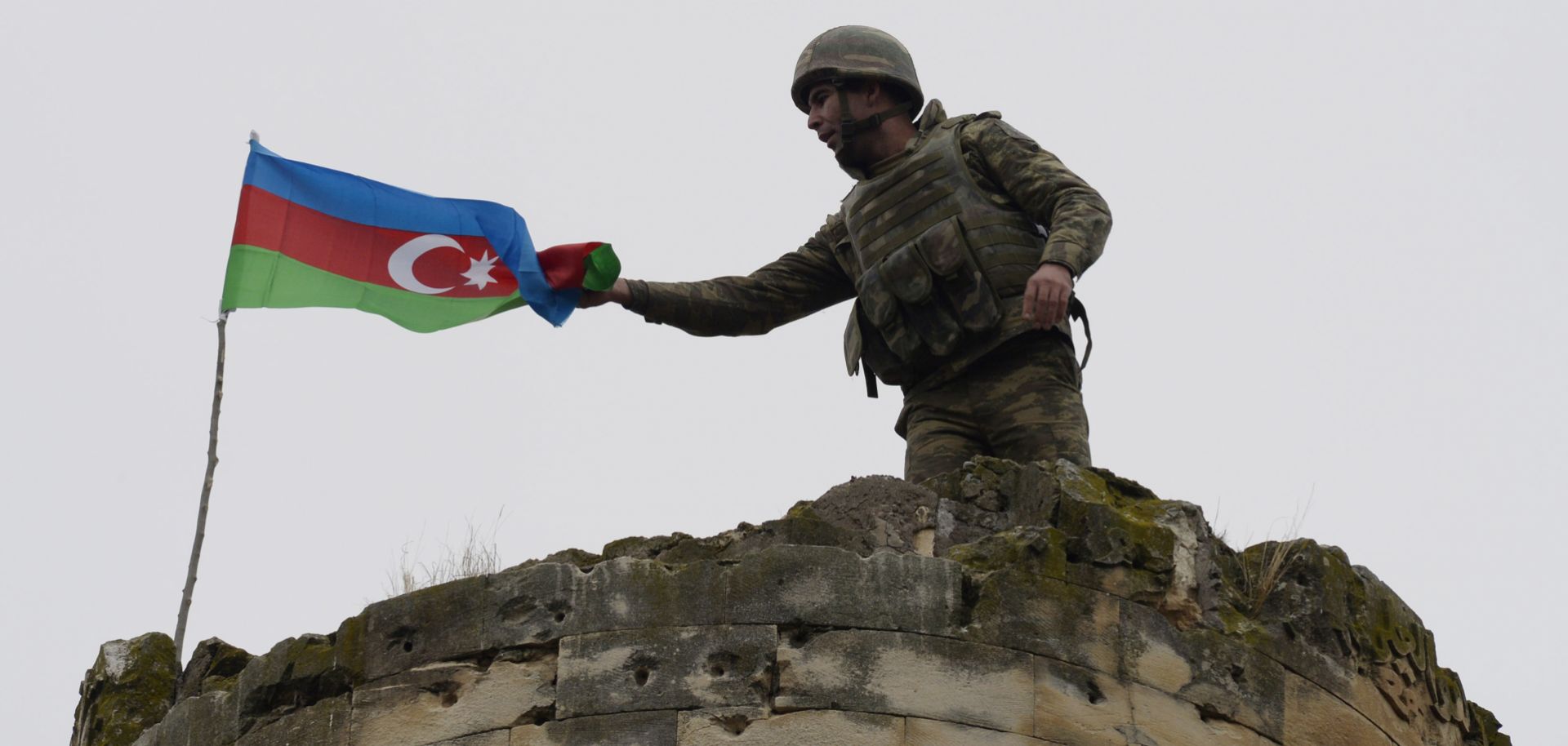
An Azeri soldier attaches Azerbaijan’s national flag to a tower near a town in Nagorno-Karabakh on Nov. 26, 2020.
Azerbaijan's latest cease-fire violations in Nagorno-Karabakh reflect its capacity to continue escalating the conflict with Armenia with relative ease due to Baku's superior negotiating leverage and military power. On March 24, Azeri forces crossed the line of contact with Armenia-backed authorities of the unrecognized Nagorno-Karabakh republic, occupying the village of Parukh and forcing women and children from the nearby village of Khramort to evacuate. On March 27, Russia claimed Azeri soldiers had withdrawn from the villages. But on March 28, Azerbaijan denied doing so and said the area was its sovereign territory, implying Azeri forces remained set to conduct military movements there. The advance by Azeri forces follows weeks of elevated tensions with Armenia, with authorities in Nagorno-Karabakh accusing Azerbaijan of cutting natural gas supplies to the region.
- In a statement issued on March 28, Armenia's foreign ministry presented maps drawn up by Russia's defense ministry that appeared to show Azeri troops had still not left the area of Nagorno-Karabakh policed by Russian peacekeepers.
- Armenian authorities have also called for an investigation into the actions of Russia's peacekeeping force during the incursion, noting they had expected Russia to ensure Azerbaijan withdrew troops from the contested area.
Russia's peacekeeping contingent has proven ineffective at preventing or reversing Azerbaijan's violation of the 2020 cease-fire, which weakens Moscow's credibility as a guarantor of peace in the region. Russia's 15th Separate Motor Rifle Brigade operates a peacekeeping force in Nagorno-Karabakh of approximately 2,000 soldiers as part of the truce Moscow brokered between Armenia and Azerbaijan in November 2020. Since then, however, the role of those peacekeepers has not been further clarified, and there remain no stipulations on the circumstances under which they have the right to use force in the region. Russian peacekeepers' failure to convince the Azeri forces to retreat threatens to further erode the 2020 cease-fire agreement — especially at a time when the war in Ukraine already risks siphoning off Russian troops from the region and further weakening Moscow's already extremely doubtful motivation to use force to uphold the status quo in Nagorno-Karabakh. Indeed, on March 18, Ukraine's defense ministry claimed Russia had been withdrawing units from a military base in Armenia to participate in the war against Ukraine.
- In the wake of the recent incursion by Azerbaijan, the Russian government has resorted to diplomacy, with Russian officials and ministries calling on their Armenian and Azeri counterparts to prevent further escalation. On March 26, the Kremlin announced that President Vladimir Putin had twice discussed the situation with Armenia's prime minister; Russian Defense Minister Sergei Shoigu also spoke with his Armenian counterpart Suren Papikian on March 25.
- On March 26, Russia's defense ministry issued a statement accusing Azerbaijan of violating the cease-fire agreement that ended the 2020 war in Nagorno-Karabakh. This marked the first time that Russia had publicly accused either side of violating the deal, though the truce has already been undermined by several deadly exchanges of fire since its signing.
Azerbaijan is probably seeking to push the Armenians toward greater concessions by eroding the 2020 cease-fire and demonstrating Russian peacekeepers' failure to stop the incursion. Baku is frustrated that a comprehensive peace deal with Armenia has not been signed. Following the 2020 cease-fire, Azerbaijan likely hoped that Armenia would deem defending the Nagorno-Karabakh region as hopeless and that Armenian soldiers would leave the area to defend the newly-contested borders between Armenia proper and Azerbaijan. In this scenario, Nagorno-Karabakh residents who feared that the area could soon fall under Azeri authority would also depart for Armenia. Instead, however, Armenian soldiers have remained in the region, and negotiations have stalled on a broader peace settlement including border demarcation and the opening of a transit corridor through Armenia to Azerbaijan's exclave region of Nakhchivan.
- On March 26, Azerbaijan's ministry of defense reiterated that its Russian counterpart should facilitate the complete withdrawal of the remnants of the Armenian army from Nagorno-Karabakh, which the Azeri ministry referred to as ''the territory of Azerbaijan recognized by the international community.''
In a low probability, high impact scenario, the seizure with little consequences could embolden Azerbaijan to continue similar operations in Nagorno-Karabakh, threatening a renewed war with Armenia. Its recent aggression suggests Baku believes it has the capability to establish a more favorable status quo in the contested area. Azerbaijan has military superiority over Armenia, which could push Baku to continue escalating. At the same time, Azerbaijan believes it possesses the manpower and technical advantage over Armenian forces, which will deter Armenia from entering a renewed war with Azerbaijan to defend the territory.
Even if there is not another war between Armenia and Azerbaijan, the deteriorating security situation in Nagorno-Karabakh will risk fueling a surge of far-right militarism in Armenia and derailing the normalization of relations between Turkey and Armenia. Turkey supported Azerbaijan during the 2020 war. But in January, Armenian and Turkish officials met in Moscow to discuss normalizing relations after more than a decade of animosity, which Turkey's support of Azerbaijan during the 2020 Nagorno-Karabakh war only exacerbated. Armenia may have believed that Ankara would act as a restraining force on Azerbaijan in negotiations to resolve the territorial conflict, which Turkey sees as the central obstacle to solidifying its influence on the South Caucasus. But the latest escalation will risk similar incidents of Azerbaijan methodically occupying more territory of Nagorno-Karabakh until Armenia comes back to the negotiating table. Armenia's political leadership fears that another full-scale war with Azerbaijan could result in additional territorial losses, particularly amid the continued Turkish military assistance for Azerbaijan. For this reason, Armenian Prime Minister Nikol Pashinyan will seek to avoid a return to full-scale confrontation. His government, however, will likely still incur painful losses on either the battlefield or at the negotiating table. This could lead to the rise of far-right forces in the country and a return to militarization, rather than a push toward normalization with Turkey and Azerbaijan. And despite Moscow's repeated failure to decisively back it, Armenia will also have little choice but to maintain close security relations with Moscow amid growing threats from Azerbaijan.
