
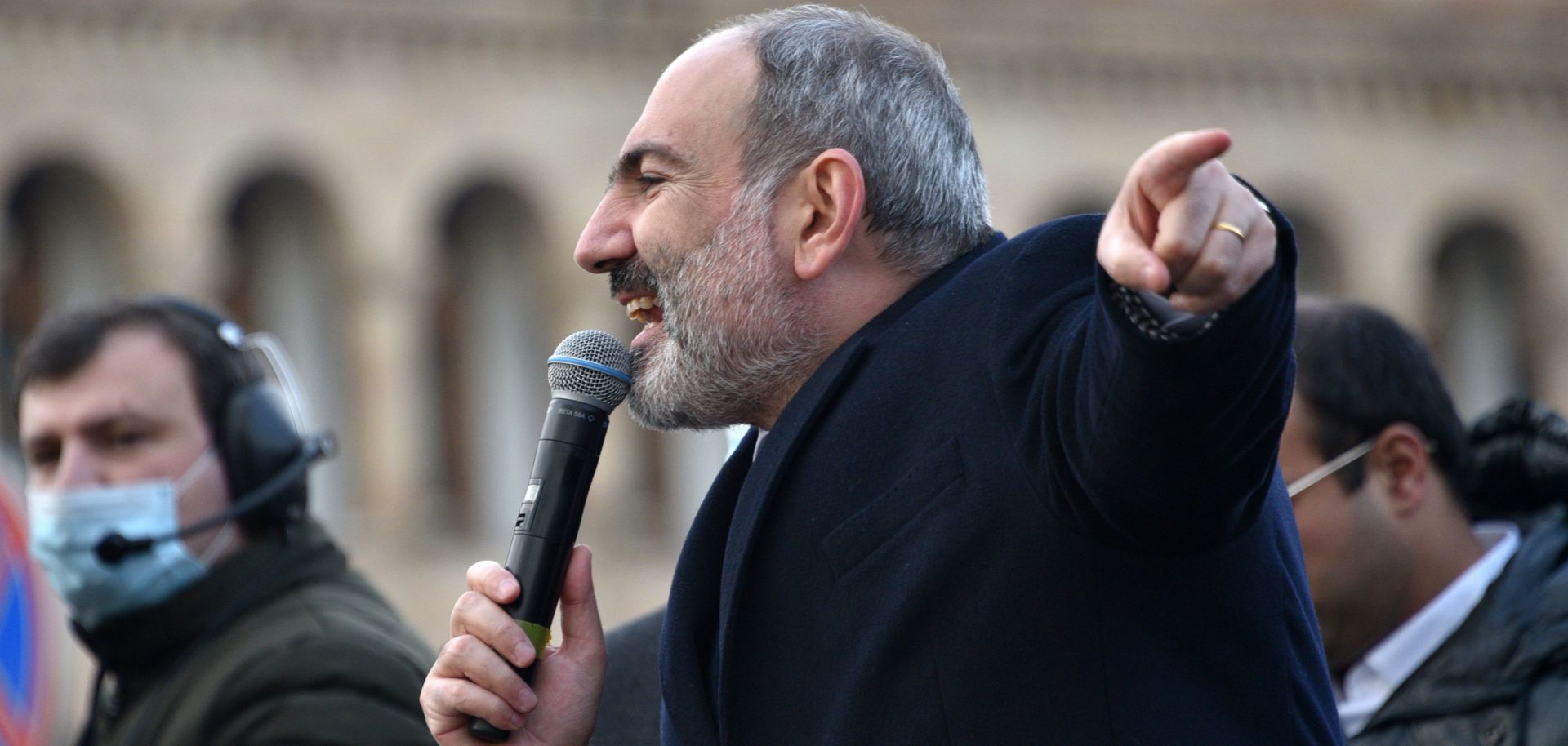
Armenian Prime Minister Nikol Pashinyan addresses his supporters gathered on Republic Square in downtown Yerevan, Armenia, on Feb. 25, 2021. Pashinyan called on the army to fulfill its duty and obey the people after the military called on him to resign.
Armenian Prime Minister Nikol Pashinyan is facing the most significant challenge to his beleaguered rule, although the outcome of the current standoff and any subsequent impact is likely to remain contained to the country. On Feb. 25, Pashinyan warned of an “attempted military coup” after military leaders called on him to resign following months of protests over his widely criticized handling of last year’s war with Azerbaijan over the disputed Nagorno-Karabakh territory. Pashinyan was responding to a letter published earlier in the day signed by Chief of the General Staff Onik Gasparyan and three dozen other military leaders, which stated Pashinyan was “no longer able to make adequate decisions at this current fateful and critical moment” and called on him to resign. Pashinyan also announced that he had dismissed Gasparyan, although that formally requires the approval of the country’s largely ceremonial president, Armen Sargsyan, who reportedly has not endorsed the move.
- The military’s Feb. 25 letter was triggered by Pashinyan’s Feb. 24 decision to dismiss Gasparyan’s first deputy who had criticized Pashinyan’s rule in an interview earlier that day. That criticism was specifically aimed at statements Pashinyan had made in a separate Feb. 23 interview in which the prime minister blamed allegedly defective Russian weapons, rather than his leadership, for Armenia’s poor military performance last year.
- Responding to Pashinyan’s call for public shows of support, thousands of demonstrators took to the streets of Yerevan, Armenia’s capital, where Pashinyan’s opponents also gathered to call on him to stand down. Despite sporadic small scuffles, the two sides have so far avoided direct confrontations, although the situation remains fluid.
The current crisis brings to a head political tensions that have been simmering since November 2020. Pashinyan has faced calls to resign since he signed a Russian-brokered peace deal ending a six-week war with Azerbaijan that was widely seen as a major Armenian strategic loss. In the agreement, Armenia was forced to cede large parts of Nagorno-Karabakh that Armenian forces had held for more than a quarter-century.
- Nagorno-Karabakh is a contested territory within Azerbaijan’s borders that is largely populated by ethnic Armenians. Thousands of soldiers on both sides were killed in the latest round of fighting in the region that began in September 2020, marking the worst period of the decades-old conflict since the 1990s.
- In the wake of the peace agreement, which Pashinyan characterized as painful but necessary, Armenian protesters took to the streets for weeks to demand that he resign. Although protests ebbed amid the cold in December and January, they resumed earlier this week and have gained steam since Pashinyan’s Feb. 23 interview.
Although the outcome of the current standoff is uncertain, a peaceful resolution is possible. Regardless of the result, the standoff is also unlikely to reignite war with Azerbaijan or provoke direct external intervention into Armenian politics. Military leaders may feel they are in a position where they must follow through on their demand, lest they be seen as submitting to the prime minister. So far, however, they have not shown signs that they intend to use force. Later on Feb. 25, military leaders also issued another statement saying they had made their previous demand of their own volition and not in support of any opposition party, suggesting a possible opening for negotiations if opposition politicians are not seen as being influenced by the military. For his part, Pashinyan continues to insist that he intends to remain in power, but also appeared to walk back his earlier comments in a subsequent Feb. 25 interview in which he said that his “statement about the threat of a military coup was emotional” and urged his supporters to avoid conflict with soldiers, whom he called “our brothers.” Possible political solutions include new parliamentary elections and direct talks between the president and opposition leaders.
- Armenia’s defense ministry issued a statement on Feb. 25 saying that the military “is not a political institution and attempts to involve it in political processes are unacceptable.” Despite playing a largely symbolic role, President Sargsyan has said he is “taking urgent measures to defuse tensions and find ways to resolve the situation peacefully.”
- Both Russia and Turkey — which supported Armenia and Azerbaijan, respectively, during last year’s surge of violence in Nagorno-Karabakh — have called for calm in Armenia and decried any attempts at a forcible change in the country’s government. Although Moscow and Ankara are competing for regional influence, both sides have portrayed Armenia’s current crisis as an internal matter.
- Despite widespread outrage in Armenia over the terms of last year’s peace deal with Azerbaijan, there is little chance that the current crisis could spark a resumption of war, given the clear superiority shown by the Azeri armed forces and the presence of Russian forces and Turkish observers on the ground. Any Armenian aspirations to renew conflict would also require the assent and military and financial assistance of Russia, which is unlikely to provide its backing.
