
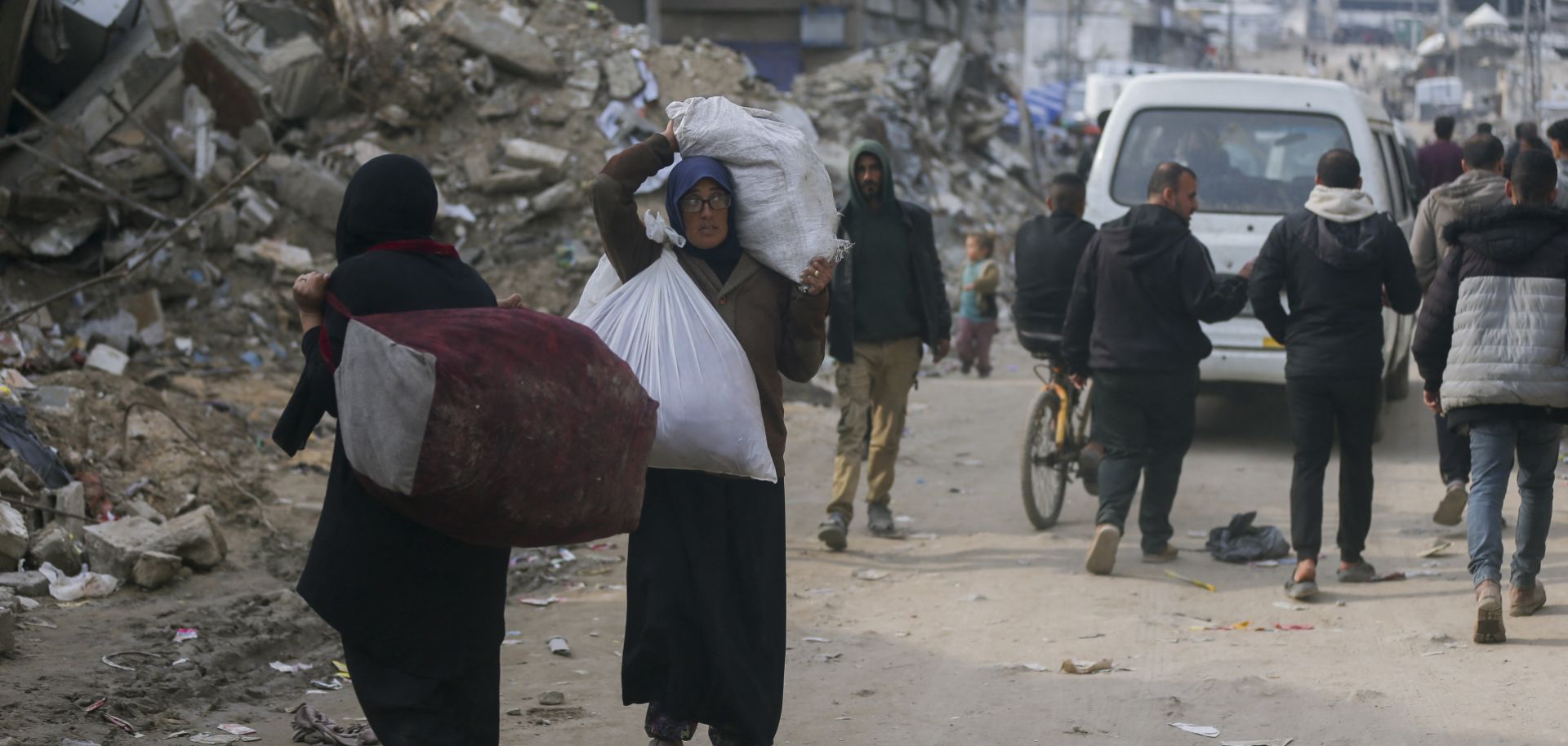
Egypt and Jordan will reject U.S. President Donald Trump's proposal to resettle large numbers of Palestinians from Gaza to their territories due to concerns about potential domestic unrest, but they will likely permit smaller, gradual resettlements via illegal smuggling routes to appease Trump and maintain U.S. aid. In recent days, Trump has proposed resettling Palestinians from the Gaza Strip to nearby countries, sparking international outrage, particularly from the Arab world. During a Jan. 25 call with Jordan's King Abdullah II, Trump said he had discussed building housing — either temporary or long-term — to facilitate moving roughly 1 million Palestinians from Gaza to Jordan, as part of an effort to ''clean out'' the war-torn Strip. That same day, while talking with journalists on Air Force One, Trump similarly floated the idea of having Egypt accept more Palestinians from Gaza, which he later claimed to have discussed with the country's president Abdel Fattah al-Sisi during a Jan. 26 phone call, though Egyptian sources deny this call occurred. Trump's suggestions gained traction with far-right Israeli policymakers like Finance Minister Bezalel Smotrich, who said, ''The idea of helping them [Gazans] find other places to start a better life is a great idea.'' However, the Arab world, Palestinian groups, and the Egyptian and Jordanian governments all disavowed the notion of displacing Palestinians from Gaza. In response to Trump's comments, Palestinian Authority President Mahmoud Abbas expressed ''strong rejection and condemnation of any projects aimed at displacing our people from the Gaza Strip.'' Similarly, a member of Hamas' Politburo said the Palestinian political and militant group would ''foil such projects,'' while Palestinian Islamic Jihad, another Palestinian militant group in Gaza, called Trump's suggestion ''deplorable.''
- According to the Palestinian Central Bureau of Statistics, as of Jan. 1, 2025, 2.1 million Palestinians reside in the Gaza Strip and nearly 90% of them have been internally displaced during the 15-month Israel-Hamas war. At the end of January 2024, a U.N.-World Bank interim damage report estimated the cost of rebuilding Gaza would be $18.5 billion. This figure likely increased significantly over the past year. The statistics bureau also estimated in January 2025 that Gaza's population had dropped 6% since the start of the war, with at least 46,000 killed and over 100,000 more displaced to places like the West Bank and Egypt.
- Trump's Jan. 25 comments mark his first statement suggesting a policy of displacing Palestinians from Gaza. However, his son-in-law and former Senior Advisor Jared Kushner previously suggested a similar idea in a February 2024 interview at Harvard University, saying, ''It's a little bit of an unfortunate situation there, but from Israel's perspective I would do my best to move the people out and then clean it up.'' However, he had proposed relocating Palestinians from Gaza to the Negev Desert — not Egypt and Jordan.
Trump's comments diverge from his previous administration's stance and resurrect regional concerns of a mass influx of Palestinians to neighboring countries. During Trump's first term, his administration backed the ''Peace to Prosperity'' proposal, which would have enabled Israel to annex its existing settlements in the West Bank and proposed a Palestinian state that would include the remaining parts of the West Bank and the Gaza Strip. The Palestinian Authority rejected the proposal on the grounds that it favored Israel. However, Trump's Jan. 25 suggestion does not include any plans for a Palestinian-led state, indicating a potential departure from his previously held position. Regardless, the proposal to send Palestinians to Egypt and Jordan — two countries that have normalized relations with Israel and have suffered economic spillover effects from the Israel-Hamas war and broader regional conflict — reignites earlier Egyptian and Jordanian concerns of a mass influx of Palestinian refugees. Illustrating this concern, the Egyptian government threatened to suspend its 1979 peace treaty with Israel in February 2024 amid concerns that Israel's impending military actions in Rafah would drive Palestinians across the Egypt-Gaza border. To bolster its borders, Egypt constructed a walled buffer zone to contain any refugees that might cross over. Similarly, Jordan has rejected any mass displacement of Palestinians, with Jordanian Foreign Minister Ayman Safadi reiterating on Jan. 26, ''Jordan is for Jordanians, and Palestine is for Palestinians.''
- Jordan currently houses around 2.39 million Palestinian refugees, and even more Jordanian citizens cite Palestinian heritage.
- Trump's Jan. 25 suggestion aligns with the priorities of Israel's far-right, indicating that some of his administration's policies may align more closely with far-right elements of Prime Minister Benjamin Netanyahu's government than the more right-wing Likud faction.
- In both Egypt and Jordan, citizens have protested their government's ties to and trade agreements with Israel. However, Cairo has controlled protests much more stringently due to concern over the potential for growing anti-government sentiment. The protests in Egypt largely occurred in the early days of the Israel-Hamas conflict, and the government allowed protesters to demonstrate in preapproved areas, arresting those who protested in unauthorized areas like Tahrir Square, where the 2011 Arab Spring uprising began. Egypt has also arrested social media activists criticizing the government's relations with Israel and some activists calling for Boycott, Divest and Sanctions activities. If a wave of Palestinian refugees entered Egypt, there would very likely be a heightened risk of widespread anti-government protests and broader calls for Egypt to sever ties with Israel, though the Egyptian government would likely reject them.
Steps to enact the proposal would further strain the United States' relations with the broader international community and will likely hamper Israeli-Saudi normalization efforts. Without Palestinian support of the plan, Trump's proposal for forced displacement would widely be considered illegal under international law. Efforts to enact it would likely also be seen as ethnic cleansing, which would strengthen the genocide case against Israel at the International Court of Justice, or ICJ. The proposal will thus further pit the Trump administration against international legal bodies, thereby straining U.S. relations with allies who adhere to international court rulings. It also risks hindering U.S. efforts to broker a normalization deal between Israel and Saudi Arabia, given that Riyadh has conditioned any such agreement on a plausible path toward Palestinian statehood — something that would be much harder to conjure in a deal brokered by the United States while it advocated for Palestinian displacement. The United States has discussed signing a defense pact with Saudi Arabia, conditioned in part on Saudi Arabia normalizing ties with Israel, but negotiations on the matter had already largely stalled before Trump took office. These talks are now even more unlikely to make significant progress in the near term amid Saudi concerns that Trump's plan will backtrack efforts toward Palestinian statehood, resulting in likely smaller cooperation deals between Riyadh and Washington instead of a larger, blockbuster deal.
- The new Republican-led U.S. Congress recently introduced a bill to sanction the International Criminal Court for its issuance of arrest warrants against Israeli Prime Minister Benjamin Netanyahu and former Israeli Defense Minister Yoav Gallant, but it was blocked by Democrats in the Senate on Jan. 28.
Despite likely promises of U.S. aid, the Egyptian and Jordanian governments will strongly oppose Trump's proposal under the existing terms to avoid stoking anti-government sentiment and domestic unrest. Trump's current proposal would likely include significant increases in U.S. aid to Egypt and Jordan to support the influx of Palestinian refugees, which would benefit Egypt's and Jordan's struggling economies. However, backing the proposal would be antithetical to the pro-Palestinian/anti-Israeli rhetoric Egypt and Jordan have espoused since the start of the Israel-Hamas war, and their citizens would very likely view such actions as aiding Israel's military operations against Palestinians, raising the risk of protests. Additionally, even with external support, hosting large numbers of Palestinians would further strain Egypt's and Jordan's domestic resources, further increasing the likelihood of widespread domestic unrest that would risk destabilizing the governments. As a result, Egypt and Jordan will not back Trump's proposal. However, Egypt's and Jordan's reliance on Israel for imports and on the United States for foreign aid will constrain actions beyond denouncing the plan. If Trump continues to push for this plan amid Egyptian and Jordanian opposition, he may threaten to continue freezing foreign assistance to Jordan (which was frozen on Jan. 24) and threaten to cut aid to Egypt.
- On Jan. 24, U.S. Secretary of State Marco Rubio sent a cable notifying diplomatic posts that the government was freezing nearly all foreign assistance, with exceptions for emergency food assistance and foreign military financing to Egypt and Israel. Jordan is the second-largest recipient of U.S. foreign aid in the region, having received $1.7 billion in 2023, although this number has declined since peaking at $2.6 billion in 2020.
- In 1951, a Palestinian nationalist assassinated Jordan's King Abdullah I as he was leaving the Al-Aqsa Mosque/Noble Sanctuary in Jerusalem's Old City. Later, the Jordanian army clashed with the Palestine Liberation Organization, or PLO, in 1970 after leftist factions of the group called for overthrowing the Jordanian Hashemite dynasty. As a result of violent clashes and Palestinian terrorism including airplane hijackings, the Jordanian government cracked down on the PLO and expelled members to Lebanon via Syria. As a result of Jordan's history with Palestinian militancy, ties with Israel and large Palestinian population, the threat of Palestinian militancy attacks remains. If the Jordanian government backs a mass resettlement of Palestinians — which would be viewed as a betrayal of the Palestinian cause — Palestinian militants would become increasingly likely to conduct attacks on Jordanian soil.
However, to appease U.S. pressure, Egypt and Jordan would likely tolerate quietly resettling smaller groups of Palestinian refugees to their countries, though this would probably be done through illegal routes to reduce political backlash and media coverage. Egypt and Jordan will likely establish an en masse displacement of Gazans as a ''red line'' in any negotiations with the Trump administration, given the potential existential political threat that backing such a plan would pose to their regimes. However, to relieve U.S. pressure and maintain U.S. aid into the countries, Cairo and Amman may consider allowing small numbers of Palestinian refugees to gradually enter their territories via already-established smuggling routes, as opposed to legal border crossings. Compared with Trump's current proposal, this plan would be far less likely to spur significant political backlash. Although Egypt officially blocks Palestinian refugee flows, at least 100,000 Palestinian refugees have entered the country since the start of the Hamas-Israel conflict in October 2023, mostly through illegal smuggling routes. However, this gradual refugee inflow has not sparked widespread domestic criticism of the Egyptian government, nor has it gained much attention in local Egyptian media. While data for Palestinians smuggled into Jordan is unavailable, the country also has robust human smuggling routes, meaning gradual inflows of Gazan refugees to Jordan through these routes would unlikely generate much media coverage as well. Furthermore, the use of smuggling routes to gradually resettle smaller numbers of Palestinians would grant the Egyptian and Jordanian governments some degree of plausible deniability, further buttressing them against any potential scrutiny. However, in such a case, as with the Palestinians who have already resettled in Egypt and Jordan, there would unlikely be a plan in place between Egypt, Jordan and Israel to eventually enable Palestinians to return home to Gaza, likely making their resettlement permanent.
Over time, as recurrent ceasefires in Gaza fail to hold and reignite violence, more Palestinians will steadily be pushed out to Jordan, Egypt and the West Bank, resulting in de facto displacement. In the likely case that the fragile Hamas-Israel ceasefire collapses and the consequent resumption of fighting prevents reconstruction efforts, the continued erosion of living conditions in Gaza will increasingly compel the Palestinians still living there to illegally migrate to other countries or resettle in the West Bank. Emboldened by the Trump administration's support, far-right Israelis will likely also pursue some of their more radical policies, such as resuming settlements in the Gaza Strip, which has so far not gained traction within the Netanyahu government but may strengthen once the government achieves partial or total annexations in the West Bank. Over the decades, this — combined with the gradually expanding exodus of Palestinians from Gaza and declining Palestinian fertility rates — would likely shift the demographics of the region toward a Jewish majority, something that the Israeli far-right would support.
- According to the World Bank, Palestinian fertility rates have been declining. In 2000, there was an average of 5.4 births per woman but this number decreased to 3.4 births in 2022. According to the Palestinian Central Bureau of Statistics, there are currently around 5.61 million Palestinians living in the Gaza Strip and the West Bank.
