
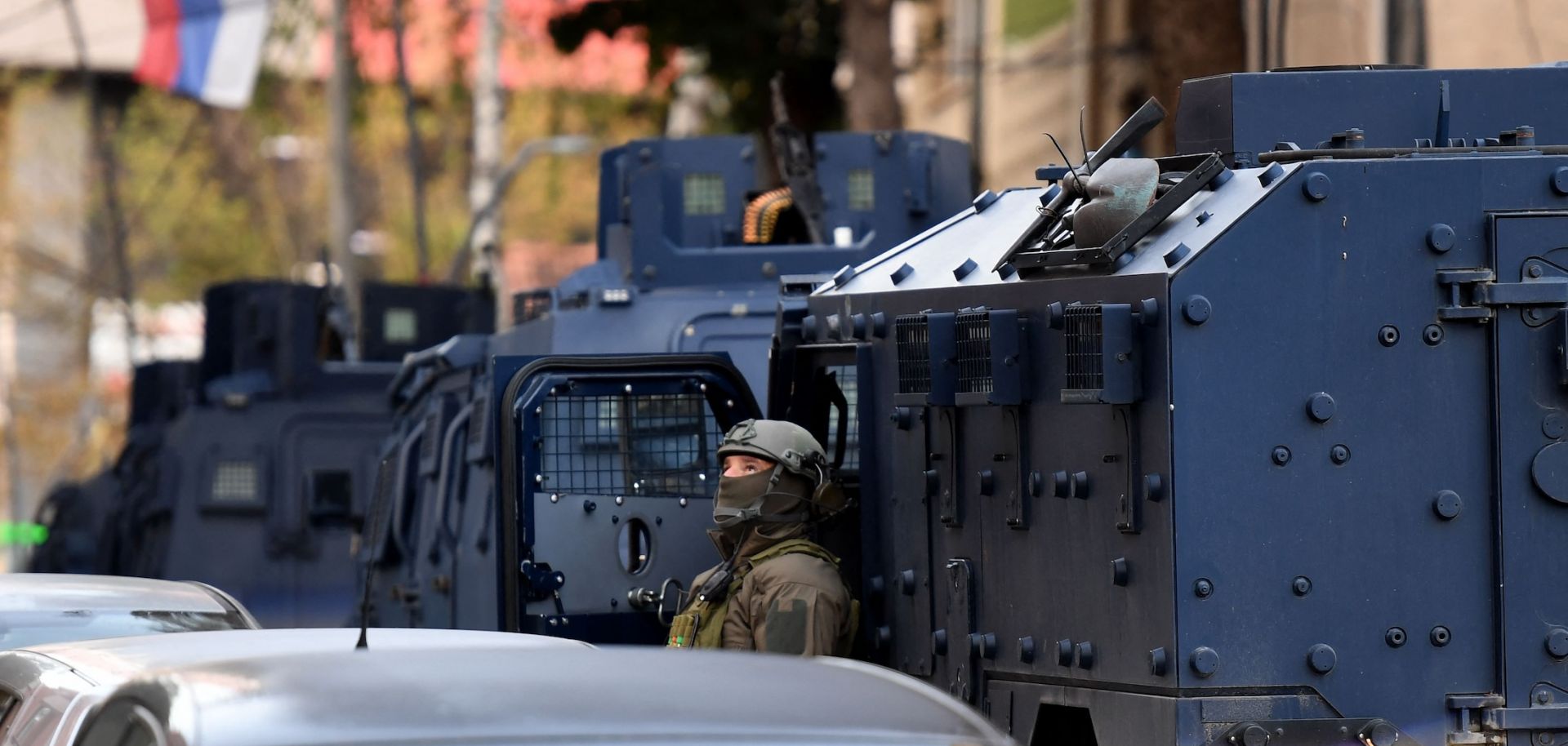
With the prospect of EU membership frozen for both countries, Serbia and Kosovo will be incentivized to escalate bilateral tensions in the coming months, which will increase the risk of security incidents in Kosovo, even if a full-on war remains highly unlikely. On Sept. 24, Kosovo's Prime Minister Albin Kurti demanded that Serbia's government hand over several Serbians who were allegedly involved in the killing of a Kosovar police officer a year ago. Kurti also accused Serbia of trying to annex parts of Kosovo and called on the international community to hold Serbia accountable for its aggressive behavior. Separately, in an interview with the Financial Times also published on Sept. 24, Kurti said that Kosovo will resist pressure from the international community to compromise with Serbia on the multiple issues that have fueled tensions between the two neighboring states.
- On Sept. 24, 2023, a group of roughly 30 Kosovar Serb gunmen shot and killed Kosovar police officer Afrim Bunjaku and injured another policeman during an attack against law enforcement near the Banjska village in northern Kosovo in which three of the attackers were also killed. The surviving gunmen then fled to Serbia. While Serbian authorities briefly detained some of the suspects (including Milan Radoicic, a politician and businessman with ties to Serbia's government), none of the suspects has been arrested or deported to Kosovo.
- The September 2023 attack on Kosovar police officers triggered protests and violent clashes between ethnic Serbians and ethnic Albanians in northern Kosovo, in which dozens of NATO soldiers (whose task was to keep the two crowds apart) were injured. Following the violence, Kosovar authorities seized hundreds of weapons (including machine guns, mortars and anti-tank grenades) during raids in the country's northern regions.
- Kosovo, where a majority of the population is ethnically Albanian, unilaterally declared independence from Serbia in 2008. While Serbia does not officially recognize Kosovo's independence, Belgrade de facto accepts it and in 2013 the two countries signed an EU-sponsored plan to normalize their relations. Still, bilateral relations remain tense, and the status of northern Kosovo (where ethnic Serbians are a majority of the population) remains a significant obstacle to the normalization process.
Kurti's inflamed rhetoric happens at a time of worsening relations between Kosovo and Serbia against the backdrop of stalled progress on both countries' EU membership bids. In recent years, Kosovo's government has taken several measures to increase the country's sovereignty that have irritated Serbia. This has included phasing out Serb-issued vehicle license plates and personal IDs, and banning Kosovar banks and other institutions from using the Serbian dinar. A particularly problematic event took place in April 2023, when Kosovo's government held local elections in four municipalities in northern Kosovo despite the largest pro-Serbian political party in the region boycotting the vote, which resulted in the election of ethnic Albanian mayors in areas that are predominantly Serbian. Bilateral tensions then escalated again in August 2024 after Kosovo shut down several so-called ''parallel institutions'' run by ethnic Serbians in northern Kosovo, such as post offices, on which many Kosovo Serbs depend to receive their Serbian pensions. These events are happening against the backdrop of stalled EU-sponsored negotiations between Serbia and Kosovo to normalize their relations. While these negotiations happen regularly, they rarely make progress. In fact, both Kurti and Serbian President Alexander Vucic attended a lunch with EU Commission President Ursula von der Leyen in early September, but the two leaders refused to talk to each other and accused each other of aggressive behavior in statements to the press afterward.
- Serbia was granted official EU candidate status in 2012, and has since been engaged in ongoing accession talks with Brussels. Meanwhile, the European Union has identified Kosovo as a ''potential candidate'' to join the bloc. While the European Union does not formally request Serbia recognize Kosovo as a prerequisite for EU membership, Brussels wants Belgrade to normalize its relations with Pristina before it can join the bloc. Against this backdrop, Serbia and Kosovo have for years discussed plans to grant more autonomy to northern Kosovo. However, these conversations have made little progress and the issue remains unresolved.
- In addition to the tensions between Serbia and Kosovo, there is little appetite in the European Union to accept new member states in the short to medium term. Current EU members broadly agree that the bloc has already become too large and difficult to govern, which means that reforms to streamline EU decision-making are needed before the European Union can accept new member states. Moreover, amid the rise of nationalist parties across Europe, many member states are now opposed to accepting poorer countries like Serbia and Kosovo into the European Union, as this would result in an increase in migration from these countries to richer EU member states.
Escalating tensions between Pristina and Belgrade will heighten the risk of violence between Serb and Albanian populations, particularly in northern Kosovo. Kosovo will hold parliamentary elections in February 2025, and according to polls, Kurti's center-left party will win them by a comfortable majority. With the prospect of EU accession currently frozen, Pristina has no incentives to de-escalate with Serbia and is, in fact, politically incentivized to keep tensions high ahead of the election, which could help bolster domestic support for the Kosovar government by pledging to defend national interests. Serbia also stands to politically benefit from recurrent diplomatic disputes with Kosovo, which could help distract domestic attention away from rising protests against the Serbian government's push to increase lithium mining in the country. While neither Kosovo nor Serbia want a full-on war (which would threaten their financial and investment links with the West and their prospects for EU membership), these domestic political drivers will likely compel both countries to keep tensions high. This means that occasional protests by ethnic Serbians and ethnic Kosovars are likely in the coming months, as are isolated episodes of inter-communal violence (some of which could turn deadly), sabotage, and foreign efforts (notably by Russia) to promote instability. There is also a low risk that armed groups from both ethnic groups exploit tensions, leading to border skirmishes or small-scale insurgencies. Against this backdrop, a likely flashpoint in the coming months will be Kurti's promise to reopen a bridge in Mitrovica (the largest city in Northern Kosovo) that has been closed since 2011 to prevent clashes between ethnic Serbs and ethnic Kosovars. Should Kurti move ahead with this plan, renewed episodes of violence between the two communities are likely.
- In mid-August, tens of thousands took to the streets of Belgrade and other Serbian cities to protest lithium mining in Serbia. While the Serbian government argues that exploiting the country's lithium resources would create economic opportunities for the country, critics warn against the environmental impact of mining. Serbian officials and state-controlled media have accused the protesters of seeking to depose the government, and have compared the protests to those that overthrew Ukrainian President Viktor Yanukovych in 2013. The European Union wants to increase its access to Serbia's raw materials (and lithium in particular) as a part of its energy transition, and in July, Brussels and Belgrade signed a Strategic Partnership on sustainable raw materials, battery value chains and electric vehicles.
- Roughly two-thirds of Serbia's trade is with the European Union, which is also the largest provider of financial assistance to Serbia and a large source of foreign direct investment in the country. Since 2009, a visa liberalization regime has allowed Serbian citizens to travel within Europe's passport-free Schengen area without a visa.
- The European Union is also the largest provider of financial assistance to Kosovo. Between 2021 and 2023, the European Union provided 231 million euros to Kosovo as a part of the bloc's Instrument for Pre-accession Assistance (IPA). Since 1999, the European Union has loaned Kosovo 338 million euros through the European Investment Bank. The volume of EU-Kosovo trade in goods totaled nearly 2.7 billion euros in 2022.
