
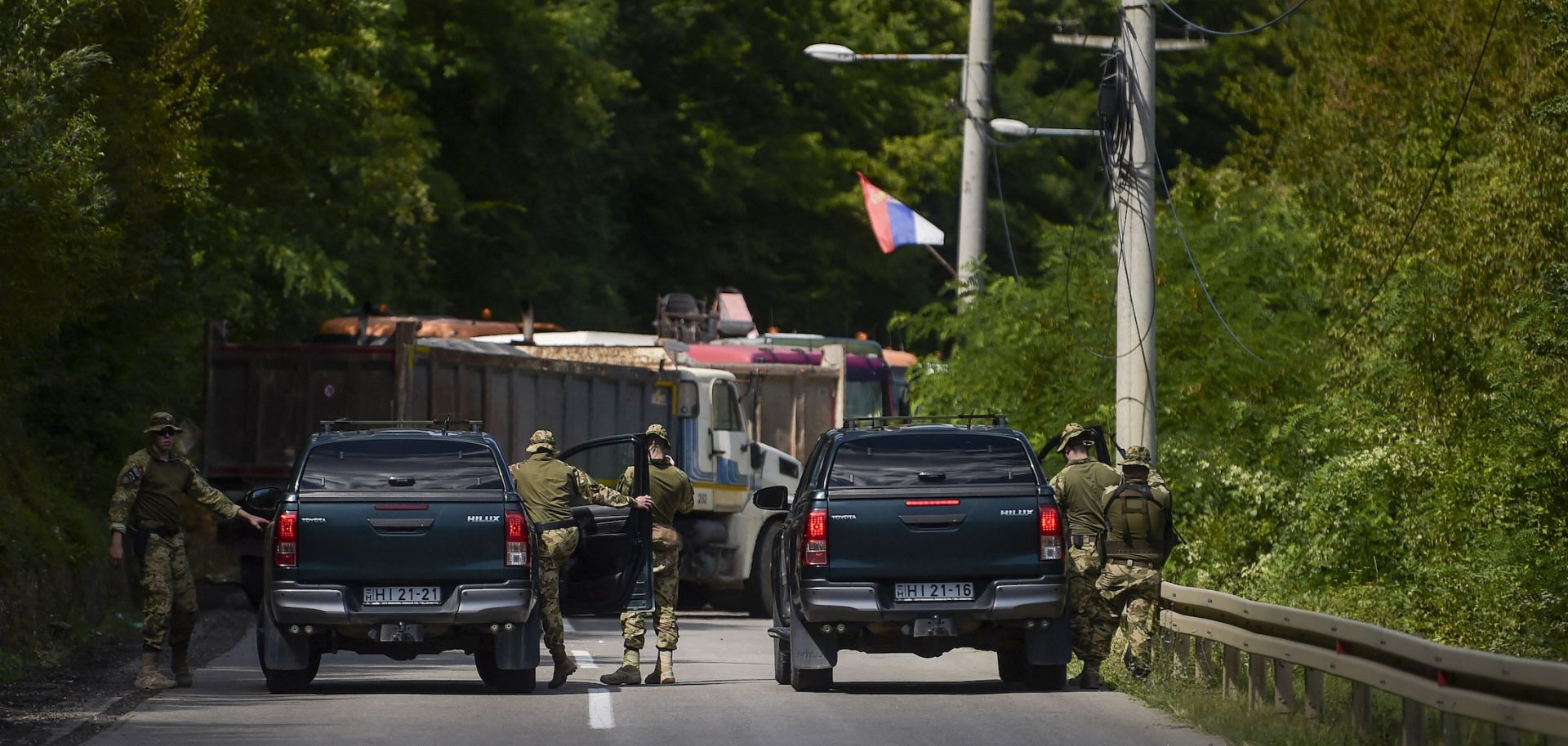
NATO soldiers patrol a roadblock set up by ethnic Serbs in northern Kosovo, on Aug. 1, 2022.
Editor's Note: This column is the first of a two-part series that assesses the risk of another war breaking out in the Balkans amid renewed concerns over ethnic tensions, political unrest and competing external influence in the region. The second part, which looks at China and Russia's interests in the Balkans and what their activities may mean for the region's long-term stability, can be found here.
Call it the ''license plate conflict'' — or maybe not. Two weeks ago, global media outlets intensely covered the short outbreak of protests in northern Kosovo. A recurring dispute over license plates led ethnic Serbs to block roads and forced Kosovar authorities to briefly close two border crossings into Serbia. Kosovar police also reported that unknown assailants fired shots at them, though there were no injuries, and some Serbian demonstrators reportedly beat up a few drivers who tried to bypass the roadblocks. The protests began July 31, but were over by Aug. 1.
Depending on your perspective and choice of media coverage, the incident was either much ado about nothing or a harbinger of a potential return to ethnic conflict. However, as is often the case in all-or-nothing framing of events, the flare-up should not be dismissed and deserves real attention, but it also does not suggest Kosovo, or the wider Balkans region, is in imminent danger of collapsing into widespread violence as it did in the 1990s. Instead, the license plate dispute is a symptom of a much larger challenge — unresolved ethnic identity politics — which makes it incumbent on us as analysts to consider the risks, but also the larger context in which they are present.
The Ghosts of Balkans Past
The July 31 protests were by no means unprecedented. The dispute has been simmering since September 2021, when Kosovar authorities first announced they would not renew a decade-old agreement with Serbia to recognize its license plates in Kosovo. Kosovar authorities played down the decision, saying the change would merely match the rules issued by Belgrade, which does not recognize osovo Unification Risks Destabilizing the Balkans. However, in a preview of the latest flare-up, ethnic Serbs in northern Kosovo temporarily blocked border crossings, with sporadic reports of low-level street violence, before Kosovar authorities withdrew the ban and the situation de-escalated.
While the row is ostensibly about license plates, it taps into much deeper divisions that explain why the measure has generated these flare-ups in unrest. Although various peace agreements ended the fighting that comprised the multiple conflicts that accompanied the breakup of Yugoslavia in the 1990s, they left many fundamental questions unsettled — most of which touch on questions of ethnic identity. As one of the largest regional flashpoints, the dispute between Kosovo and Serbia touches on two underlying challenges. First, there is the aforementioned question of the legitimacy of Kosovo's independence. The dispute is nominally a political one that could, in theory, reach some form of accommodation. But it also has an ethnic dimension because the vast majority of Kosovo's population is ethnically Albanian and Muslim, whereas Serbia's is largely ethnically Serbian and Christian. Adding to this division is the fact that more than half of Kosovo's Serbian minority is concentrated in the northernmost region of Mitrovica, bordering Serbia, making it ethnically distinct from the rest of Kosovo and helping explain why demonstrations over the license plate dispute have been concentrated there. Further complicating matters, however, is the fact that smaller groups of Serbian minorities are spread throughout pockets of the rest of Kosovo.
Many academic studies have dissected the question of whether ethnic conflicts are truly about competing identities or whether they're actually veiled disputes over other issues, such as political power and access to natural resources. However, the fact remains that such conflicts can cause serious divisions, especially when ethnic differences and material grievances overlap.
In the Balkans, this is partly because of its history. After all, Yugoslavia — be it as a kingdom prior to World War II or as a communist federation in its wake — was always held together by a strong central leader, not because of any logical unity among the varied peoples that inhabited the territory. Unsurprisingly, therefore, the wars (and war crimes) of the 1990s that comprised the dissolution of Yugoslavia were fought largely along ethnic lines, thus reinforcing the fundamental importance of cultural identities.
Since then, Balkan leaders across the political spectrum have frequently made appeals to ethnicities over nationalities, thus keeping personal identities at the center of society. This has meant that many aspects of daily life — everything from political debates to, yes, license plates — still have ethnic connotations. Even measures designed to assuage ethnic concerns, such as ethnic quotas for government positions in many countries, have kept identity politics front of mind and in some cases worsened tensions.
As a tragic demonstration of the salience of identity politics, even highly unlikely threats risk inflaming ethnic unrest in the Balkans. For instance, there has long been speculation over the creation of a ''Greater Albania'' that would incorporate Kosovo's majority-Albanian population into Albania itself. Politicians in both countries have spoken in favor of it and polls suggest citizens on both sides of the border would, in theory, be amenable to the idea. Nonetheless, the notion of a ''Greater Albania'' has largely been relegated to the periphery, as it is widely believed that creating such a state would run into potentially insurmountable legal challenges, practical objections over implementation and unpopular economic and political changes. But even so, the mere discussion of the idea has raised heckles from Serbia and prompted concerns of the knock-on effects in other Balkan countries with large Albanian minorities — all of which have kept ethnic divisions front and center.
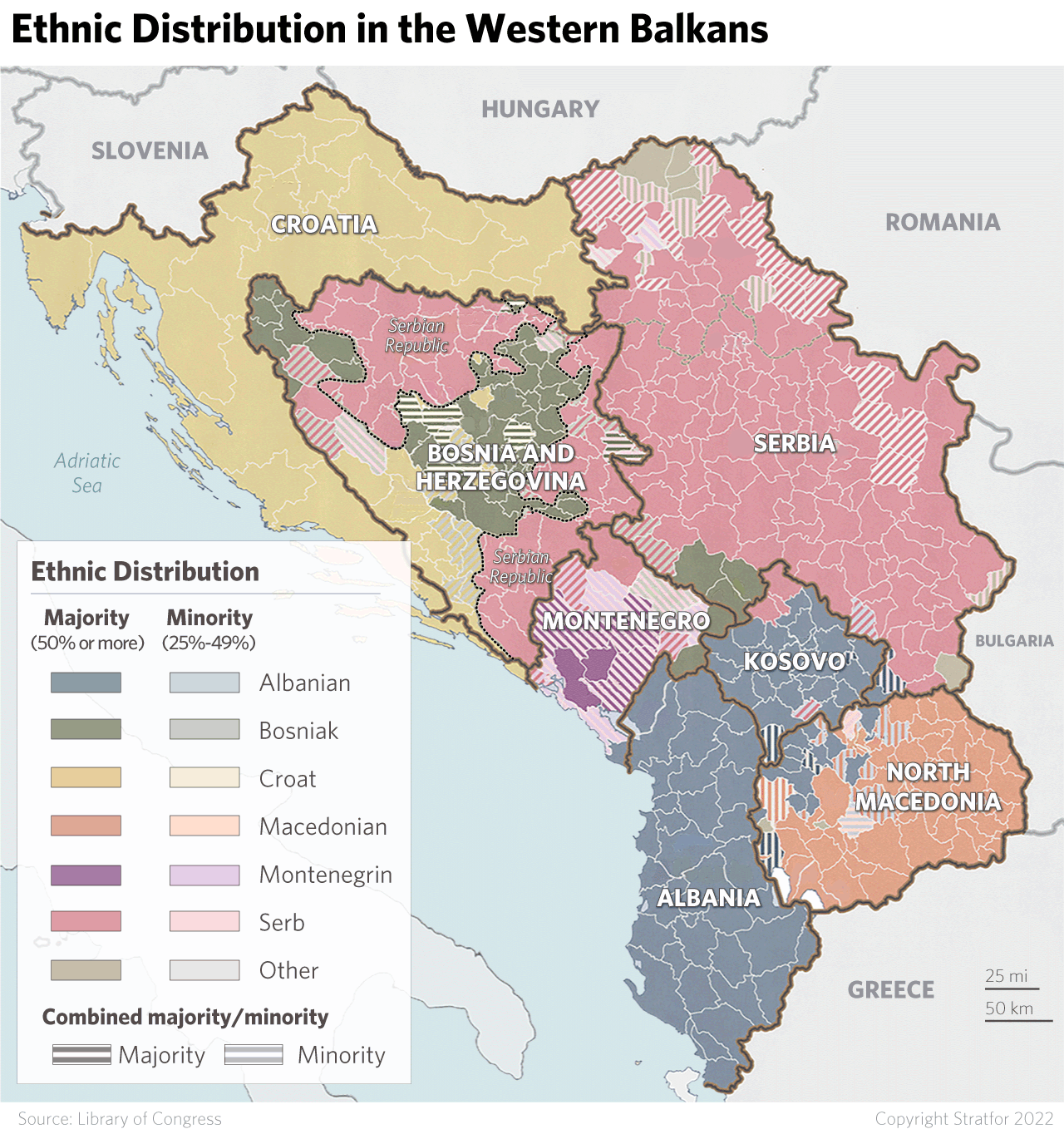
To this end, while it was ethnically-tinged tensions between Kosovo and Serbia that most recently made the news, arguably the greater threat of unrest lies in Bosnia and Herzegovina — another Balkan country with a large, distressed Serbian minority. There, decentralized governance is effectively split into two largely autonomous entities: the mainly Bosniak-Croat Federation of Bosnia and Herzegovina and the Serb-dominated Republika Srpska. This unwieldy system — which also includes a tripartite presidency (one from each of the three main ethnic groups) at the national level — was established in the 1995 Dayton agreement that ended the Bosnian War. While the U.S.-brokered peace deal resolved the more than three-year war, it did so at the cost of creating an unsustainable governance structure that has effectively paralyzed the country and entrenched ethnic distinctions.
This has resulted in numerous flare-ups in Bosnia and Herzegovina, most recently caused by the country's top Bosnian Serb politician, Milorad Dodik. Dodik leads the Republika Srpska and often engages in cynical political appeals to ethnic divisions. Most concerningly, he has repeatedly threatened to remove the Republika Srpska from Bosnia and Herzegovina's national institutions — a move that would directly undermine the tenuous postwar peace. As a testament to this threat, earlier this year the United States and the United Kingdom each sanctioned Dodik for charges related to threatening the stability of both his country and the wider region.
Looking to the West
But for all the media headlines questioning whether the Balkans is barreling toward another war, these recent flashpoints have notably resulted in much more of a whimper than a bang. This is in large part because, for all their differences, the Balkan states share a desire to integrate deeper into Europe and in many respects depend on Western economic financing and in some cases security guarantees.
Most importantly, every country in the region is either already an EU member (Croatia and Slovenia), an official ''candidate country'' engaged in ongoing negotiations with Brussels (Albania, North Macedonia, Montenegro and Serbia), or a ''potential candidate country'' for EU membership (Bosnia and Herzegovina and Kosovo). All Balkan states are thus highly incentivized to keep the peace, as any return to violence would jeopardize their accession process and the many benefits they hope to accrue by joining the European Union.
The European Union is already the main economic partner for regional countries, with Brussels and individual EU countries accounting for the majority of trade and much of the financial aid that flows into the Balkans. Straining EU relations by engaging in conflict is thus not merely a notional, longer-term concern, but one that would have immediate consequences for Balkan economies as well.
Combined with historic U.S. political and economic influence (as evidenced by Washington's role in ending the Yugoslav Wars of the 1990s), the European Union's influence over the Balkans is crucial leverage that has time and again helped to calm tensions. Furthermore, the presence of EU and NATO peacekeepers, advisors and trainers on the ground in Kosovo and Bosnia and Herzegovina provides a tangible check on conflict in arguably the two largest potential powderkegs in the region, both by deterring violence and ensuring unrest remains minimal when flare-ups do occur.
Take the license plate dispute between Serbia and Kosovo, for example. It was EU and U.S. political intervention, backed by NATO peacekeepers on the ground, that de-escalated tensions last September, as well as two weeks ago. In fact, the European Union's foreign policy chief is scheduled to hold negotiations in Brussels on Aug. 18 between Kosovo and Serbia as part of an ongoing EU-facilitated dialogue (another restraint on armed conflict) between the two sides. While the territorial dispute at the root of the issue is unlikely to be resolved anytime soon, multinational pressure and historical precedent suggest that Kosovo will adjust the license plate measure or again delay its implementation beyond Sept. 1, when it is currently scheduled to take effect. This means the disagreement is likely to remain a stalemate, much more of a problem to be managed than a crisis to be countered. Indeed, for all their rhetorical bluster, neither Kosovar Prime Minister Albin Kurti nor Serbian President Aleksandar Vucic has shown a serious appetite for actual armed conflict, which would bring significant costs for both of their countries with little benefit. Instead, both leaders appear to be using the appeals of ethnic identity more as a way to drum up domestic political support, establish strong negotiating positions and, in some cases, extract concessions from the West — before ultimately backing down.
Furthermore, consider that some Balkan states are taking steps to deepen regional integration. Indeed, ethnic and other disputes have not prevented Albania and Serbia (along with North Macedonia and potentially others one day) from making plans to create a single market to allow the free movement of people, goods, services and capital. While the process is admittedly slow-going and faces near-term challenges, it is hardly the sort of policymaking that suggests these countries are planning for major conflict.
Finally, what may seem like intractable problems need not be so. What is now North Macedonia had a nearly three-decade dispute over its former name, simply Macedonia, which is also a region in Greece. For years, the disagreement — which also featured arguments over ethnic identity — was a source of regional instability. Tensions with Greece over the name change also inhibited Macedonia's aspiration to join NATO and the European Union, as neither bloc wanted to admit a country that had such an ongoing dispute with an existing member. Ultimately, however, Athens and Skopje came to an agreement in 2018 in which Macedonia became North Macedonia, facilitating its entrance into NATO and becoming an official EU candidate in 2020 — a clear demonstration of the underlying drivers for peace over conflict even after years of rhetorical sniping and negotiations at loggerheads.
Next: The Risk of Another Balkans War, Part 2: Russian and Chinese Influence
