
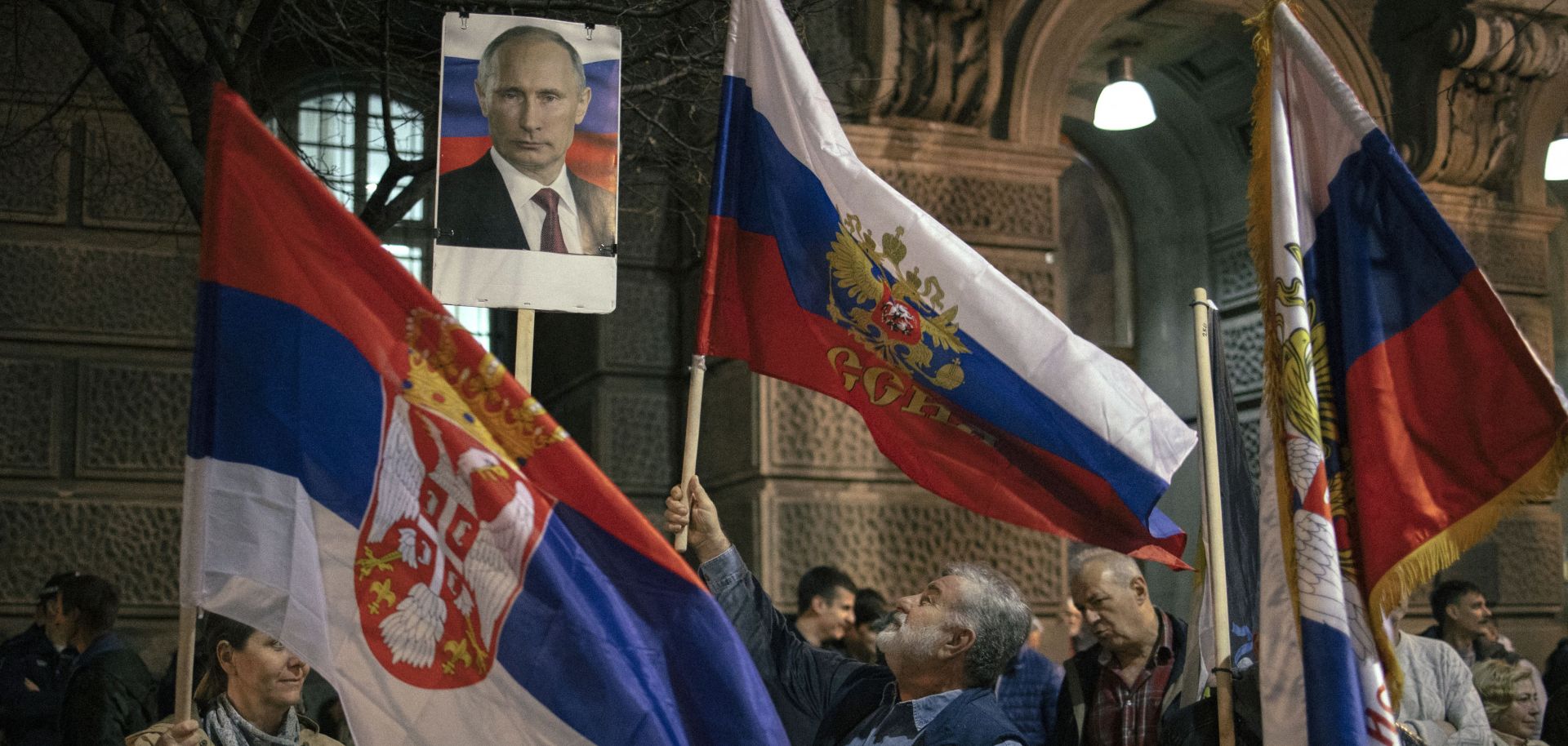
Demonstrators in Belgrade, Serbia, hold up a photo of Russian President Vladimir Putin and wave Serbian and Russian flags on March 24, 2022, during a rally in support of the Russian invasion of Ukraine.
Editor's Note: This column is the second of a two-part series that assesses the risk of another war breaking out in the Balkans amid renewed concerns over ethnic tensions, political unrest and competing external influence in the region.
In the first part of this series, we examined the local drivers and constraints on the potential for renewed conflict in the Balkans. However, the actions of external actors — namely Russia and China — are also key to evaluating regional stability.
Russia's Historical Influence
Russia has historically seen the Balkans as falling within its sphere of influence. This has contributed to some of the corruption, political paralysis, increased militarization and other challenges that bedevil Balkan countries. Moscow's influence is most pronounced in Serbia, with which it shares a variety of practical and symbolic ties. Particularly in Serbia, but throughout the region, Russian propaganda (including disinformation that a ''war'' had broken out between Kosovo and Serbia two weeks ago) has sought to exploit ethnic tensions and other divisions in an attempt to keep regional states from aligning westward.
Indeed, just two weeks ago, Russia spread disinformation that a ''war'' had broken out between Kosovo and Serbia after the former's decision (now delayed until the start of September) to no longer recognize Serbian license plates led to a brief outburst of unrest along the Kosovo-Serbia border. The Kremlin has also been a destabilizing force in other disputes; in Bosnia and Herzegovina, Russia has implicitly endorsed the threats made by the country's top Bosnian Serb politician, Milorad Dodik, to dismantle the governance structure established in the power-sharing agreement that ended the Bosnian War in 1995.
Moscow has even been accused of trying to foment a (failed) coup in Montenegro in 2016 as part of a larger destabilization campaign to try to prevent the country from joining NATO (which it did the following year). And of course, in the aftermath of Russia's invasion of Ukraine earlier this year, fears have risen that President Vladimir Putin's high tolerance for risk could lead him to take aggressive moves in the Balkans to further destabilize political and security dynamics in Europe.
But even in Serbia, there are constraints on Russia's influence. Unlike other Western governments, Belgrade hasn't directly sanctioned Moscow in response to its aggression against Kyiv. But Serbia has backed other sanctions against Russian proxies and voted in favor of multiple U.N. resolutions condemning the Ukraine invasion. And while some have called Serbian President Aleksandar Vucic ''little Putin'' in reference to his perceived close ties with the Kremlin, Vucic's leadership has ultimately been defined much more by a desire to hold power. In May, for example, Vucic made headlines when he criticized remarks made by Putin comparing Kosovo's right to independence with that of the Russian-occupied Donetsk and Luhansk regions of Ukraine. More recently, Vucic also condemned a legislator from his ruling Serbian Progressive Party (SNS) for appearing to call for war with Kosovo in response to the license plate dispute; in a July 31 tweet, the SNS lawmaker raised the idea that Serbia would ''be forced to begin the denazification of the Balkans'' — using the same controversial term Putin used before sending troops into Ukraine — which Vucic publicly denounced as ''stupid'' and ''irresponsible.''
To this end, Vucic is more than happy to play Russia and Europe off each other to achieve his goals. Indeed, Serbia is the largest regional recipient of EU pre-accession funds, but at the same time recently inked a gas deal with Moscow. Vucic also knows he must at times cater to the pro-Russian sympathies harbored by Serbians, some of whom have protested in support of Russia's actions in Ukraine.
On a more strategic level, the Ukraine war is also a double-edged sword for Russia. While it offers Moscow another wedge issue to try to split the Balkans away from the West, it has also forced the European Union and NATO to refocus on their near-peripheries to counter Russian influence. Both alliances are reexamining their relationships with the Balkans and are newly cognizant that any serious instability, let alone real conflict, would give Russia an opening. This suggests there are even greater motivations in the West to help manage Balkans disputes and move forward with their deeper integration with the European Union and NATO, even if that means in some cases toning down criticism (such as over corruption) in order to keep regional countries facing westward.
The war in Ukraine has even helped check some regional provocations, most notably in June when Milorad Dodik announced a six-month delay in pulling his Republika Srpska region out of Bosnia and Herzegovina's national institutions. Dodik did not formally scrap the plan, but he did specifically cite geopolitical uncertainty as the reason for the postponement, opening an avenue for mediation.
China's Growing Impact
China, too, represents a challenge, primarily economically though increasingly also politically and militarily. A large part of the European Union's leverage in the Balkans is the vast economic benefits that membership would bring. But the longer the accession process takes, the more likely regional states will start looking elsewhere for economic ties, a gap Beijing has eagerly sought to fill.
In recent years, China has poured investment into the region, particularly Serbia, to the tune of billions of dollars annually. And unlike EU and U.S. aid, which is often conditioned on fighting corruption or strengthening the rule of law, most of China's aid comes with few strings attached, making it especially attractive to regional recipients. Though still far behind Russia, China has also started to become more engaged in the region's political disputes and military affairs; this was most notable in April when Chinese military planes delivered an air defense system to Serbia — a visually evocative representation of growing Chinese influence.
But there are also major caveats to this narrative. While Chinese investment in the region has increased, it's still nowhere near the level of EU investment. Serbia, for example, is by far the largest Balkan recipient of Chinese funds, though Chinese investment is estimated to represent approximately just 1% of total foreign direct investment in Serbia (compared with the European Union's 70%). Moreover, while Chinese loans may come with fewer conditions, their terms are also opaque and hard to repay, which ends up trapping borrowers. In Montenegro, a Chinese-financed $1 billion road project (dubbed the ''highway to nowhere'') has attracted global media attention for the havoc it has wreaked on the country's finances — a cautionary tale many regional states have taken note of.
And if anything, Serbia's acquisition of the Chinese air defense system is further evidence that Vucic's administration is hardly in hock to Russia, but instead seeking to play great powers against each other — likely looking to the West to counter. After all, Serbia (like Bosnia-Herzegovina) has an Individual Partnership Action Plan with NATO, the closest form of cooperation a non-member state can have with the bloc.
Turkey's Role
Finally, there is a third external actor, Turkey, which also plays a role in the region, though ultimately its influence has been less impactful and drawn less concern in Western capitals. Geographic proximity and historic ties underlie Ankara's interest in the region, particularly in Muslim majority countries like Albania and Bosnia and Herzegovina. Generally, Turkey has played the role of foreign investor, but has also competed for influence on religious terms by spreading its brand of Islam.
While these factors have at times spurred complaints in Europe, ultimately Turkey's membership in NATO and deep trade ties with the European Union (even if not as a member) mean that its activities have not raised fears akin to those by Russia and China. In fact, whereas Moscow and Beijing have been cast as ideologically-driven destabilizers, Ankara has largely pursued a highly practical foreign policy in the Balkans and favored the Europe-oriented status quo, keen to be seen as a mediator that resolves disputes rather than a disrupter that fans them.
Beijing, Brussels or Moscow?
In this assessment, therefore, concerns over regional ethnic tensions are real but also manageable. Balkan leaders may offer a lot of proverbial bark, but comparatively little bite. This is not to say that sporadic flare-ups, like that seen two weeks ago, will not be ongoing risks. They could even grow in severity and length, especially if regional leaders fan ethnic flames. After all, the danger of playing identity politics is that such passions are deeply personal and harder to temper. But fundamentally, the constraints — politically, economically and militarily — on wider conflict appear to surpass the drivers for it.
An implicit assumption, however, is that the Balkans states feel that deeper integration with the West is still a realistic possibility, despite many years of waiting. Indeed, much of the underlying rationale for peace comes from the belief that conflict would do far more harm to the Balkan states' aspirations than would achieve any major benefits. But should the European Union and NATO fail to offer concrete accession paths, and individual Western states lose interest in the Balkans, regional leaders' calculations could change. This could open the door for greater Russian and Chinese influence or even set the stage for a regional leader to gamble that a major provocation would jolt the West into making concessions rather than see the country swing toward Moscow or Beijing. To be sure, key European leaders have made recent statements supportive of deeper integration with the Balkans and taken trips to the region, but ultimately they will need to show action, not offer mere words.
In this sense, general elections in Bosnia and Herzegovina set for Oct. 2 will provide a key litmus test, not only based on how they play out domestically but also for how engaged the European Union, NATO and other key Western players are in the run-up and following the vote. After all, in many respects, the Balkans is the West's to lose. While the Ukraine war has certainly refocused the region's relevance to the West, Russia's invasion is also a tragic reminder of how quickly things can escalate — even when there does not appear to be a clear strategic rationale.
