
An external view of the building of the European Union in Brussels, Belgium.
The European Union will not accept any new member states for the foreseeable future, which will erode the promise of EU accession that has made the bloc an influential political and economic force in the Western Balkans. As the fallout from the COVID-19 crisis forces the European Union to remain focused on recovering (and not enlarging) its economy, candidate countries risk veering off from the reforms they had been pursuing to earn their place in the bloc. Non-EU players such as the United States, Russia and China, meanwhile, will likely become more active in the region, seeing European Union's waning presence as an opportunity to assert their own influence in the Balkans.
The European Union's internal contradictions, as well as the lengthy and complex accession mechanism, will limit the bloc's ability to use money and the promise of membership as foreign policy tools. Candidate countries receive pre-accession funds, as well as other kinds of assistance from the European Union, which has traditionally given Brussels some degree of influence on the governments of the candidate countries. Large swaths of the populations of the candidate countries are also supportive of EU accession, which they see as key to modernizing their economies, as well as reducing domestic corruption and mismanagement. The European Union also engages in partnership programs with other countries, which gives Brussels some degree of influence over them.
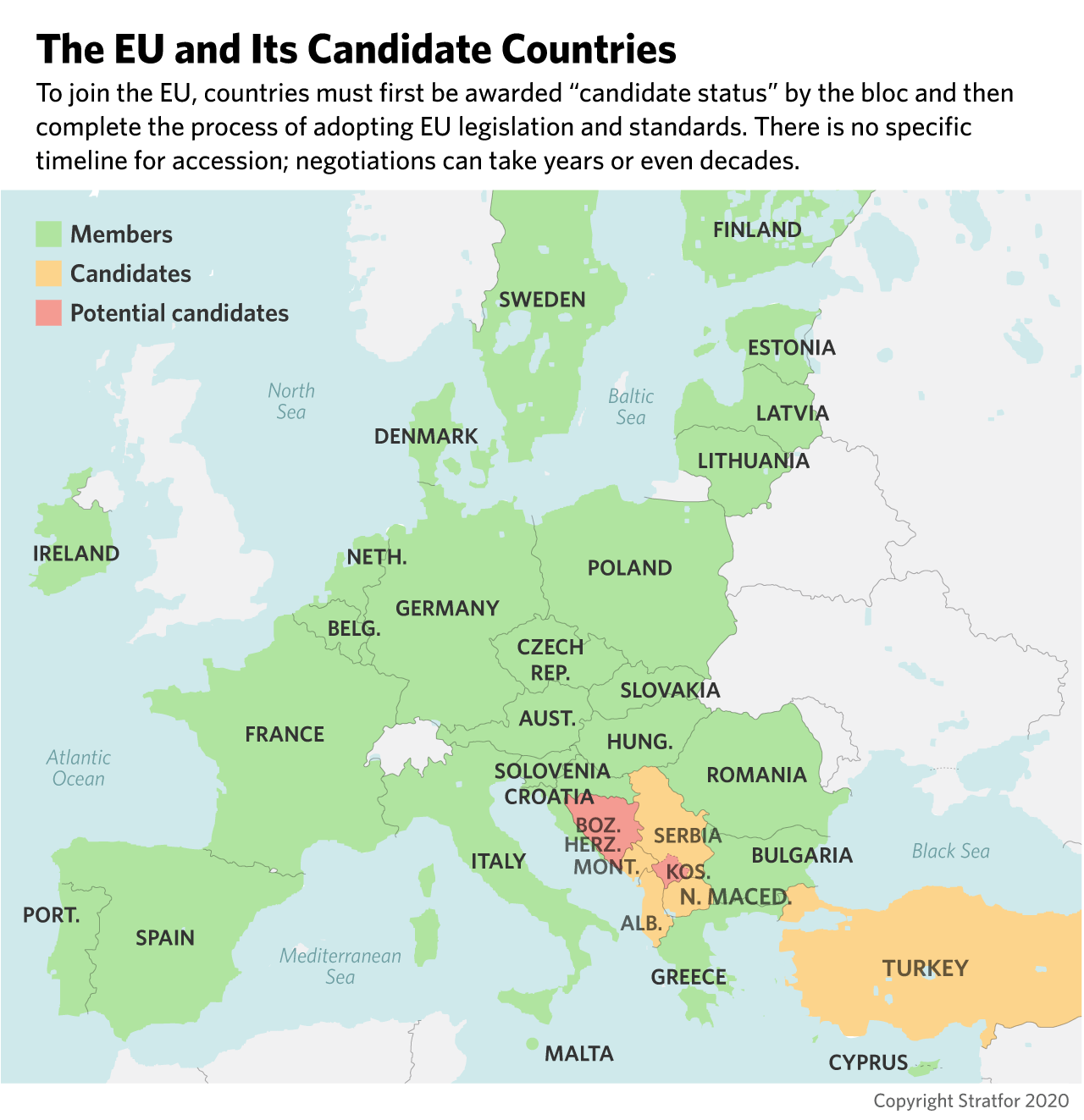
- Albania, North Macedonia, Montenegro, Serbia and Turkey have all been declared candidate countries for EU membership. The EU has also identified Bosnia-Herzegovina and Kosovo as potential candidates.
- The EU allocated almost 12 billion euros ($14 billion) in pre-accession funds for candidate and potential candidate countries between 2014 and 2020. The bloc plans to increase pre-accession funds to 12.5 billion euros ($15 billion) for the 2021-2027 period.
- The European Union provides technical assistance, information and training for public officials in candidate and potential candidate countries as well.
- Initiatives such as the Eastern Partnership program are also meant to deepen the bloc's political and economic cooperation with countries that are not candidates to join, such as Armenia, Azerbaijan, Belarus, Georgia, Moldova and Ukraine.
The European Union is also increasingly competing with non-EU countries for influence in the Balkans, though it's unlikely any single country will become a dominant player in the region. The United States, Turkey, China and Russia have all increased their presence in the Balkans through investment, military cooperation and political support. None of these non-EU players, however, will likely be willing to become the Balkans' main economic and political sponsor. The region's political and ethnic fragmentation also means that countries have different interests when it comes to looking for international allies.
- The European Union last expanded its membership in 2013, when Croatia joined the bloc. In early 2020, Brussels said further enlargement was possible by 2025, but there is not an official timeline for new accessions.
- Under pressure from France, the European Union modified its accession criteria in February to put a stronger emphasis on the rule of law and the transparency of democratic institutions, which will make it harder for the candidate countries to join.
- Serbia is a part of China's Belt and Road Initiative and has expressed interest in receiving Chinese investment. Belgrade has also been purchasing military equipment from China.
- In Montenegro, an alliance of opposition parties won the general election in late August. While the parties have promised to continue with the process of EU integration, they have also pledged for closer cooperation with Russia.
- In recent years, Turkey has been financing educational, healthcare and cultural projects in Balkan countries with large Muslim populations such as Albania, Kosovo and Bosnia.
- The United States is currently acting as a mediator between Serbia and Kosovo. Serbian President Aleksandar Vucic and Kosovar Prime Minister Avdullah Hoti met at the White House on Sept. 4, where they signed documents meant to improve the economic ties between their countries. The summit took place just days ahead of a similar meeting in Brussels.
The weakening promise of EU accession and the presence of non-EU actors offering less-conditional cooperation could prompt countries in the Balkans to slow the pace of economic and political reforms, and potentially even turn to nationalist and populist policies. EU candidate countries are all grappling with issues that have delayed their negotiations with Brussels, including corruption, a weak rule of law, lack of transparency in their democratic institutions, unsolved territorial disputes and inefficient economies. In the coming years, Balkan countries will implement modest economic reforms in order to attract foreign investment and create jobs. But the lack of a clear perspective for EU accession will weaken one of the main incentives for such reform, especially when it comes to institutional transparency, democratic participation and minority issues. It will also open the door for these countries to increase cooperation with non-EU actors as they hedge their geopolitical bets. Moreover, a weaker EU presence creates the risk of populist and nationalist rhetoric returning to the region, which could lead to a potential increase in ethnic violence.
- Unlike the European Union, countries such as Russia and China do not request institutional or political reforms in exchange for political, economic and military cooperation.
- Brussels' demand for a normalization of relations with Kosovo creates a particularly big obstacle for Serbia's accession, as it does not recognize Kosovo's independence.
- The weakening of the rule of law in Turkey and the growing tensions in the Eastern Mediterranean are adding to the pre-existing obstacles to Ankara's accession as well, which include the reluctance from several Western European countries to accept a predominately Muslim nation.
