
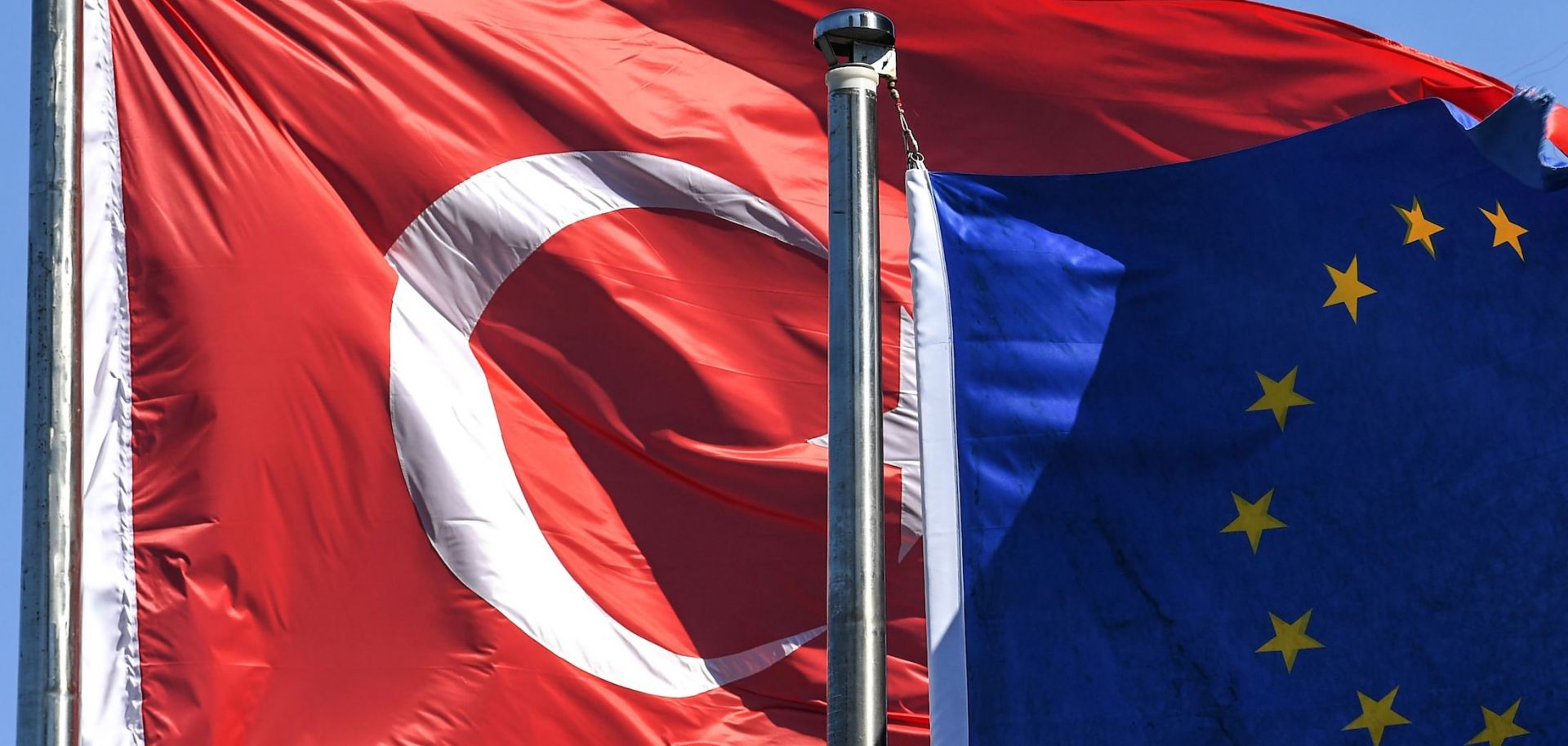
The Turkish flag (left) waves alongside the EU flag in Istanbul.
The results of a foreign policy-focused EU summit signal that bilateral tensions with Russia will continue while a more pragmatic approach to Turkey is possible. During a summit of EU heads of government and state on June 24-25, the bloc rejected a Franco-German proposal to hold a meeting with Russian President Vladimir Putin and only pledged to “explore” the format and conditions for dialogue with Moscow. The leaders also approved granting an extra 3 billion euros to Turkey over the next three years to continue the migration agreement between Brussels and Ankara, while Germany proposed to restart negotiations to upgrade the EU-Turkey customs agreement. The summit once again highlighted the European Union’s limitations when it comes to foreign policy, as the most crucial decisions are taken by unanimity, which severely constrains the bloc’s room for action on controversial issues.
The European Union’s ongoing frictions with Russia will force France and Germany to explore a more bilateral and less effective approach to relations with Moscow. The European Union will keep its sanctions on Moscow in place and will be ready to expand them over issues including human rights violations, the crackdown on opposition forces, disinformation and cybercrime campaigns, and threats to Ukraine’s sovereignty. Tensions could further escalate in the coming months, especially if the West perceives Russia’s military exercises near the Ukrainian border in September as an additional threat to Ukraine’s sovereignty. As a result, the room for EU-Russia cooperation will remain very limited and restricted to specific issues such as the Iran nuclear deal. This means that Germany and France could seek to preserve their own bilateral communication channels with Russia, even if the strategy will be less effective than an EU-wide approach.
- Hours before the beginning of the EU summit, German Chancellor Angela Merkel and French President Emmanuel Macron proposed to hold a summit between EU leaders and Putin to emulate the meeting that the Russian president recently had with U.S. President Joe Biden.
- Several EU member states including Poland, Romania, Latvia and Lithuania opposed the idea, arguing that Moscow has shown no signs of trying to improve its ties with the West. The Netherlands and Finland also expressed skepticism about the idea.
- According to the EU summit’s conclusions, the member states agreed to “explore format and conditionalities of dialogue with Russia" and said that “the European Council expects the Russian leadership to demonstrate a more constructive engagement and political commitment and stop actions against the European Union and its Member States, as well as against third countries.”
- In recent years, the European Union has imposed political and economic sanctions on Russia because of issues including the illegal annexation of Crimea and the poisoning of opposition leader Alexei Navalny. On June 24, EU leaders asked the European Commission to come up with a list of additional sanctions in case they need to impose them in the future.
The European Union wants to improve ties with Turkey to prevent a repetition of the 2015 immigration crisis, and will be willing to make additional concessions if Ankara agrees to de-escalate tensions in the eastern Mediterranean. The European Union is worried that the softening of COVID-19 lockdown restrictions and a growing economy will result in more migrants trying to enter the bloc. This explains why Brussels is granting additional help to Ankara at the start of the summer, which is generally the peak of the migration season in the so-called Balkan route. The European Union is also offering to resume the negotiations on updating its customs agreement with Turkey, but this will depend on the evolution of the situation in the Eastern Mediterranean. EU member states including Greece and Cyprus will veto any customs agreements with Turkey unless Ankara de-escalates tensions in their disputed waters. Because of Turkey’s fragile economy, Ankara will remain interested in customs talks with the European Union. Those negotiations, however, will be slow and fragile, as Turkish President Recep Tayyip Erdogan is unlikely to introduce radical changes in many of the domestic policy areas that irritate the European Union, such as the crackdown on opposition parties and the treatment of minority groups.
- Turkey is the European Union’s sixth-largest trade partner, while the bloc is Ankara’s main trade partner.
- The European Union and Turkey have been in a customs agreement since 1995. The agreement only covers industrial goods and excludes agricultural products, services and public procurement. Over the past 20 years, Brussels and Ankara have discussed expanding the agreement to include the missing sectors, but political tensions have stalled the process.
- The arrival of migrants to the European Union through the route that links Turkey to the bloc has decreased dramatically since the two sides signed a migration deal in 2016. However, the Turkish government has repeatedly asked for additional funds from Brussels in exchange for preserving the deal.
- In recent years, the European Union has imposed limited sanctions on Turkish nationals in response to Turkey’s energy exploration activities in waters disputed with Greece and Cyprus. The Greek government has said it will support economic concessions to Turkey as long as they are reversible, depending on Ankara’s behavior.
