
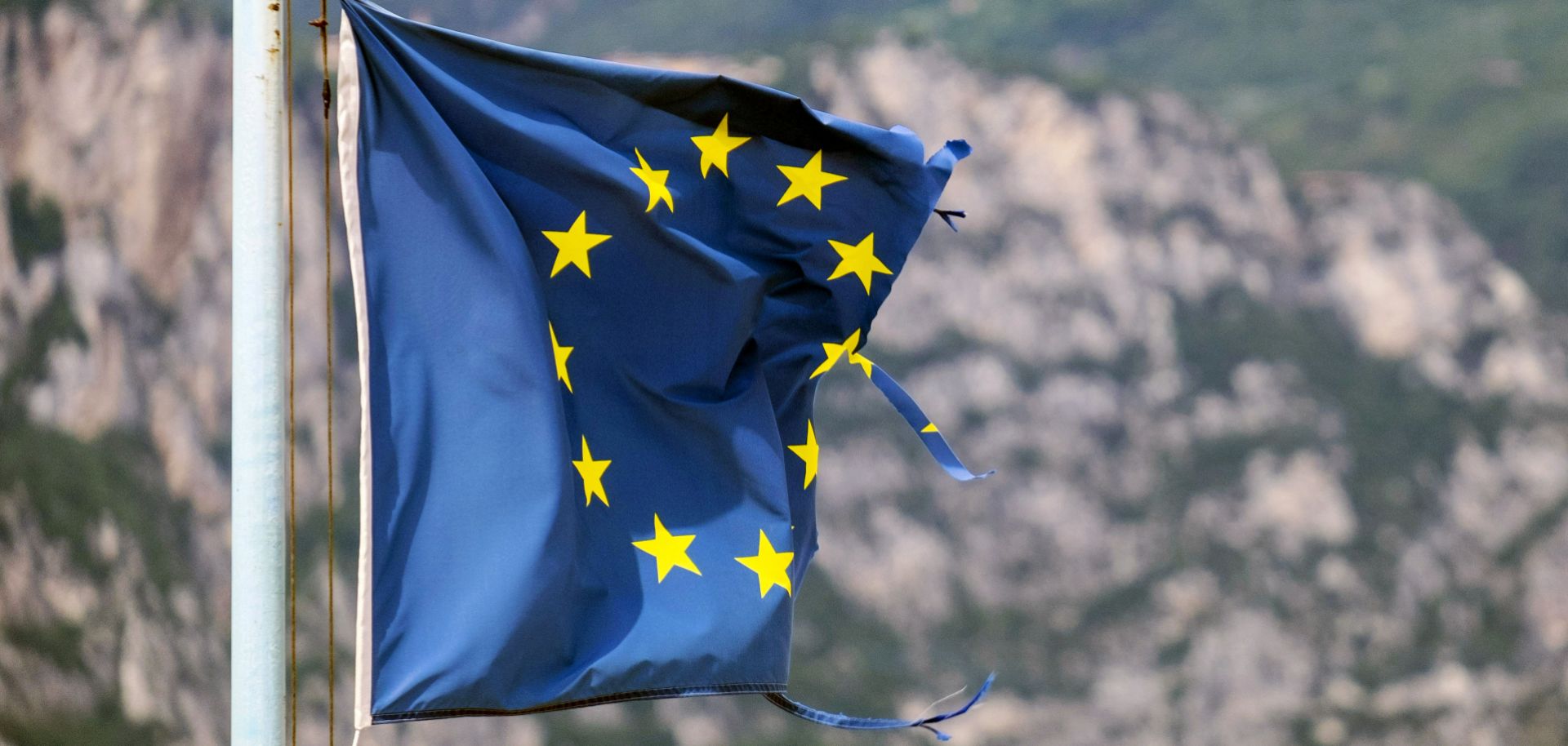
A damaged EU flag is seen in Brenzone, Italy, on Aug. 14, 2019.
“In the long run, customs unions formed of naturally related states, and general security in time of peace, will prove of far more importance to the peoples of Europe than the exact position of boundary lines.”
Isaiah Bowman, The New World: Problems in Political Geography (4th ed., 1928)
Europe faces a challenge of identity and international role over the next decade. For nearly 500 years, Europe sat at the center of the international system, its internal competitions rippling out across the globe. But the relative balance of global power and influence has shifted. And rather than being the driving force of global dynamics, Europe is increasingly caught between major powers: the United States and the Soviet Union during the Cold War, and now the United States and China. Internally, Europe still strives for the creation of a continental union, though those dreams have been eroded by financial crises, Brexit and a resurgence of nationalism in recent years. Externally, Europe remains fragmented in its foreign policy and prioritization. The shifting patterns of global competition will compel Europe to rethink its internal structures and to come to grips with defining its interests abroad. Otherwise, it will find itself drifting further from the center of history, with internal divisions once again becoming its defining characteristic.
Overcoming European Divisions
History is not static. It meanders and flows like a river. You can see some of the curves ahead, but the precise shape, pace and turbulence is often not fully recognized until it is past. Yet for several decades, Europe has strived to end history, or at least to overcome the longstanding geographic, cultural and linguistic divisions that have so long shaped the development of the Continent. While the closing of the Cold War allowed the United States its brief “unipolar moment,” it provided Europe with the opportunity to accelerate its plans to create unity from a traditionally fractious set of nations. The expansion of the European Union, the introduction of the Euro and the promotion of a progressive regulatory environment were all part of the same strategic and philosophical mindset: the desire to unify Europe, overcome national identities, and progress human society based on European liberal models.
The progressive drive for European unity, however, was just the latest in a long line of attempts to create a common European destiny — whether shaped by conquest and war, royal marriages and diplomacy, or economic domination. In some ways, Europe has long thought of itself as a common entity, or has at least recognized a common European heritage compared with the rest of the world. Europe could overcome its internal differences and pull together in the face of external threats, whether they be the Moors, the Ottomans or the Russians.
But more often than not, European history is rife with shifting alliances, as varying powers sought to either create a universal monarchy or dominate the Continent. Ethnic, linguistic and religious differences, combined with the competition between rising ideas of “national liberties” and universal monarchies, created an ever-shifting pattern of key countries seeking to maintain a balance of power in Europe, or dominate the whole system. The two paths both sought a common goal — that is, some form of peace and stability that could facilitate economic growth and security.
Internal Challenges
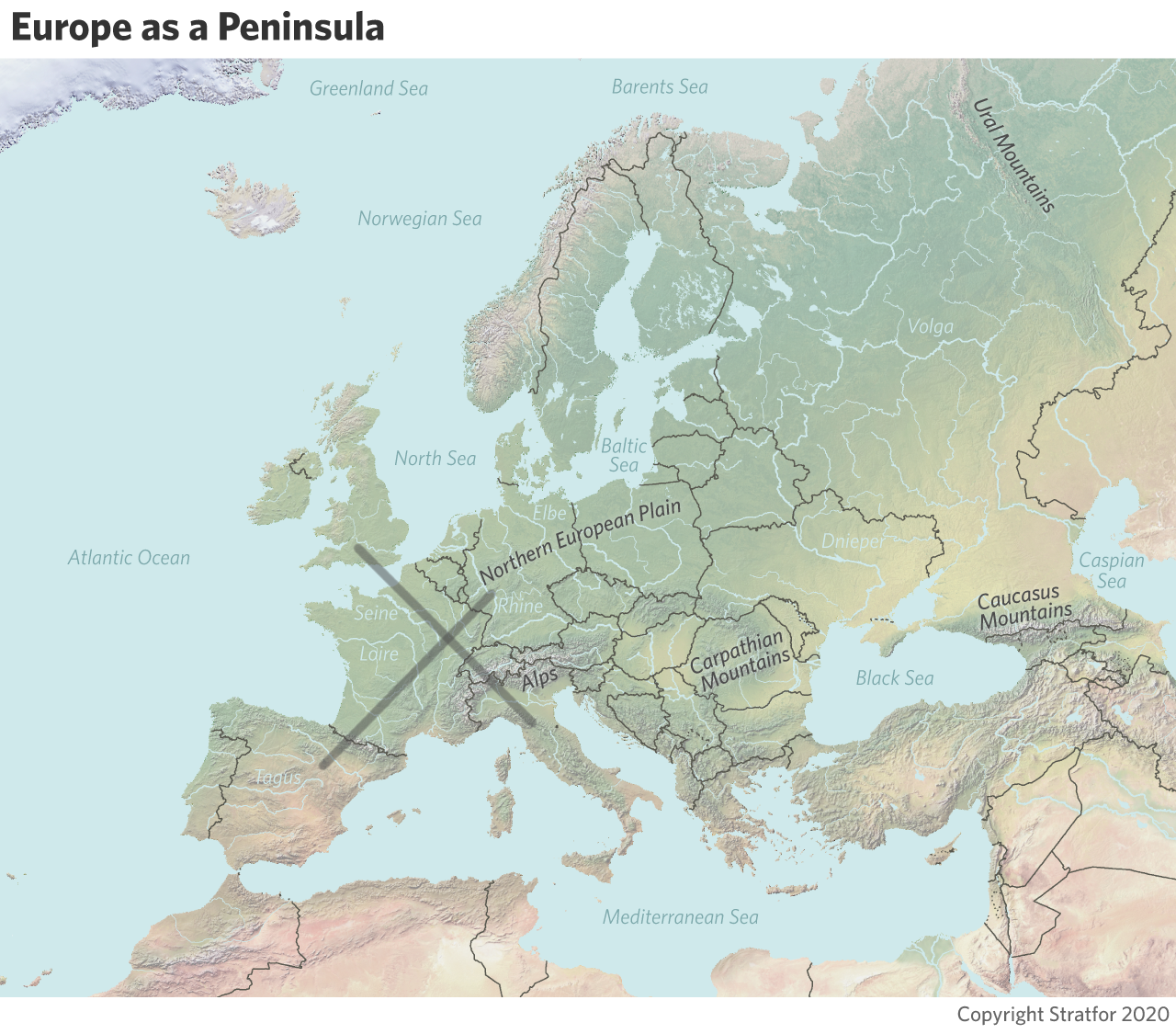
One of the biggest challenges Europe has faced has been defining Europe itself. From a continental perspective, Europe includes parts of Russia and Turkey. From a geographic perspective, Europe is a peninsula, squeezed at its base between the Black and Baltic seas, and reaching out toward the Atlantic. British geographer Sir Halford J. Mackinder, commenting on the long history of internal European dynamics at the close of World War I in 1919 , noted that the core of Europe could be seen in a cross, drawn with the intersecting axes of Spain-France-Germany and U.K.-France-Italy. This area represented the core of modern European activity and competition for power and position, but relegated Central and Eastern Europe to contested frontier zones against Ottoman Turk and Russian expansion. Britain and the United Kingdom, in its island redoubt, played a shifting role on the mainland, at times active in continental contests, while at other times shifting to an offshore naval and balancing strategy.
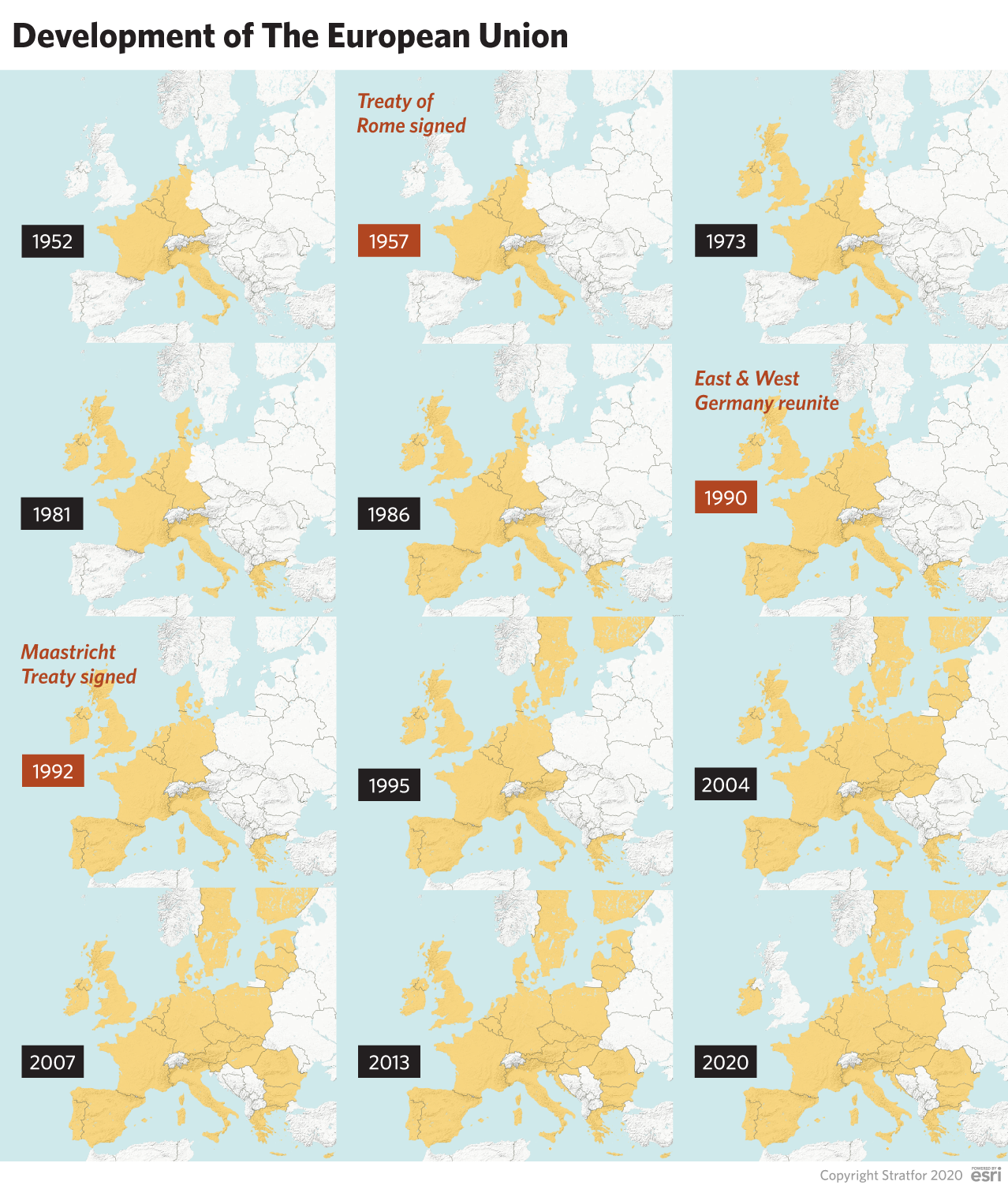
The origins of the European Union, in the founding of the European Coal and Steel Community in the 1950s, reflect this core of Europe, with then West Germany, France and Italy joined by Belgium, Luxembourg and the Netherlands. The United Kingdom, Ireland and Denmark then joined in the 1970s, followed by Spain, Portugal and Greece in the 1980s. With the exception of Greece, Cold War-era Europe fit cleanly within Mackinder’s cross. But with the end of the Cold War, the European Union launched a currency union and several rounds of expansion (politely termed “enlargement” by Brussels to avoid appearing imperialistic) — stretching the bloc into Scandinavia and then into the former Soviet frontier in the Baltic states and deep into Central and Eastern Europe. The European Union has also considered expanding its membership to Turkey and further into the Balkans.
The rapid expansion of the European Union, coupled with the drive for greater integration, created many of the challenges the bloc must face going forward. Socio-economic and political differences were already evident in the core of Europe, but expansion and the 2008 Global FInancial Crisis brought them to the fore. Other complications include finding the right balance between net contributors and net receivers of European funds, differential labor costs, internal migration and persistent differing national cultures. Politically, Europe is seeing a rise in populism and a lean toward more authoritarian governments, particularly on its eastern frontiers — reflecting old geopolitical patterns that pitted liberal democratic maritime powers against conservative, autocratic continental states.
The European Union’s foundational pillars are increasingly coming under attack from within the bloc, contributing to the United Kingdom’s decision to leave. Between the Global Financial Crisis and the current COVID-19 crisis, the core European countries are struggling to maintain unity in demanding fiscal responsibility among member states. Responses to the two economic crises have also awoken calls for at least limited trade barriers and protectionism. And these crises are reviving opposition to free movement of peoples within the European Union as well — not only regarding increased asylum seekers from outside the bloc, but also intra-European labor migration. An uneven economic recovery from COVID-19 will only exacerbate the growing rifts within Europe, and may force the European Union to either ease its ambitions for higher integration, or rethink the scope of the bloc itself.
External Challenges
Europe’s internal structural challenges are matched by a shifting global environment. For much of the post-Cold War period, Europe has been at the center of shaping the global regulatory environment, using the combined heft of the European single market to further a progressive agenda that ran the gamut from livestock welfare to digital privacy rights. But the comparative strength of the European market is weakening, and disagreements over regulations within the Continent are growing.
China has taken advantage of European internal divisions and limited European investment monies to accelerate Beijing’s own economic (and by default political) expansion and influence into Central and Eastern Europe, as well as Greece, the Balkans and even into the core European countries. The core of Europe is only now starting to shape a more unified stance on countering Chinese investment, espionage and its human rights and territorial assertions abroad. As China grows more assertive of its own international position, its pressure against European unity, and against European ideals, is forcing the Continent to prioritize and define its counter.
Russia, too, has been able to exploit European divisions, playing on energy ties and differing internal European perceptions of the Russian “threat.” Central and Eastern Europe are much more attuned to Russian actions than Western Europe, and this poses potential friction as Europe seeks to define its own internal and external security priorities. This is heightened by questions of the future role of NATO, the overall stability of U.S.-European relations (or at least the trajectory of interests), and the role for European defense forces outside of the NATO framework. As the United States continues its drawdown of forces abroad and seeks to reduce active engagement in global conflicts, the European Union will find itself pulled by varying foreign policy interests, as its member states deal with issues in either former colonial empires or along the European periphery.
Turkey and the Balkans are also both raising new security challenges for Europe, with Chinese arms sales into Serbia, as well as rising tensions between Greece and Ankara over territorial disputes in the Mediterranean Sea. The ongoing civil conflict in Libya has drawn differing interests and involvement from core European states, and counterterrorism in the Sahel region of sub-Saharan Africa continues to draw attention from France and others. Core European states, including France and Germany, are taking a greater interest in the South China Sea and Chinese maritime expansion, with France moving faster due to its Pacific holdings and its longstanding more independent foreign defense policies. The Arctic is also gaining attention as climate changes open the area to more economic activity and revived military competition, driving the European Union to seek more of a role in regional management. The need to define European defense priorities in the near and far abroad, and to balance European and NATO responsibilities, will further test Europe’s evolution.
Europe in the New World Order
For the European Union, the post-Cold War world has not shaped up the way it had hoped. Northwestern European liberalism appears to be reaching its limit and facing resistance around the world. Relations with the United States have wavered for several decades, as differences in strategic outlook and attention have diverged. The resurgence of Russia is forcing Europe to deal with its internal divisions. And China’s rise as not only an economic and military power, but an alternative source of new global norms, clashes with the very conception of Europe as the vanguard of modern civilization and political order.
Internally, the old struggle of “liberties” versus absolutist governments has re-awoken. The expansion of the European Union has made consensus nearly impossible, and even compromise increasingly difficult. Demographic declines and lingering economic fallout from a series of crises is already forcing a reassessment of what it means to be European and whether borders can and will remain open within the union. And Brexit, even if troubled, may well inspire some European countries to expect more from Brussels on threat of exit. Others, meanwhile, may wonder if the bloc itself is too large to manage, and perhaps force non-conforming countries to exit, or at least promote a new tiered system of Europe as the best path to manage the future.
What is abundantly clear, however, is that despite the noble sentiment, the European Union as the great European experiment has failed to end history and replace the ideas of nation, border and differences with a common European identity as a model for the future of global cooperation. In the fourth edition of his book The New World: Problems in Political Geography released in 1928, the American geographer Isaiah Bowman envisioned a European customs union less interested in borders than in trade. But while Bowman’s prognostication may have come true, so too has his caution that we “need never fear international cooperation as a leveling process” and that “the peoples of the world are too unlike, their differences are too inveterate, for leveling to take place.”
The European Union is unlikely simply to collapse, but its identity crisis will force it to reconcile with both the changing global environment, and the reality of differences within the enlarged bloc itself. If the European core cannot pull together and come to a common understanding on a collaborative economic, technological and security path, Europe may find its global position sliding further, which will only embolden nations to either break free and pursue their own national path, or tighten their reliance on other great powers.
