
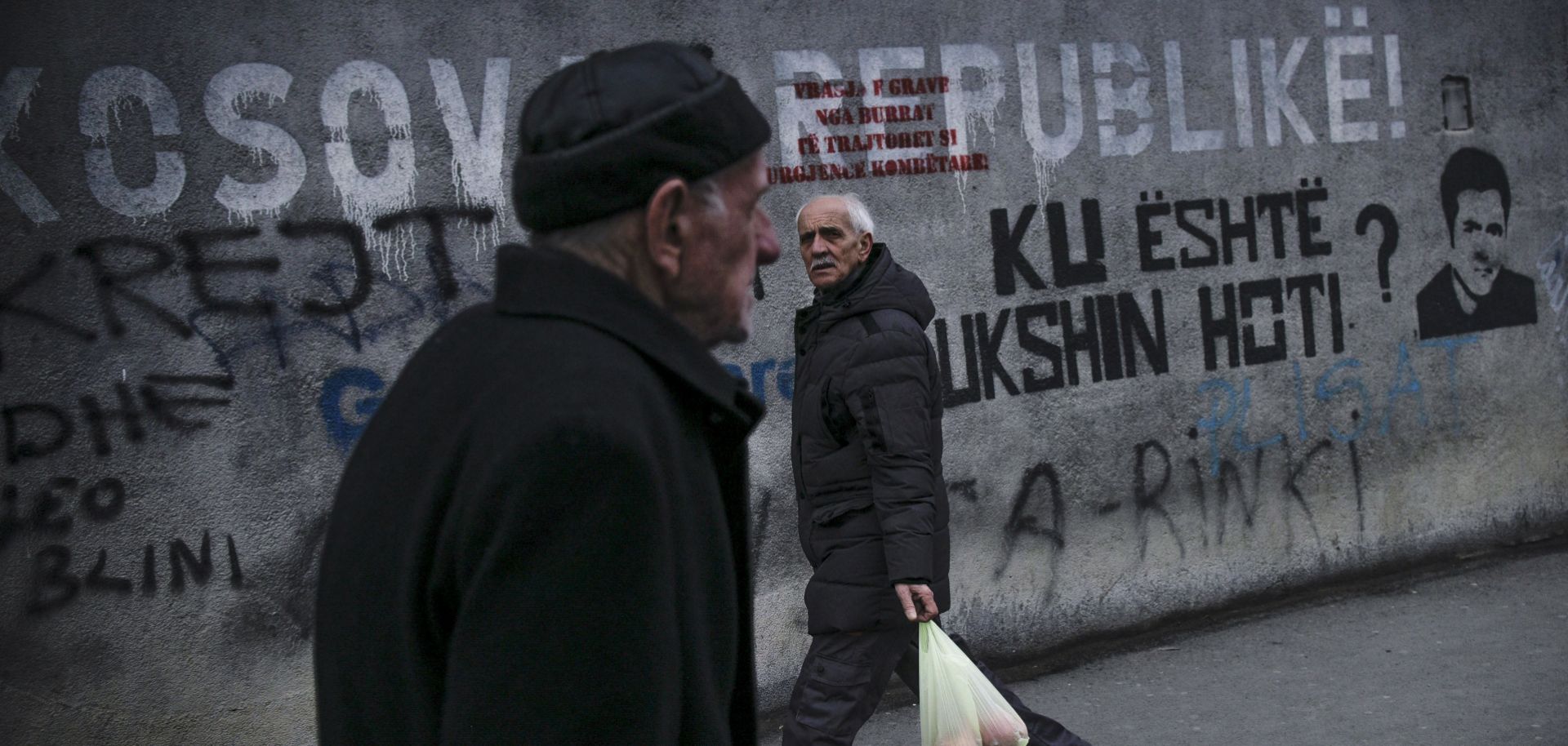
People walk past a mural reading ''Republic of Kosova'' in Pristina on Feb. 27, 2023, as the European Union hosts talks between the rival leaders of Kosovo and Serbia.
An EU-brokered normalization deal between Kosovo and Serbia marks a key first step in resolving a simmering conflict that has threatened to return the Balkans to war. But significant constraints remain toward a legally binding comprehensive agreement. Serbian President Aleksandar Vucic and Kosovar Prime Minister Albin Kurti agreed on Feb. 27 to an EU-sponsored deal to normalize the relations between the two Balkan neighbors during a meeting in Brussels. Under the 11-point plan, Serbia and Kosovo are required to ''develop normal, good-neighborly relations with each other on the basis of equal rights.'' Neither party has to formally recognize the other as a state, but both have to respect the territorial integrity of the other, refrain from any action that would renew tensions on the ground and exchange permanent missions in each other's capitals. While Serbia does not have to formally recognize Kosovo as an independent state, it will recognize Kosovo's official documents (such as passports, diplomas and license plates). Serbia is also expected to cease its attempts to obstruct Kosovo's membership in international organizations, a key demand from Pristina. Kosovo, in turn, pledged to ''ensure an appropriate level of self-management'' for the Serbian community living in its territory, which is Belgrade's main request. Further talks will be held in March to finalize the agreement and lay out an implementation plan.
- EU foreign policy chief Joseph Borrell, who hosted the meeting between Vucic and Kurti, said future talks will be aimed at finalizing an annex to the agreement that will lay out steps toward the implementation of the final deal, as well as previous commitments.
- Vucic revealed the next meeting would be held in North Macedonia on Mar. 18.
The EU-facilitated dialogue between Kosovo and Serbia has long struggled to yield significant results. But several factors, including Russia's invasion of Ukraine and renewed U.S. support, have accelerated normalization efforts over the past year. Kosovo unilaterally declared independence from Serbia in 2008, but Belgrade has since refused to recognize its statehood and still formally considers Kosovo part of its territory. Despite this, both countries remain engaged in EU-facilitated negotiations to normalize bilateral ties as a part of their push to join the European Union. But efforts to reach a comprehensive deal have hit significant roadblocks over the years, including enlargement fatigue within the bloc and lack of commitment to implementing past agreements by both Serbia and Kosovo. However, three main drivers are now giving new momentum to normalization efforts, beginning with Russia's invasion of Ukraine. The ongoing war and deterioration of Europe's security situation over the past year have increased Western leaders' focus on other frozen conflicts that could reignite and further destabilize the Continent — especially those that involve Russia, like Serbia and Kosovo's conflict. This has, in turn, seen the United States and the European Union intensify efforts to progress the dialogue process between Pristina and Belgrade. Secondly, the EU-facilitated dialogue is now enjoying full support from Washington, with the administration of U.S. President Joe Biden backing Brussels' plan (unlike the previous administration, which instead ran parallel U.S.-led talks between Kosovo and Serbia). And finally, while Vucic and Kurti are nationalist leaders who often inflame ethnic tensions for political gains, both also lead stable governments with a large parliamentary majority, which will help them push through contentious normalization deals in their respective constituencies despite little domestic support.
- Serbia applied to join the European Union in 2009 and became an official candidate country in 2012. While Brussels has not formally demanded that Serbia recognize Kosovo's independence, it has demanded that Belgrade ''normalize'' its relations with Pristina, which amounts to a de facto recognition. Serbia's negotiations with the European Union on its accession to the bloc remain ongoing, and there is not a formal end date.
- Serbia, backed by Russia and China, frequently lobbies to block Kosovo's diplomatic recognition from other states, as well as the country's accession to international bodies like the United Nations.
- Like Ukraine, Russia views the Balkans as falling within its sphere of influence. To keep the region from aligning with the West, Moscow has sought to exploit ethnic tensions and other divisions between Balkan countries, including Serbia and Kosovo. Over the summer, Russia spread disinformation that a ''war'' had broken out between Kosovo and Serbia after the former's decision to no longer recognize Serbian license plates triggered unrest along the Kosovo-Serbia border.
- In 2022, the European Union proposed its plan to de-escalate tensions between Serbia and Kosovo, which had escalated since September 2021 amid attempts by Kosovo to exert its sovereignty over its Serb-majority northern regions through various pieces of legislation. Tensions peaked at the end of last year, when Kosovo's ethnic Serbs erected multiple road blockades across the country and exchanged fire with local and EU police forces, prompting Serbia to increase its military presence at the border.
- The United Kingdom, Germany, France and Italy have all recently appointed special envoys to Kosovo and/or the Western Balkans, in addition to the EU special representative, highlighting renewed Western attention to the conflict. Prior to the Feb. 27 meeting in Brussels, German Chancellor Olaf Scholz, French President Emmanuel Macron and Italian Prime Minister Giorgia Meloni also sent a joint letter to both Vucic and Kurti urging them to sign the EU-brokered normalization deal.
Many unresolved disputes between Kosovo and Serbia still stand in the way of the two countries reaching a comprehensive and legally binding agreement, while a fragile situation on the ground still risks hindering diplomatic efforts. One of the main constraints to a comprehensive agreement is Kosovo's reluctance to create an Association of Serb-majority municipalities in the northern part of its territory; this was a key element of the normalization deal that Pristina agreed to in 2013 under EU auspices but never implemented over fears it could lead to the creation of a Serbia-influenced microstate within its borders that would make Kosovo a dysfunctional ethnically divided state. Another major obstacle is Serbia's strongly anti-Kosovo and increasingly eurosceptic population, which could make it hard for Vucic to justify a compromise with Pristina in exchange for Serbia's EU membership — especially as Belgrade's own negotiations to enter the bloc are moving slowly. Finally, a fragile social situation in northern Kosovo may complicate the dialogue process, with ethnic-based grievances on the ground potentially leading to new flare-ups in tensions that could hinder progress at the diplomatic level.
- The creation of a semi-autonomous Association of Serb-Majority Municipalities in Kosovo was a central part of the 2013 Brussels Agreement that set out the principles for the normalization of relations between Pristina and Belgrade. Kosovo's parliament ratified the agreement shortly thereafter, but the government never implemented it. Kosovo's Constitutional Court later ruled the association to be unconstitutional, arguing that it fundamentally violated the spirit of the country's multi-ethnic system.
- Numerous recent polls show that most Serbs favor their country partnering with Russia over the European Union and oppose joining the bloc. This eurosceptic shift in Serbian public opinion first became apparent in April 2022, when an Ipsos poll revealed that 44% of participants were against EU membership.
