
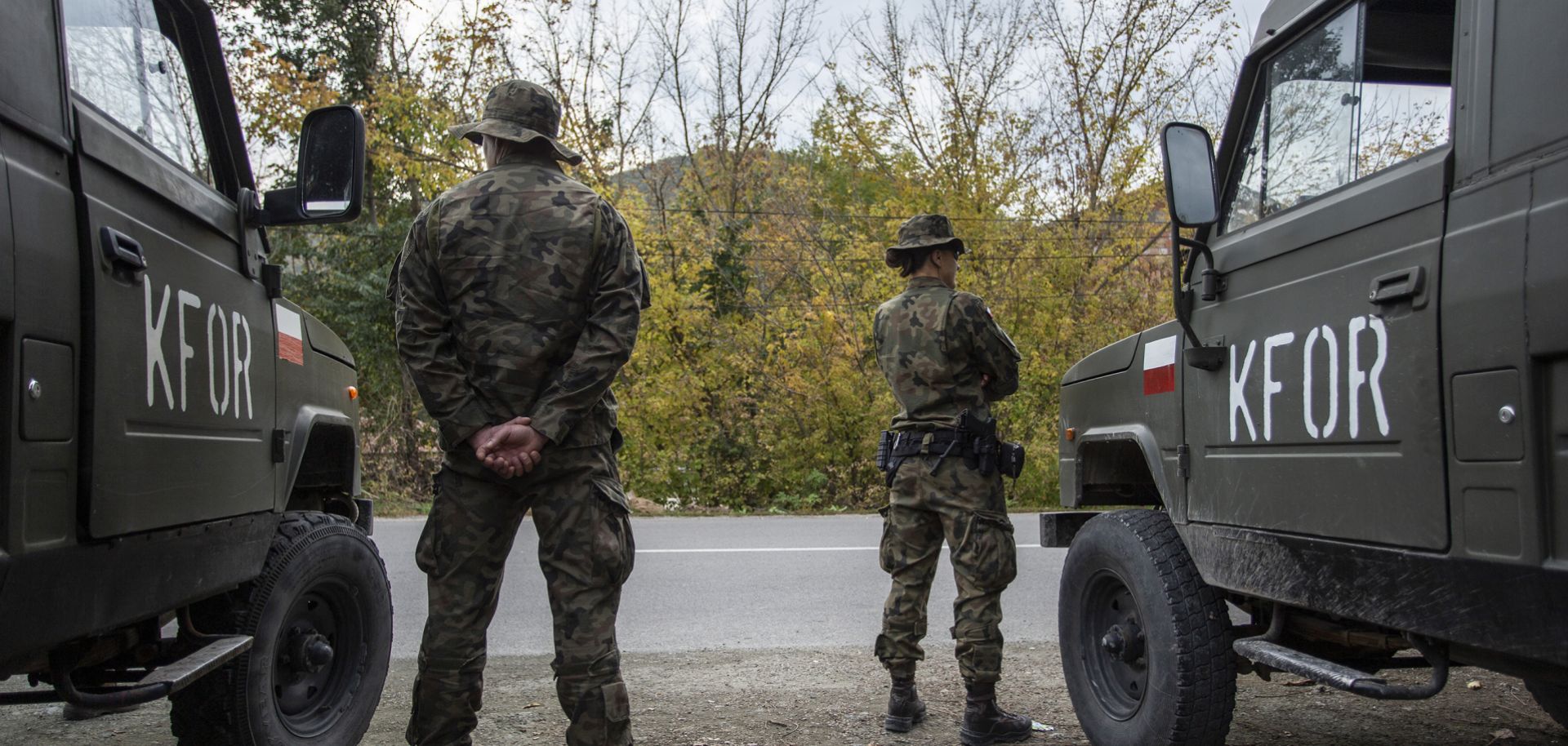
NATO soldiers from Poland patrol a road near the town of Zvecan in northern Kosovo on Oct. 12, 2022.
Despite recent border clashes and escalating threats between Serbia and Kosovo, a widespread outbreak of ethnic violence remains unlikely in north Kosovo due to the large presence of NATO peacekeepers in the region and Western diplomatic pressure. On Dec. 10-11, tensions flared in north Kosovo as hundreds of ethnic Serbs erected roadblocks using heavy machinery at two border crossings with Serbia, obstructing traffic in the Zvecan and Leposavic areas. The Serbs exchanged gunfire with the Kosovar police near the Brnjak checkpoint, while EULEX — the European Union mission tasked with patrolling northern Kosovo — confirmed that an unidentified individual also threw a stun grenade at one of its armored vehicles. Kosovar authorities said two Serbs were arrested for attacking police officers. But no injuries have been reported following the incidents, which marked the worst escalation of ethnic violence in Kosovo since 2004. In response to the latest flare-up, Serbian President Aleksandar Vucic called for a de-escalation, but also warned that Serbia's army was ready to intervene to protect the Serb minority in Kosovo. In addition, Vucic demanded that Kosovar police release all recently arrested Serbs, who he says ''are held on trumped up charges,'' and withdraw from the Serb-majority regions in the country's north. Following Vucic's statements, Kosovar Prime Minister Albin Kurti accused his Serbian counterpart of threatening military aggression and promising that, in such a scenario, Kosovo will ''defend itself, forcefully and decisively''. European and U.S. diplomats, meanwhile, have demanded an immediate end to the unrest.
- On Dec. 11, Vucic said he would request permission from KFOR — NATO's peacekeeping force in the region — to send 1,000 Serb troops into north Kosovo to protect its Serb minority, though he also acknowledged that such a request had little chance of succeeding.
The latest unrest comes despite recent progress in resolving Kosovo and Serbia's license plate registration dispute, demonstrating that fundamental disagreements between the two Balkan countries remain the main drivers of instability. In November, Serbia and Kosovo reached a last-minute deal brokered by the European Union to resolve a dispute over a controversial new law requiring Kosovo's Serbs to phase out old Serbia-issued car license plates in favor of new ones released by Pristina, whose sovereignty is not recognized by Belgrade. But since then, tensions between Kosovo's Serb minority and ethnic Albanian majority have continued to escalate in northern Kosovo — hindering efforts to normalize its ties with Serbia. The latest flashpoint emerged on Dec. 10, when demonstrators took to the streets to protest the arrest of a former Serb police officer, who had resigned in November (alongside hundreds of other state officials in Serb-majority northern Kosovo municipalities) in protest of the license plates requirement. In response, Pristina deployed police forces to the majority-Serb areas in the north, heightening tensions further.
- Kosovo unilaterally declared independence in 2008, but Serbia has since refused to recognize its statehood and still formally considers Kosovo part of its territory. Serbia regularly tries to block Kosovo's official diplomatic recognition, as well as its accession to international bodies such as the United Nations. But despite this, both countries remain formally engaged in EU-facilitated negotiations to normalize bilateral ties.
- Serbia has called for the establishment of a semi-autonomous community of ethnic Serbs, or an Association of Serb-Majority municipalities (ASM), that would operate under Kosovo's jurisdiction. Pristina has yet to concede to this request, despite it being part of the 2013 Brussels Agreement that set out the principles for the normalization of relations.
The current unrest in north Kosovo is likely to remain isolated despite rising tensions thanks to the presence of NATO's troops on the ground deterring Serbia and diplomatic pressure from the European Union on Kosovo to de-escalate. The latest incidents represent the most intense fighting between ethnic Serbs and Albanians that Kosovo has seen in nearly 20 years. However, the presence of around 4,000 NATO peacekeepers in the region will likely prevent the recent spate of scattered attacks from escalating into widespread ethnic violence. The NATO peacekeepers will also act as a powerful deterrent against Serbia sending any troops into Kosovo, preventing an escalation into an inter-state conflict between the two Balkan neighbors. Diplomatic pressure from the European Union will also motivate both sides to mitigate tensions. This is because Brussels has made resolving the territorial dispute a condition for either of the two Balkan states to achieve EU membership, which remains a major priority in both Belgrade and Pristina — the latter of which recently announced plans to formally submit an application to join the bloc. Thus, while further sporadic acts of lower-level street violence may reoccur, the broader EU-led dialogue to improve Kosovo and Serbia's relations will continue and likely eventually yield a compromise in which the two countries agree to at least somewhat normalize ties and lower tensions on the ground. In the short term, however, these negotiations will mostly focus on de-escalating the current unrest in north Kosovo instead of resolving the two countries' more fundamental disputes. In this sense, commitments from Brussels to move forward with Kosovo's upcoming application to join the EU might suffice in convincing Pristina to concede on Belgrade's main demands and significantly de-escalate the situation in north Kosovo.
- A plan recently proposed by Germany, France, and the European Union to solve the long-standing issues between Kosovo and Serbia calls for the two countries to develop ''good neighborly relations with each other based on equal rights'' — which would include the establishment of permanent representations in each other's capitals — bound by the common goal of joining the bloc.
- Besnik Bislimi, Kosovo's first deputy prime minister in charge of European integration, held an interview with Politico on Dec. 11 in which he confirmed that Pristina was planning to submit an official application to join the European Union ''in the coming days,'' eyeing 2030 as an initial target for the country's accession to the bloc. During the interview, Bislimi also noted that even a partial deal with Belgrade ''might be sufficient'' for Kosovo to move closer to Brussels and, potentially, fully normalize ties with Serbia down the line.
- Kosovo's northern Serb-majority municipalities of Northern Mitrovica, Zubin Potok, Zvecan and Leposavic were scheduled to hold local elections on Dec. 18 to replace the hundreds of Serb representatives that left their posts last month. But the vote has since been postponed to April 2023 due to the recent spike in tensions.
