
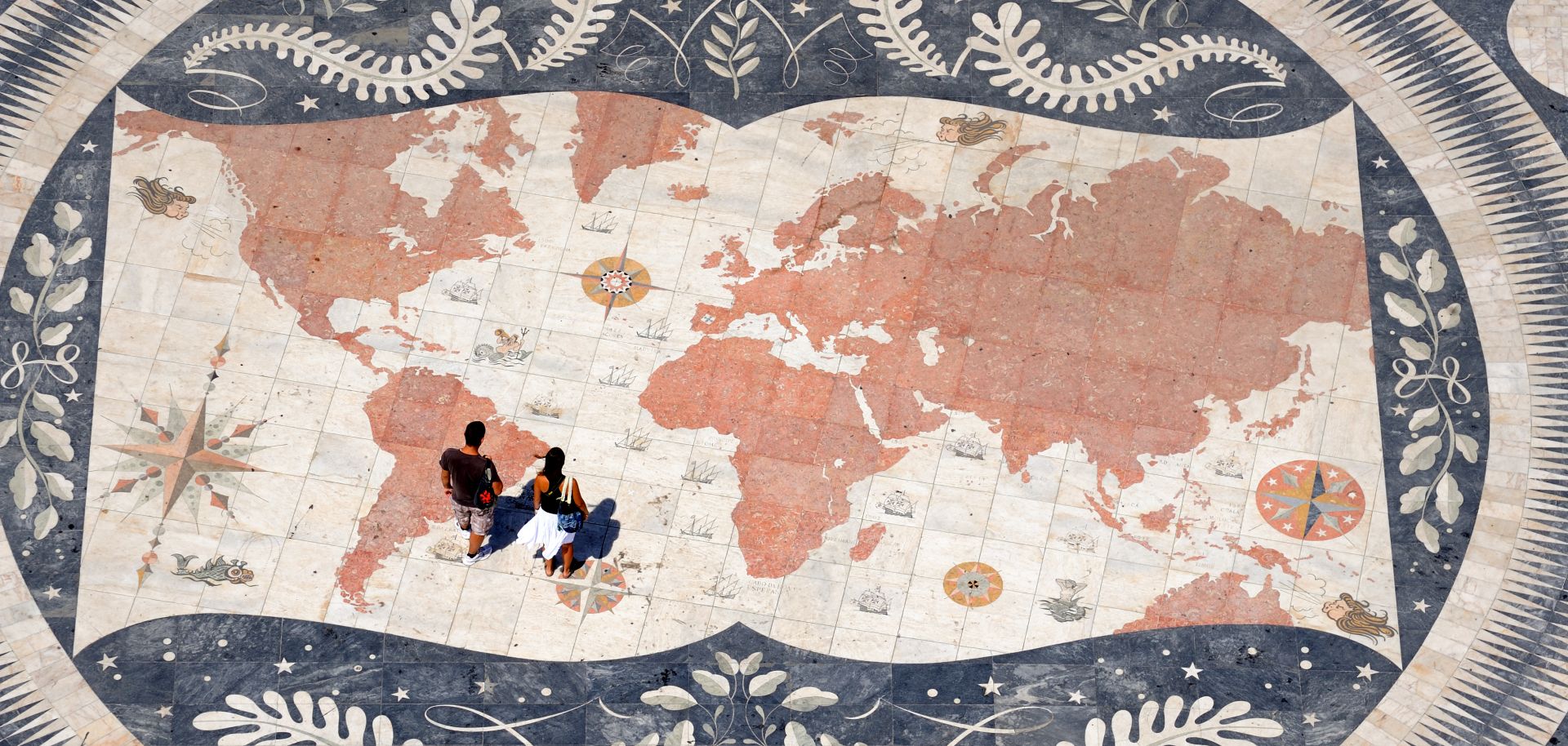
People stand over a world map at the Monument to the Discoveries in the Belem parish of Lisbon, Portugal, on Aug. 21, 2014.
How many countries are there in the world? It’s a seemingly simple question. But like so many things in geopolitics, the answer is, well...complicated.
The 1933 Montevideo Convention on the Rights and Duties of States listed four requirements for statehood: a permanent population, a defined territory, a government and the capacity to enter into relations with other states. The issue, however, is defining who meets that criteria, which varies depending on who you ask.
The Common Standards
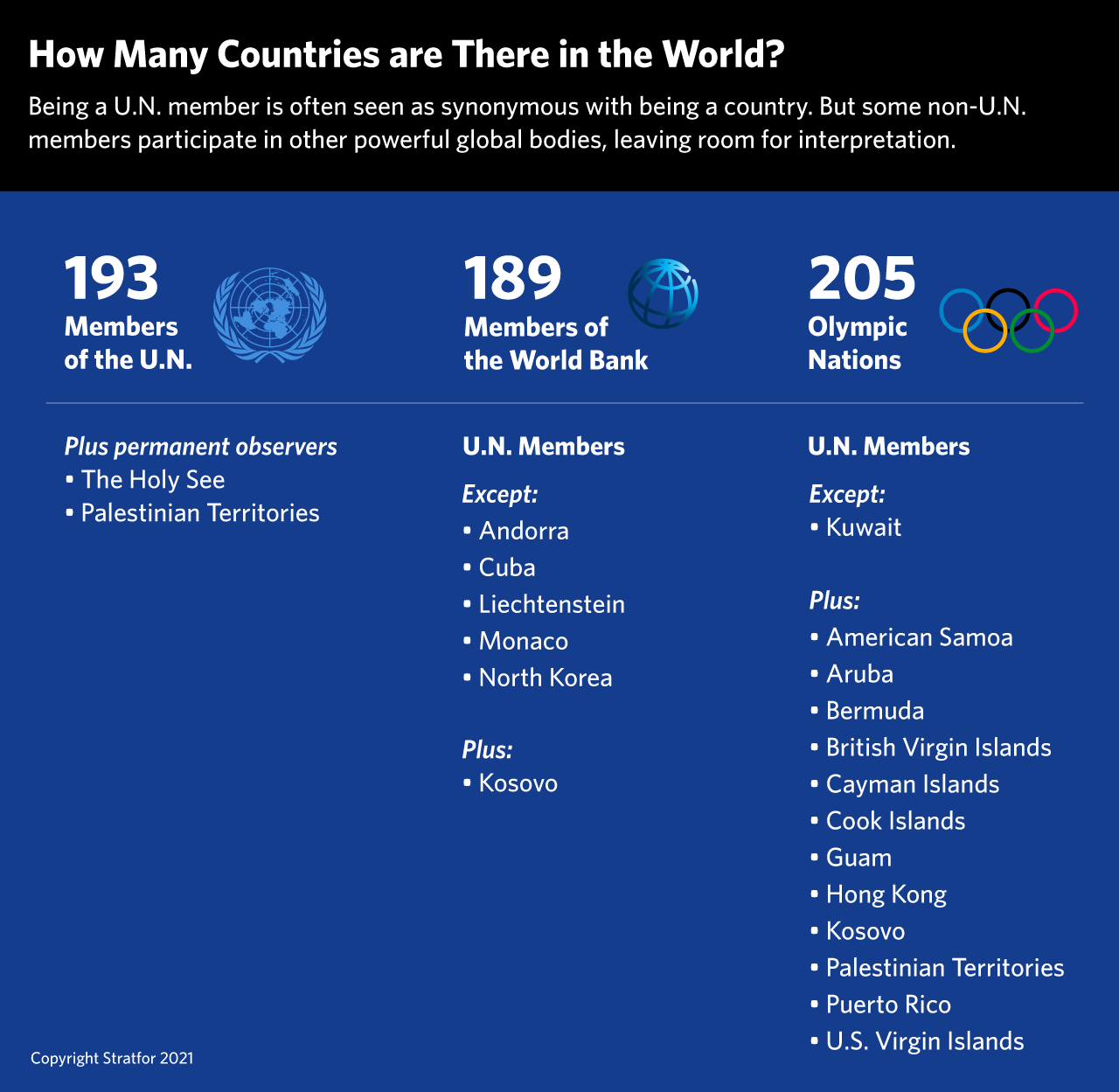
United Nations: Since the middle of the 20th century, U.N. membership has largely been seen as the standard for what makes a country a country. South Sudan was the last new member to join the United Nations in 2011, bringing the total number of U.N. member-states (and some would say recognized countries) to 193.
- Admission of new members is managed by the U.N. Secretary-General with approval from the General Assembly, based on whether the applicant is deemed a “peace-loving” state that is “able and willing to carry out the obligations contained in the [U.N.] Charter.”
- The United Nations also allows for non-member states to serve as “permanent observers” in the General Assembly, which currently includes The Holy See (commonly known as Vatican City) and the Palestinian territories.
The World Bank: Another large global body that we reference often in our work here at Stratfor is the World Bank. While World Bank and U.N. membership overlaps significantly, they have different missions and different criteria for admission. Andorra, Cuba, Liechtenstein, Monaco and North Korea are U.N. members but not World Bank members, whereas Kosovo is a World Bank member but not a U.N. member.
The Olympics: Of course, the International Olympic Committee (IOC) is another large international organization with a global membership and reach. The number of countries competing changes slightly each time the events are held, as well as between the summer and winter games. But for our purposes here, we’ll consider the 2016 Summer Olympics, which saw athletes from a whopping 205 countries compete. This included all 193 U.N. countries except Kuwait (whose athletes competed under the banner of Independent Olympic Athletes), along with 12 other countries.
The Gray Areas
It is worth noting that there are dozens of areas around the world that are not formal members of these international organizations, but meet the 1933 criteria for statehood listed above (i.e. permanent population, defined borders, a government and capacity for international relations). This includes:
- Self-proclaimed states like Liberland, located between Croatia and Serbia.
- Partially recognized states like Western Sahara and Northern Cyprus.
- Politically ambiguous states like Palestine and Taiwan, which are both recognized by some U.N. member states and not others.
- “De-facto” states like Donetsk and Luhansk in eastern Ukraine, which operate mostly independently but are still widely recognized as part of another nation-state. Other breakaway territories that fall into this category include Somaliland, Tibet, Abkhazia and Transnistria.
Our Definition
As for our analysts and experts here at Stratfor and RANE, we use our own standard for defining countries based on geopolitical realities. We started with the U.N. list (including the permanent observers), and then added Greenland, Hong Kong, Kosovo and Taiwan. All four of these added states operate independently in the world system, at least geopolitically, which we deemed distinct enough to warrant them being treated as individual actors. While bound to spark some controversy, our standard should not be construed as taking a side in the quest for independence in these disputed regions, but rather a necessary framework for us to do our jobs.
And that, there, is why there is no one “right” answer to how many countries there are in the world, as the definition of country will always depend on the context in which it’s being used. For us, it’s outlining the constraints and compulsions within states’ (sometimes disputed) borders. But for others, it may have nothing to do with geopolitics and everything to do with what is “home.” And neither one of us is more right than the other.
