
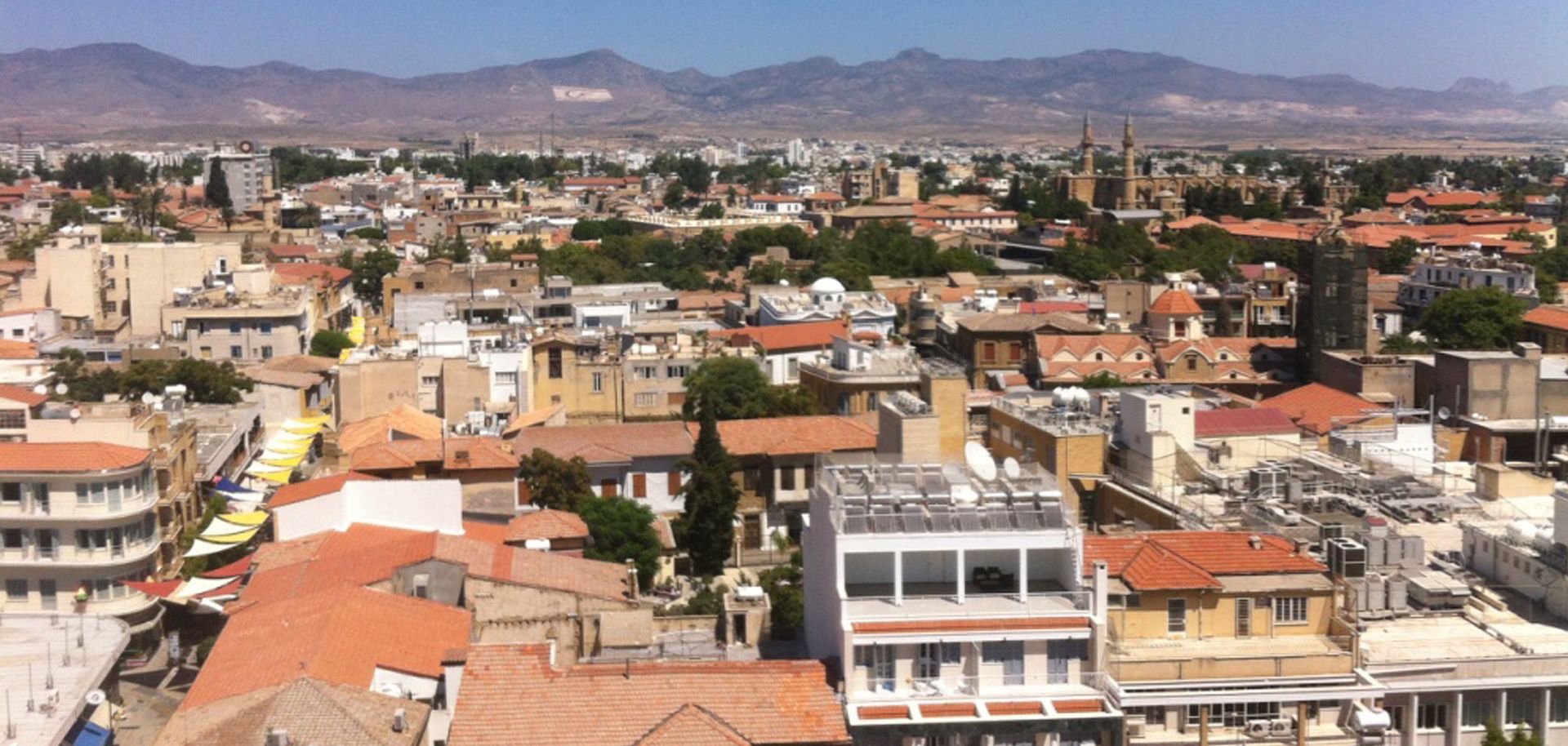
Sitting at an outdoor cafe one late Sunday afternoon in the old city of Nicosia, the capital of Cyprus, I had an unusual experience. Church bells began ringing at the Panagia Phaneromeni, an 18th-century Greek Orthodox church just across from the cafe. Then, about 20 minutes later, the nearby strains of an Islamic call to prayer filtered in. Gripped by its hauntingly beautiful tones, I left the cafe and followed the sound to try to get a better listen. Walking through the labyrinth of narrow streets that pervade Nicosia's old town, I suddenly came to a barricade in the street; I had quite literally hit a wall and could go no farther. I soon realized, the call to prayer came from the Selimiye Mosque, Nicosia's largest and most famous. And though it stood just a few hundred meters from the cafe where I had just been, Selimiye Mosque was in a separate part of Nicosia. In fact, it was in a different country entirely, the Turkish Republic of Northern Cyprus.
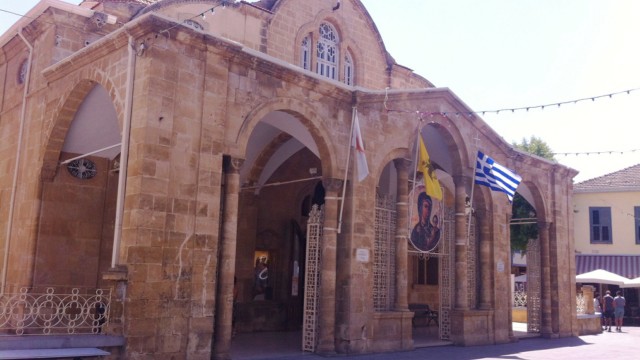
The Greek Orthodox Panagia Phaneromeni Church stands only a few hundred meters, but a world away, from the Nicosia's largest mosque.
Cyprus has been split since the Cypriot conflict of 1974, and the cafe where I had been happened to be near the dividing line between the two political entities. Only Turkey officially recognizes the Turkish Republic of Northern Cyprus, which has enjoyed de facto independence from the Republic of Cyprus for over 40 years. But the origins of the rift, and of Cyprus's modern culture, reach much further back in history.
The Beginnings of a Conflict
Lying near the shores of modern-day Turkey, Syria and Lebanon in the far eastern Mediterranean Sea, Cyprus is at the crossroads of Europe, Asia and Africa. Its strategic location has subjected the island to waves of invasion and influence by foreign powers for thousands of years, beginning with the ancient Greeks. The Persians followed, then the Romans, Byzantines, French and Venetians. At the end of the 16th century, the Ottomans took control of Cyprus, ceding it to the British three centuries later.
By the time Cyprus gained its independence in 1960, it embodied a mix of European and Middle Eastern influences, a characteristic it retained as an autonomous country. The newly independent Cyprus inherited a culturally and demographically diverse population, made up mainly of Greek Cypriots, who account for 77 percent of the populace, and Turkish Cypriots, who constitute 18 percent. Soon after the country's independence, violence erupted between those groups, with Greece and Turkey each backing their respective ethnic cohorts. When a Greek military junta staged a coup against the Cypriot government in July 1974 in an attempt to unite the island with Greece, Turkey invaded the northern part of Cyprus. The result was a military conflict that left thousands of people dead or wounded and displaced more than 160,000 others.
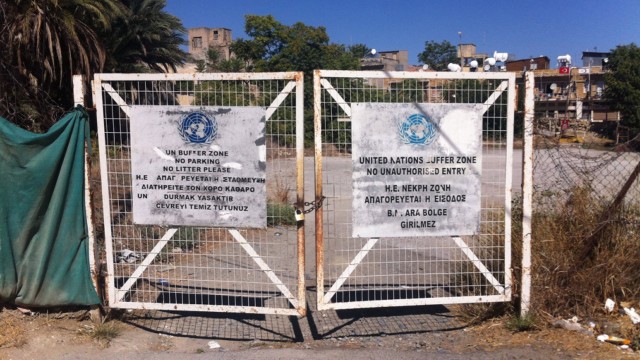
The United Nations Green Line divides the island's Turkish and Greek Cypriot populations.
In August 1974, a cease-fire agreement was signed, ending the conflict. But by then, Turkey had taken control of 36 percent of the island's territory, the portion of the country that eventually became the Turkish Republic of Northern Cyprus, formally established in 1983. A U.N.-administered buffer zone known as the Green Line separates this territory from the Republic of Cyprus to the south, dividing Cyprus's capital city — as I soon discovered — into two distinct halves.
Reopening the Border
In the 40 years since the country's partitioning, Greek and Turkish Cypriot leaders have made numerous attempts to negotiate a reunification, but an agreement has remained elusive. A litany of issues, including disagreements between the two sides over power-sharing structures, property restitution and compensation to people displaced by the war, have hamstrung negotiations time and again. The various interests of the other countries with a stake in Cyprus — Greece, Turkey and the United Kingdom, which keeps two sovereign military bases on the southern part of the island — further complicate matters.
Nevertheless, some progress has been made in bridging the divide. In 2003, for instance, travel restrictions across the Green Line were lifted and a border crossing opened in Nicosia, enabling Cypriots to move freely between the Republic of Cyprus and Northern Cyprus for the first time in 30 years. Within two weeks of its opening, more than 200,000 people — a quarter of Cyprus's population at the time — traversed the Green Line without incident, quelling fears that violence would resurface in the absence of border restrictions. The Green Line remains open, and six more crossings have opened across the island. When I reached the impasse in my quest to find the source of the enchanting call to prayer, I was not held up for long. I simply walked a few blocks to Ledra Street — which became the main pedestrian crossing after a barricade there was lifted in 2008 — presented my passport to Greek Cypriot and then Turkish Cypriot officials, and entered Northern Cyprus. In a matter of minutes, I made it to the Selimiye Mosque.
A Cultural Crossroads
It struck me then that Cyprus represents the epitome of a geopolitical borderland. Over thousands of years, European and Middle Eastern powers have collided on the island, eager to make their mark on its territory. The clash of cultures is manifest on either side of the Green Line in Nicosia's architecture, from the Venetian-built walls that surround the city to the mosques and cathedrals that tower over its winding streets. In fact, the Selimiye Mosque is of Gothic design; the French Lusignan dynasty originally built it as a Roman Catholic church in the 13th century, and the Ottomans adapted it 300 years later.
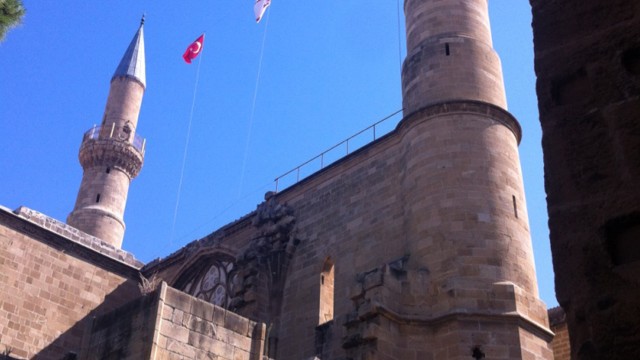
The Gothic architectural features of the Selimiye Mosque, a converted Catholic cathedral, attest to the melange of cultural influences that define Cyprus.
Nicosia bears other marks of Cyprus' dueling identities as well. The Republic of Cyprus joined the European Union in 2004 and the eurozone a few years later, but because the bloc does not recognize Northern Cyprus, its laws and currency do not apply there. So while EU flags fly alongside Cypriot (and often Greek) flags throughout south Nicosia, where the euro reigns, Turkish flags and the Turkish lira predominate in the capital's northern area.
But its position as a cultural confluence also exposes the island to the contemporary trends happening elsewhere in the world. The Republic of Cyprus' strong ties to Greece's financial system — and its status as an offshore haven, particularly for Russian interests — forced it into a painful "bail-in" package from the European Union and International Monetary Fund in 2013. Like much of the eurozone, the country has not shaken sluggish economic growth and has a double-digit unemployment rate. Cyprus has also not been immune to the European migrant crisis. Although it is not on the main migration route through Greece and the Balkans, its proximity to Turkey and Syria makes it susceptible to refugee flows from the Middle East. The Cypriot government's strict asylum policies have kept most migrants from settling there, but even so, nearly 3,000 refugees entered the country last year.
More than half a century into its independence, Cyprus is still at the whim of the foreign influences that surround it. Whether through economic pressures from the east and west or through the lingering divisions between its north and south, Cyprus must contend with challenges from all directions. But as my journey across the once-closed Green Line proved, its divisions can narrow in time.
