
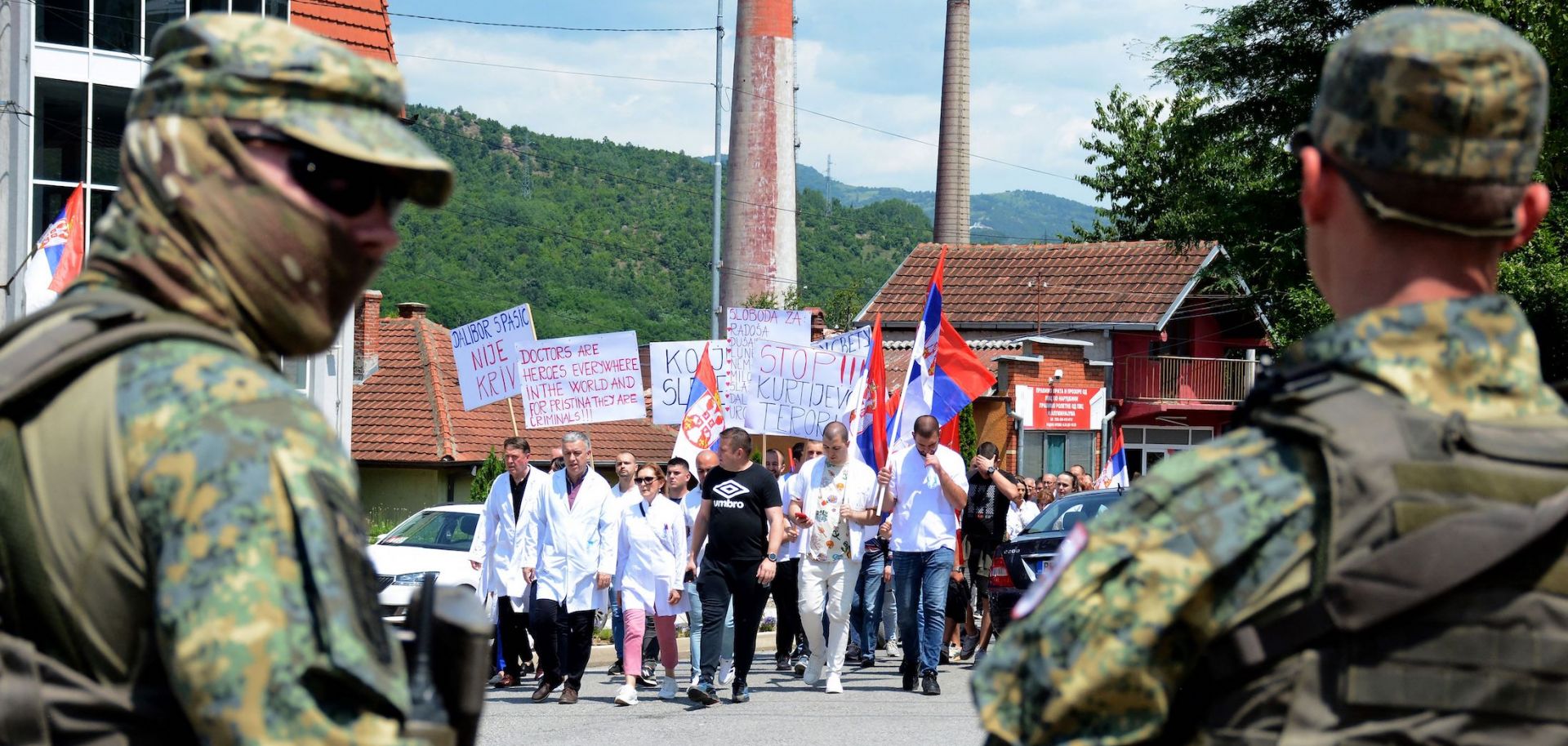
Russian influence operations are fomenting EU accession fatigue and anti-Western narratives in Serbia and raising risks of violence in Kosovo, further disrupting the normalization process between Belgrade and Pristina, while fanning ethnic tensions in the wider Balkans region. Against the backdrop of ongoing EU accession negotiations, including normalization talks between Serbia and Kosovo, and following outbreaks of violence in northern Kosovo in September, Russian actors will likely pursue an opportunity to further inflame tensions to distract from Ukraine and contribute to destabilization risks in the Balkans. Russian influence operations in Serbia largely consist of narratives aimed at fueling ethnic and religious tensions between the country and its Balkan neighbors, discrediting the European Union and West more broadly, and promoting Russian views on key issues like the Ukraine war. Particularly in recent months, many popular narratives from Russian sources involve Serbia's claim over Kosovo, whose independence it has not recognized despite pressure from the European Union and the United States. Russian propaganda in Serbia and northern Kosovo also promotes messages portraying Ukraine as being responsible for starting the war and spreading disinformation regarding alleged war crimes committed by Ukraine during the conflict. Other common tactics in covering the Ukraine war include using fabricated or footage taken out of context, along with terminology such as ''special operation'' or ''forced mobilization'' to refer to the war — terms in line with the language used by the Kremlin to describe the war, as well as other Russian sources publishing content on Russia's role in Ukraine. Russian influence operations also seek to solidify a wedge between Serbia and the West, promote anti-Western and NATO sentiment, and highlight historical events (such as the 1999 NATO bombing of Serbia and Serb forces in Kosovo) to advance simultaneously pro-Russian and anti-Western perceptions.
- In 2015, Russian state media outlet Sputnik News established a Serbian hub, and in late 2022, Russian state-funded news agency Russia Today (RT) also established a Serbian language outlet. According to an Oct. 5 analysis from DailyBeast, which cites data from Meta-owned public insights tool CrowdTangle, RT and Sputnik Serbia received the most interactions on Facebook from early September through early October.
- One article from Sputnik Serbia in late September used the headline, ''The West's action has never been more morbid: They do not know that the day of mourning for the Serbs lasts until freedom comes to Kosovo,'' promoting long-standing nationalist sentiments and claiming that ''evil reigns in Kosovo.'' Another article from Sputnik Serbia sought to exploit Serbia-Kosovo tensions when highlighting ongoing issues in Kosovo by blaming the Kosovo government for recent incidents of violence in the Serb-populated north, saying the violence was ''solely the fault of [Kosovar Prime Minister] Aljbin Kurti,'' according to an Oct. 5 article from DailyBeast.
- A September 2022 poll conducted by Open Societies Foundation, along with Datapraxis and YouGov, found that just 12% of Serbs believed it was necessary for Russia to withdraw from Ukraine to achieve peace, while 63% said they believed the West was to blame for the war.
- Russia's disinformation campaign in Serbia pushes headlines such as ''Ukraine started the war against Russia,'' or ''Ukrainian troops shell maternity hospital.''
Russia's influence operations are taking place amid rising tensions between Serbia and Kosovo that are undermining the former's EU accession process. Between late September and early October, Serbia deployed troops along the Kosovo border after Serb militants attacked Kosovar police forces in heavily Serb-populated northern Kosovo, threatening a broader outbreak of violence between the two countries. Serbian President Aleksander Vucic withdrew some troops on Sept. 30, with more troop reductions occurring on Oct. 9. Though a full-scale Serbian invasion was unlikely due to the presence of NATO peacekeepers in Kosovo, the incident nonetheless represented further backsliding away from recent progress toward compromise in Serbia-Kosovo negotiations after Vucic and Kurti approved an EU-brokered plan toward normalization in March, though the talks ultimately came to a stalemate. Moreover, further ethnically-motivated episodes of violence in Kosovo could deteriorate security in the region, with Russian influence operations stoking the flames and raising risks of violent outbreaks in the future. There is also an elevated risk of violence between Kosovar Serbs and ethnic Albanians in Kosovo following Serb boycotts on Kosovo local elections on Nov. 3. This risk may increase if Kosovo officials do not implement an agreement to form an ''association of Serb autonomous municipalities'' — a priority for Belgrade throughout normalization talks and a key grievance for ethnic-Serbs living in northern Kosovo — which could prompt further boycotts and lead to renewed demonstrations and violence in northern Kosovo.
- EU accession would likely mean that Serbia must recognize Kosovo's independence, or at least resolve outstanding territorial disputes — an unlikely feat given ongoing tensions between the two countries and the lack of significant progress on any kind of normalization effort. In an Oct. 27 joint statement, the leaders of France, Germany and Italy called on Serbia to ''deliver on de facto recognition'' of Kosovo.
- Since becoming an EU candidate state in 2012, Serbia has made little progress toward joining the bloc, leading many to question the country's ability to adopt structural reforms demanded by the European Union before an eventual accession. For Serbia, advancing its EU membership bid would require drastic political measures for the country, including cutting ties with Russia, despite Belgrade signing a three-year gas deal with Moscow in May 2022. Additionally, while condemning Russia's invasion of Ukraine, Serbia did not join Western sanctions against Moscow, demonstrating a lack of political will to stifle pro-Russian narratives.
- The dominant Serb party in Kosovo, Srpska Lista, which the Serbian government supports, boycotted local Kosovar elections on Nov. 3, hoping to convey that the Serbian population would not accept the elected leadership.
Russia seeks to exploit ethnic and religious tensions to undermine normalization between Serbia and Kosovo and destabilize the region, hoping to spread the European Union thin with another crisis in Europe. To solidify support in Serbia, Russia has sought to position itself as the primary champion of the Serbian cause by peddling narratives that highlight Moscow's efforts to support Serbia's claims over Kosovo on the international stage. While Russia portrays itself as the defender of all Slavic peoples, Moscow largely promotes these narratives to advance its own interests, hoping in part to use Serbia's alleged claim over Kosovo as support for its own territorial pursuits. Keeping Serbia and Kosovo at odds also helps delay the two countries' normalization, which would reduce Serbia's reliance on Russian support internationally and prompt the country to lean more toward the European Union. Additionally, Russian propaganda is designed to fuel bloody flare-ups in the Balkans and fears of a broader regional outbreak of violence, in the hopes of distracting the European Union from Russia's pursuits in Ukraine. A crisis in the Balkans would contribute to mounting problems for the European Union as it tries to juggle multiple conflicts in Europe, simultaneously taking some of the focus away from Ukraine and spreading EU leadership thin.
- Open Societies Foundation's September 2022 poll also found that 51% of Serbs believe Russia to be Serbia's most important international partner, despite the fact that EU diplomatic initiatives and financial aid far outpace Russia's. Meanwhile, 66% said Russia was Serbia's ''greatest friend.''
- In a Nov. 15 interview with African media, Ukrainian President Volodymyr Zelensky urged governments to ''pay attention to the Balkans,'' and said Ukraine had information that Russia was aiming to exploit long-standing disputes there. Zelensky noted a new Balkans crisis would serve to distract the rest of the world from Ukraine just as the Israel-Hamas war has done.
In northern Kosovo, Russia's influence efforts risk engulfing the region in violence and unrest by inflaming already high ethnic tensions. Compared with those in Serbia, Russian efforts in northern Kosovo are more concentrated. They also seek to exploit political tensions to a greater extent, taking advantage of a vulnerable population that holds higher stakes for the prospect of an eventual Serbian recognition of Kosovo independence. Additionally, Russian backing of the Serbian claim on Kosovo may hold more salience among Kosovar Serbs who feel alienated from Serb leadership and ostracized under an ethnically Albanian government and majority population. Though Russia itself is not planting these prevailing tensions or prospects of violence, Russian actors are capitalizing on an already fragile situation in hopes of inflaming existing security concerns. Additional outbreaks of violence would push Serbia and Kosovo even further away from stagnant normalization efforts and instead contribute to an increased likelihood of escalation. Escalated tensions may prompt Vucic to restore a buildup of Serbian troops along the border, though the presence of NATO and EU troops, which would likely be bolstered amid signs of violence, would still mitigate the threat of a full-scale invasion and broader conflict. However, in the aftermath of boycotts on local elections — and especially without the implementation of an association of Serb autonomous municipalities — there are increased risks of riots and demonstrations that could turn violent, as well as increased risks of more isolated incidents such as attacks on individuals.
In Serbia, Russian influence operations will also continue to spread anti-Western sentiment in the lead-up to snap elections in December, consolidating nationalistic and irredentist sentiments in the country. Serbia's snap parliamentary elections on Dec. 17 will provide Russia an opportunity to ramp up influence operations aimed at bolstering support for the current Serbian leadership, which is largely aligned with Russian interests. An uptick in Russian disinformation and propaganda in the lead-up to the ballot could help to keep the ruling Serbian Progressive Party (SNS) in power, and result in the election of SNS lawmakers who are more inclined to pursue policies favorable to Russian interests. Serbia's slow progress in its EU accession process has already led to pervasive Euroscepticism among the public, which Russia will exploit in an effort to thwart Belgrade's political will to fully undertake EU reform measures. Beyond fatigue, anti-Western and -EU narratives may help to further divide Serbs on the issue of EU accession, with some believing that the reforms are being imposed on the country by external actors rather than undertaken in their country's best interests. Because EU accession requires significant political, economic and institutional reforms, these narratives will attempt to contribute to additional resistance in political decision-making and contribute to delays in any significant progress. Russia likely sees EU accession as detrimental to its interests in the long run because Serbian progress on EU candidacy reforms would entail a loss of Russian influence in the region and dim prospects of those diplomatic, economic and political ties ever being restored to previous levels. Furthermore, Moscow likely doubts that a pro-Russian Serbia within the European Union would outweigh Russia's loss of influence over Serbia and the region. Serbia as an EU member in its current state could help Russia promote its interests from inside the bloc, serving as a Slavic, traditionally pro-Russian member with the power to veto EU decisions deemed unfavorable to Russia. However, Serbia would need to be drastically transformed before its membership prospects are viable. The country has a long way to go in implementing EU-accession reforms, meaning an EU-member Serbia would likely look a lot different than current-day Serbia, with Belgrade deviating more significantly from Moscow's sphere of influence. If Serbia became more aligned with the West because of accession (and the reform process), it would keep Russia at arm's length from the most important country in its strategy to maintain influence in the region.
- Following recent flare-ups with Kosovo, Serbian President Aleksander Vucic dissolved parliament on Nov. 1 and called for snap elections to be held on Dec. 17. The move allowed Vucic to delay decision-making on the Kosovo issue and buy time to cement his authority following protests in the first half of 2023.
- On Nov. 16, the U.S. Treasury Department introduced a new round of sanctions aimed at combating Russian influence in the Western Balkans, specifying that the sanctions were ''designed to contain Russian efforts to prevent the region's integration into international institutions.''
