
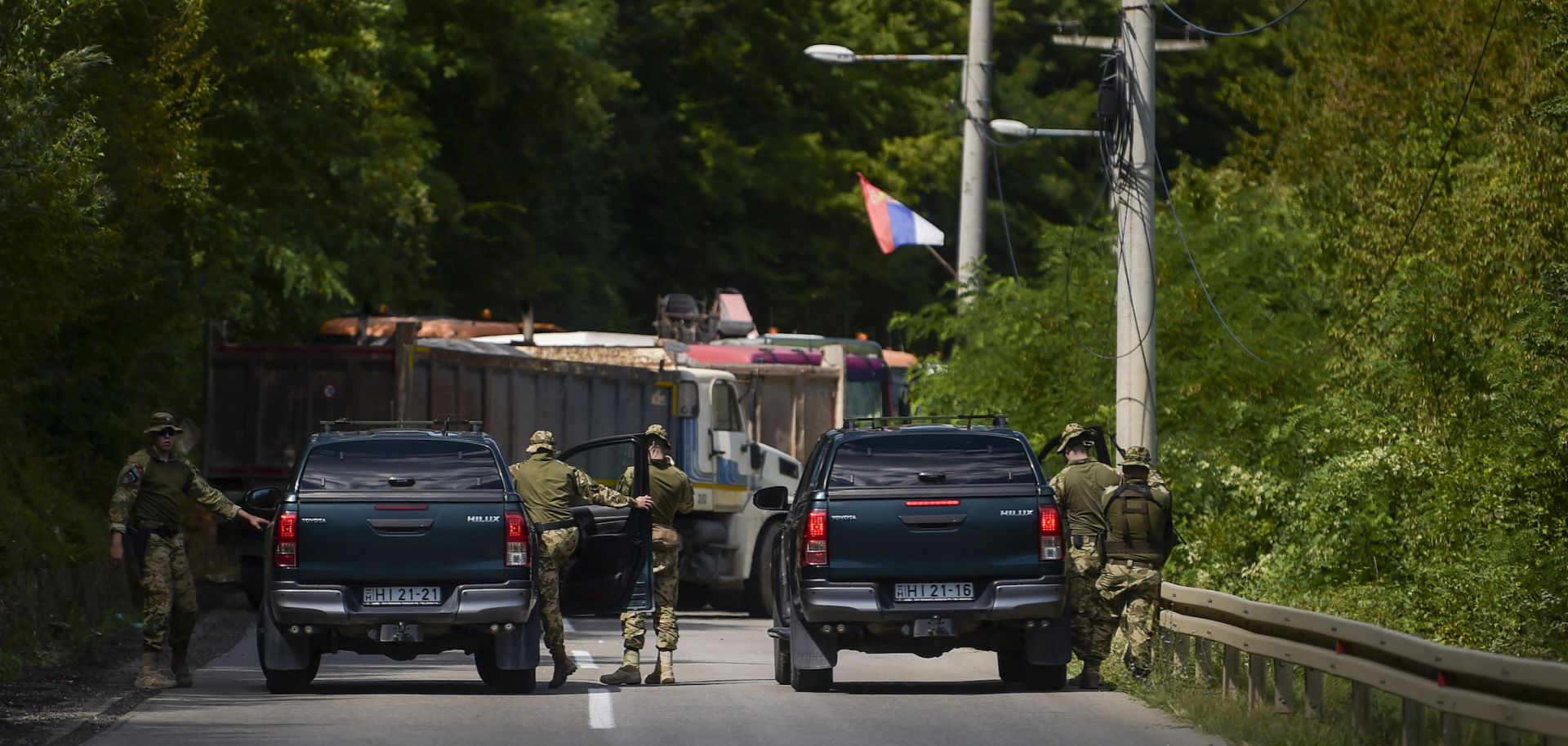
Serbia's recent military deployment along the border with Kosovo does not presage an imminent invasion, but the two countries' latest flare-up in tensions will undermine an EU-brokered normalization plan and raises the risk of further violent incidents in northern Kosovo in the coming weeks. On Oct. 3, White House National Security Council spokesperson John Kirby confirmed that the United States had seen Serbian forces start to pull back from the border with Kosovo. The statement comes after Kirby on Sept. 29 revealed an ''unprecedented'' deployment of Serbian troops along the border and announced that NATO would be deploying more peacekeepers in northern Kosovo to deter a possible invasion. In the intervening days, following U.S. and EU pressure, Serbian officials stated that they had withdrawn some of the troops their country had stationed near the border, taking the overall number from 8,350 down to 4,500 forces. In an Oct. 2 interview with the Financial Times, Serbian President Aleksandar Vucic said that Belgrade does not seek a war with Kosovo, and his army chief General Milan Mojsilovic confirmed the country had not ''raised the level of readiness.''
- These developments came shortly after a deadly incident in north Kosovo, which is home to roughly 50,000 ethnic Serbs who largely do not recognize Pristina's authority. On Sept. 24, about 30 well-armed ethnic Serb militants attacked Kosovo's police forces in the village of Banjska, near the ethnically divided city of Mitrovica, leaving three attackers and one officer dead following a shootout in a local Serbian Orthodox monastery. Kosovar authorities said the subsequent investigation has found convincing evidence that suggests Serbia and Russia were involved in the attack.
The recent escalation in tensions comes as negotiations between Kosovo and Serbia to normalize their relations have stalled, seemingly over Pristina's reluctance to create an association of autonomous Serb municipalities in northern Kosovo. The European Union and the United States have long been trying to persuade Kosovo and Serbia to bury the hatchet and normalize relations after the former unilaterally declared independence from the latter in 2008. Despite Serbia still not recognizing Kosovo's sovereignty, the two countries have been engaged in a long and complex EU-sponsored normalization process as part of their push to join the bloc. Negotiations had found new momentum over the past year, with Brussels and Washington pressing the two sides to strike a deal amid escalating ethnic tensions in the Serb-majority north of Kosovo that threatened to further undermine Europe's security situation following Russia's February 2022 invasion of Ukraine. Signs of a compromise finally emerged in March 2023, when Vucic and Kosovar Prime Minister Albin Kurti approved (though did not sign) an EU-brokered plan toward normalization. However, Belgrade's persistent refusal to recognize Kosovo's sovereignty and Pristina's reluctance to implement an EU-brokered 2013 deal to create an Association of Serb-Majority Municipalities in northern Kosovo brought normalization talks to a stalemate.
- Under the EU plan, Serbia would not be required to formally recognize Kosovo as an independent state, but it would have to recognize official Kosovar documents (such as passports, diplomas and license plates) and stop attempting to obstruct its membership in international organizations. Kosovo, in turn, would have to establish an association of Serb-majority municipalities, which is Belgrade's main request.
If Serbia was directly involved, the recent attack in Banjska may be an attempt by Belgrade to undermine Kosovo's sovereignty while maintaining plausible deniability and remaining engaged with the West. Kosovar authorities accused Belgrade of orchestrating the ambush in Banjska, with Prime Minister Kurti saying that the vast trove of weapons and ammunition found at the scene had been manufactured in Serbia and could not be bought on the open market. If, despite Vucic's denial, Belgrade was indeed somehow involved in the attack, the move could be part of a larger strategy to spark a conflict in northern Kosovo while maintaining plausible deniability. For Serbia, such a tactic could serve two purposes: 1) create a pretext for another request to NATO to allow Serbian troops to intervene in northern Kosovo ostensibly aimed at protecting ethnic Serbs, or 2) force international peacekeepers in Kosovo to boost their presence and reassume primary security responsibilities, effectively sidelining Pristina. Either of these scenarios would further undermine Kosovo's sovereignty and enable Belgrade to maintain its engagement with the West without having to address the politically painful issue of recognizing Kosovo. In this case, any EU settlement plan would be significantly complicated, yet not entirely dead in the water. Belgrade could also use the new status quo to extract concessions at the negotiating table, such as finally forcing Pristina to concede local autonomies to Serbs in North Kosovo, while minimizing the extent to which it will de-facto recognize Kosovo's statehood.
- In a statement issued to the Financial Times on Oct. 1, Vucic denied any involvement in the Sept. 24 attack and stated that he has no desire to invade Kosovo, arguing an escalation of the conflict would be counter-productive to Belgrade's own aspirations to join the European Union.
- NATO, which already has 4,500 troops in Kosovo, said in a statement on Sept. 29 it had ''authorized additional forces to address the current situation.'' The United Kingdom then announced on Oct. 1 that it was also deploying around 600 troops in Kosovo to reinforce NATO's Kosovo Force (KFOR). Separately, the European Union has around 450 troops in Kosovo, acting as the second security responder after Kosovo's regular police forces.
- Following a flare-up in tensions in north Kosovo in December 2022, Vucic asked NATO for permission to deploy Serbian troops in the region to help in the peacekeeping mission, but he was rebuffed. Following the latest incident in Banjska, he also asked on Oct. 3 that KFOR forces take over as the sole national law enforcement agency in the north of Kosovo.
By contrast, if Belgrade had no direct involvement in the incident, it would point to even greater instability in northern Kosovo and a smaller capacity from the West to contain violence in the region. If the Sept. 24 attack did indeed take place without Belgrade's direction, consent or at least knowledge (which appears unlikely given the scale of the attack and the strong presence of Serbian intelligence services in northern Kosovo), it would indicate that Kosovo's Serbs are now acting on their own initiative, free from Belgrade's control. While further grassroots violence would be lower in scale than a Serbia-backed armed intervention, a scenario in which ethnic Serbs in northern Kosovo increasingly acted independently would complicate EU-brokered negotiations by calling into question the capacity of Serbia (or Kosovo) to uphold any deal, as local actors could play spoiler.
- Milan Radoicic, a Kosovo Serb politician, admitted to organizing the Sept. 24 attack in Banjska, claiming full responsibility and denying having had any contact with the Serbian government concerning the operation. Serbian authorities arrested Radoicic on Oct. 3, accusing him of illegal manufacturing and trafficking of firearms to Kosovo after he admitted involvement in the attack, only to release him on Oct. 4.
While a Serbian invasion remains unlikely, the latest attack will undermine progress toward normalization and increase the risk of further attacks that could dramatically deteriorate the security situation. Despite the recent flare in tensions, the reduction in the number of Serbian troops amassed at the border with Kosovo indicates a de-escalation in the immediate crisis between the two countries, confirming that a full-out invasion and a return to widespread armed conflict is unlikely for now. This is thanks to the presence of NATO (and EU) peacekeepers in Kosovo, which are a powerful deterrent for Belgrade against any attack that would risk triggering a military confrontation with the West. However, the situation remains extremely tense between the two countries and increasingly volatile in Kosovo's Serb-majority north. This means that any hopes for normalization are likely off the table for the foreseeable future as the West's priority will be to contain the risk of preventing more ethnic violence and unrest. Against this backdrop, the situation in northern Kosovo could quickly deteriorate if the recent Banjska attack proves not to be an isolated incident but rather part of a broader destabilization campaign (either from Serbia or from local Serbs acting independently from Belgrade). Such a campaign could see similar attacks launched against Kosovo's regular police forces in other parts of the region where local ethnic Serbs view them as occupiers, significantly increasing escalatory risks. In a low-likelihood but high-impact scenario, a serious uptick in violence in northern Kosovo that harms ethnic Serbs could reduce Belgrade's constraints on military action, which may ultimately push Serbia to intervene militarily despite the presence of international peacekeepers.
- The risk of violent unrest will increase in the coming weeks as Kosovo prepares to hold new administrative elections on Nov. 3 in the four Serb-majority municipalities that have seen protests and violent riots in recent months. If Kurti remains reluctant to implement the promised association of autonomous municipalities in the area, this will likely prompt further boycotts from the Serbian population that could lead to renewed demonstrations and violence, further increasing escalatory risks.
- Tensions previously soared in May after clashes broke out in Kosovo's Serb-majority districts of Leposavic, Zubin Potok, Mitrovica and Zvecan, where ethnic Serbs tried to prevent ethnic Albanian mayors — who were elected in an April 2023 vote largely boycotted by local Serbs — from taking office. The riots led to the injury of more than 50 demonstrators as well as 30 NATO peacekeepers.
