
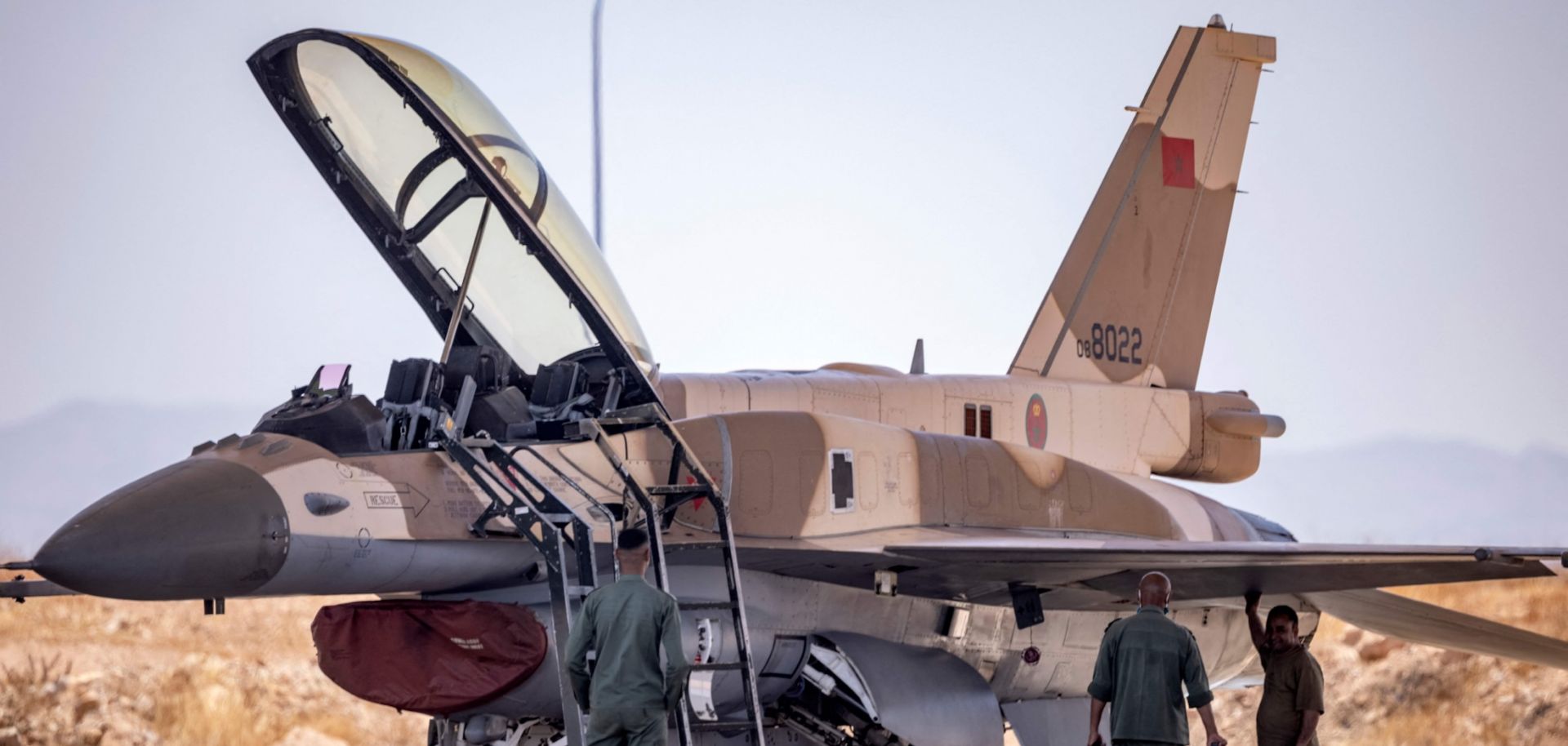
Despite the Israel-Gaza war, Morocco will continue using Israeli technology to expand the country's domestic arms production capacity and weapons arsenal, in the hopes of catching up to Algeria's military power and eventually positioning itself as a weapons exporter. In recent years, Morocco has worked to increase its domestic weapon-making capabilities and modernize its arsenal. Some of these efforts have included expanding the use of Israeli technology, after the country normalized relations with Israel in 2020. Against this backdrop, in an interview published on April 13, the CEO of BlueBird Aero Systems, an Israeli weapons manufacturer, announced that its Moroccan drone production facility ''will start operating soon.'' BlueBird's plans for a Moroccan production facility are similar to those announced by the Israeli defense company Elbit, which in June 2023 unveiled plans for two air defense production sites in Morocco, where the company would likely build short and medium-range missiles, armored vehicles, tanks, and kamikaze drones, with one production facility likely in the Casablanca area. Israeli investment in Morocco's domestic weapons production comes after Morocco finalized a series of weapons and defense system purchases with Israel Aerospace Industries (IAI), Israel's largest state-owned aviation and aerospace manufacturer, and its subsidiaries, as well as other companies like Elbit.
- IAI owns 50% of BlueBird's shares. In February 2022, Morocco inked a $500 million deal with IAI to acquire the Barak MX air defense system; in March 2022, Morocco's Ministry of Industry and Trade subsequently signed a memorandum of understanding with IAI.
Morocco is modernizing its military arsenal and developing its own domestic weapons manufacturing capacity with foreign investment, increasingly from Israel. Although Morocco has one of the strongest militaries in Africa, it is outmatched by Algeria, its North African rival. To catch up to Algeria's military capabilities, Morocco has worked to modernize its arsenal, both by expanding its capacity to make more weapons at home, and by diversifying its sources for imported weapons. While Rabat has long discussed obtaining foreign investment for military production facilities and sharing military technology, in recent years Morocco has sought to ramp up its domestic arms production to improve its control over weapons supply chains and eventually become an arms exporter. Such efforts are also aimed at reducing Morocco's reliance on arms imports in the long term. In the interim, however, the kingdom will remain reliant on such imports in order to continue growing its weapons arsenal. The United States is Morocco's largest weapons supplier by far, accounting for 69% of the country's total arms imports in 2023, followed by France at 14%. As it seeks to ramp up its domestic manufacturing capabilities, Morocco has thus also sought to diversify its weapons suppliers by inking new deals with countries like Turkey, China and, particularly, Israel. Although Morocco and Israel began signing military deals before they normalized relations in 2020, military cooperation and sales between the two countries have notably increased since then. According to the Stockholm International Peace Research Institute, Israel became Morocco's third-largest weapon supplier in 2023, accounting for 11% of the kingdom's arms imports. Morocco has also leveraged its improved relations with Israel, a leader in advanced drone technology, to build out its drone fleet, which is now the second-largest in Africa after Egypt.
- According to the Global Firepower Military Strength Index, which assesses a country's war-making potential through conventional means, Morocco ranked 61 out of 145 countries for military power in 2024, unchanged from 2023. Algeria ranked 26th in both 2023 and 2024.
- In addition to the new Israeli deals, Morocco has acquired or is in the process of obtaining other foreign-made weapons systems. In 2021, Rabat purchased Turkish TB2 drones, and in 2023, it purchased Chinese HJ-9A anti-tank missiles. The United States also recently approved a $260 million sale of U.S. Javelin anti-tank missiles to Morocco.
- Morocco has reportedly held talks with U.K. and Belgian arms producers to establish weapons and defense production facilities in Morocco. Furthermore, in 2019, Morocco and Brazil signed an agreement to share military science and technology that would support the former's domestic weapons capabilities.
Regardless of public opinion, Rabat will prioritize expanding its domestic weapons capabilities using Israeli technology to position itself as a weapons exporter. Morocco's deepening relationship with Israel remains controversial among the kingdom's citizens, who widely support the Palestinian cause. Since the onset of the Gaza war in early October, some Moroccans have taken to the streets to protest Israel's military operation and their country's ties to Israel, which were already unpopular. Rabat has so far tolerated these anti-Israel protests to allow citizens to express solidarity with Palestinians and avoid exacerbating criticism of Morocco-Israeli ties. But the Moroccan government has shown no sign that it intends to sever relations with Israel in response to the demonstrations. In the wake of the Gaza war, Rabat has also not indicated any desire to roll back its plans to make weapons using Israeli technologies. Despite pressure from its pro-Palestinian population, the Moroccan government thus appears unlikely to delay the development of Israeli weapon facilities in Morocco. This will eventually enable Morocco to export weapons, including to nearby African countries, which will help boost Rabat's regional influence. Israeli companies' factories in Morocco will likely also grant them greater access to other weapons markets in Africa, such as Zambia, Senegal and Uganda.
- According to a poll conducted by the Doha-based Arab Center for Research and Policy Studies in January 2024, 78% of Moroccans said they did not recognize Israeli sovereignty. This is a notable increase from the 67% who said so in a 2022 survey.
- In March, a Moroccan man was arrested and sentenced to five years in prison after he criticized Morocco's normalization efforts with Israel in a post on Facebook.
- Morocco's deal with the Israeli arm producer BlueBird to build a drone-making factory may expose the country's budding weapons-making industry to short-term risks related to the ongoing Israel-Hamas war. If Israel becomes embroiled in a long-term conflict, it could impede Israel's ability to jointly produce drones with Morocco, as Israeli-made components may need to be allocated for other purposes related to the war effort, potentially delaying deliveries of completed drones from the new BlueBird factory in Morocco. However, even if Morocco experiences short-term production delays, Israeli-backed production facilities (like the BlueBird drone factory) and other potential future facilities will eventually enable Rabat to export weapons.
Morocco's growing defense industry and weapons arsenal will also increase tensions with its longtime rival Algeria, including in the disputed Western Sahara region. As its weapons arsenal and domestic arms-making capacity continue to grow, Morocco and Algeria will likely continue to spend significantly on defense to eclipse each other's capabilities. Morocco will likely deploy additional air defense and drones near the sand berm between the Moroccan-controlled territory in Western Sahara and the territory controlled by Algeria-backed Polisario Front militants, in the hopes of attracting more foreign investment to develop the region by assuaging investors' security and personnel safety concerns. As part of this effort, Morocco will likely use its expanding drone capabilities to attack Polisario Front targets to deter any small-scale attacks on cities in Moroccan-controlled Western Sahara or sabotage efforts on Moroccan infrastructure and investment projects. This will raise the risk of further, potentially deadly, skirmishes between Moroccan forces and Algeria-backed militants in the contested region. However, a direct conflict between Algeria and Morocco remains unlikely, since Algeria has worked to reduce threats and improve its relationships with countries with significant ties to Morocco, like Spain.
- Algeria and Morocco maintain a closed land border due to their decades-long dispute over Western Sahara. Morocco controls about four-fifths of the region; the rest is controlled by the Polisario Front, an Algeria-backed Sahrawi nationalist militant group seeking Western Sahara's independence.
- Moroccan military forces and Polisario Front militants have periodically engaged in cross-sand berm skirmishes over the years. The Moroccan military has used drones to attack the Polisario Front-controlled areas, at times resulting in civilian casualties.
- Morocco's acquisition of new weapons systems has fueled an arms race between Morocco and Algeria. Morocco's acquisition of Turkish TB2 drones in 2021, for example, prompted Algeria to purchase Anka-S drones from Turkey.
