
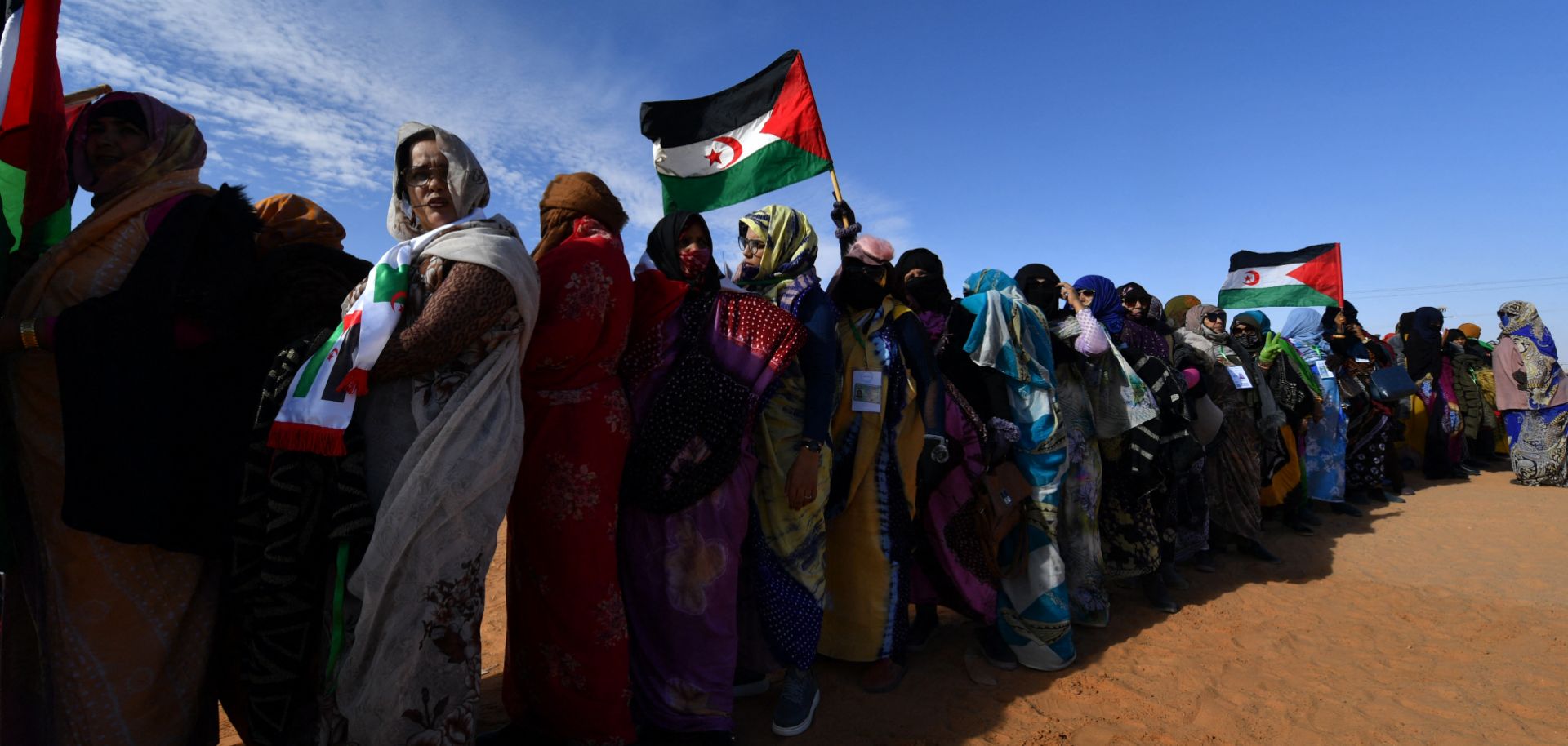
In the coming months, Morocco will prioritize receiving foreign investment and developing industries in the Western Sahara, while Algeria will try to de-emphasize the territorial dispute in its foreign engagements to improve its bilateral partnerships. The U.N. Security Council is expected to vote to renew the mandate of its peacekeeping mission in Western Sahara (formally known as the United Nations Mission for the Referendum in Western Sahara, or MINURSO) prior to its Oct. 31 expiration. The deliberations to renew the mandate come amid the United Nations' frustration with the Polisario Front, an Algeria-backed Sahrawi nationalist militant group seeking Western Sahara's independence, for allegedly infringing on MINURSO operations along the berm dividing the Moroccan-governed portion of Western Sahara and the Polisario Front-governed portion. The United Nations is also frustrated with Algeria for the country's alleged interference in MINURSO operations overseeing the region's political transition and the stalled roundtable process. MINURSO is a peacekeeping mission that was established in 1991 to monitor the then-cease-fire between the Polisario Front and Morocco, and to prepare for a referendum to determine Western Sahara's political future. While the move for a referendum has stalled, discussions over the future of MINURSO and viable plans for political progress come at a time of growing international support for Morocco's autonomy plan for Western Sahara, which proposes granting the indigenous Sahrawi people self-governance while maintaining Moroccan sovereignty.
- A U.N. Security Council report published on Oct. 3 stated that the situation in Western Sahara ''continued to be characterized by tensions and low-intensity hostilities between Morocco and the [Polisario Front],'' and that this has ''led to significant challenges for the operations of MINURSO, in particular, its logistics and resupply efforts.''
- Backed by Algeria, the Polisario Front is an armed component of the Sahrawi Arab Democratic Republic (SADR) government, which promises locals a free and independent political system. The Polisario Front has restricted MINURSO's ability to execute ''observational activities'' as part of its mandate. The head of the U.N. mission, Alexandre Ivanko, cited difficulties moving in the area east of the berm under the Polisario Front's control. As a result, MINURSO is now relegated to 20-kilometer corridors in the Polisario Front-governed territory and cannot conduct its observations using helicopter reconnaissance.
- The disputed territory of the Western Sahara became a proxy space for the Moroccan-Algerian conflict after Spain withdrew from the region in 1976 and Mauritania subsequently relinquished its territorial claims in 1979. Moroccan claims to the Western Sahara are based on traditional and cultural similarities prior to colonization with hopes to invest in the resource-rich territory. Algeria has supported the Polisario Front since the 1970s, including by supplying the group with funding and weapons.
Morocco has garnered increased international support for its Western Sahara autonomy plan in recent years. Meanwhile, Algeria's support of Polisario Front militants in the region has strained its foreign relationships. Obtaining support for its Western Sahara autonomy plan is a crucial component of Morocco's foreign policy strategy to strengthen its international legitimacy in the disputed region. One significant achievement toward that end was the United States' move to formally recognize Moroccan control over Western Sahara in December 2020 in exchange for Rabat agreeing to normalize relations with Israel. Then, in March 2022, Spain — a country with historical ties to the region — announced its support for Morocco's autonomy plan in Western Sahara in a bid to repair the two countries' relations following a diplomatic splat that saw Morroco halt the enforcement of irregular migration into Spain after Madrid allowed the leader of Polisario Front to receive medical care in a Spanish hospital. Conversely, as Morocco has gained support for its Western Sahara plan, Algeria's foreign relations with several countries — including Morocco and Spain— have deteriorated. In 2021, Algeria officially severed diplomatic ties with Morocco after the United States announced it would recognize Rabat's territorial claims in Western Sahara. Additionally, after Spain supported Morocco's autonomy plan following years of neutrality on the Western Sahara issue, Algeria suspended the treaty of friendship it signed with Madrid in 2002 and sanctioned Spanish imports.
- In December 2020, the White House and the Moroccan royal court confirmed that Israel and Morocco had decided to establish full diplomatic relations. As part of the normalization deal, the United States said it would also recognize Morocco's ''full sovereignty'' over Western Sahara.
- In 2021, then-Algerian Foreign Minister Ramdane Lamamra announced his country was officially severing its diplomatic ties with Morocco, stating that ''the Moroccan kingdom [had] never stopped its hostile actions against Algeria'' amid accusations that Morocco used Pegasus spyware against Algerian officials, reneged on its obligations in the Western Sahara referendum, and supported the Kabyle Autonomy Movement in Algeria, which the Algerian government has named a terrorist organization.
- In May 2021, the leader of Polisario Front, Brahim Ghali, was treated for COVID-19 at a hospital in the northern Spanish city of Logrono. Shortly after reports emerged of Ghali's hospitalization, Moroccan authorities allowed thousands of people to cross the border at the Spanish-governed enclave of Ceuta.
- Algeria sanctioned Spain in June 2022 after the European country announced its public support for Morroco's autonomy plan in Western Sahara. Since then, Spanish exports to Algeria have significantly declined.
Morocco will leverage increasing international support for its autonomy plan to attract more foreign investment to Western Sahara and, in turn, grow the resource-rich region's economy and mining sector. With the growing international support for its claims to Western Sahara, Morocco will strategically seek ways to strengthen the legitimacy of its control over the region, including through foreign investment. By attracting investment into Western Sahara and promoting economic growth in the region, Morocco aims to not only bolster the local economy but also incentivize foreign investors to further back its sovereignty over the disputed territory. As part of this effort, Morocco has also outlined plans for renewable energy projects in the Western Sahara that are anticipated to be supported with foreign investment. Moreover, Morocco plans to invest in phosphate mining and fishery development to grow Western Sahara's economy and export its resources. Several countries that have supported Moroccan sovereignty in Western Sahara have opened or announced plans to open consulates in Laayoune and Dakhla, the two largest cities in Moroccan-controlled Western Sahara, further integrating international support with regional development. As investment in the region grows, the Polisario Front will likely continue to conduct isolated targeted attacks to disrupt, delay and impede Morocco's development initiatives. However, the impact of these attacks will be limited due to Morocco's advanced military arsenal and the Polisario Front's reliance on outdated weapons.
- In February 2023, the Moroccan government announced plans to invest nearly $2 billion in renewable energy projects in the Western Sahara region.
- Since the 1990s, Morocco has developed the fishing industries in the coastal cities of Western Sahara. During that time, Morocco has also engaged in fishing cooperation agreements with the European Union throughout the country. But in 2019, an EU court invalidated the bloc's Sustainable Fisheries Partnership Agreement (SFPA) with Rabat on the grounds that the deal did not have the Polisario Front's consent.
- 24 consulates have been established in the Western Sahara cities of Laayoune and Dakhla.
While still providing support to the Polisario Front, Algeria will likely shift its foreign policy priorities away from Western Sahara to focus on its own bilateral ties and key partnerships. In the ongoing dispute over Western Sahara, Algeria's support for the Polisario Front has come at a minimal financial cost, but it has had significant reputation and diplomatic repercussions. The Algerian government wants to expand its relationships with the European Union, the Arab League and the African Union as part of President Abdelmadjid Tebboune's push to establish his country as a regional power. But to successfully do so, Algeria will have to avoid turning its support for the Polisario Front into a contentious issue, as the question of Western Sahara sovereignty has divided member countries within all three of these regional organizations. To prioritize effective partnership development in its foreign policy, Algeria will thus need to reduce its emphasis on the Western Sahara issue. But for Algiers, departing from its longtime position in Western Sahara would risk damaging its domestic legitimacy by being seen as yielding to Morocco in the two countries' ongoing power competition. Thus, while it may downplay the territorial dispute abroad in its effort to strengthen its diplomatic standing and foster new regional relationships, Algeria will still continue to provide both material and political support to the Polisario Front.
- Algeria, under President Tebboune, Algeria has worked to improve its ties with Egypt, as well as its relationships with countries in the Sahel region of sub-Saharan Africa and members of the African Union, several of whom have expressed support for Morocco's autonomy plan in Western Sahara.
- Algeria's falling out with Spain has taken a significant toll on its economy over the past year by robbing Algeria of a key client for its gas. As Madrid and Algiers' relationship soured due to the former's support for Moroccan claims to Western Sahara, the United States expanded its gas exports to Spain, where Algeria had previously been the largest supplier of gas. Other European Union countries looking to strengthen their ties with Algeria may also now approach the Western Sahara issue with caution, given Algiers' punitive actions toward Madrid.
