
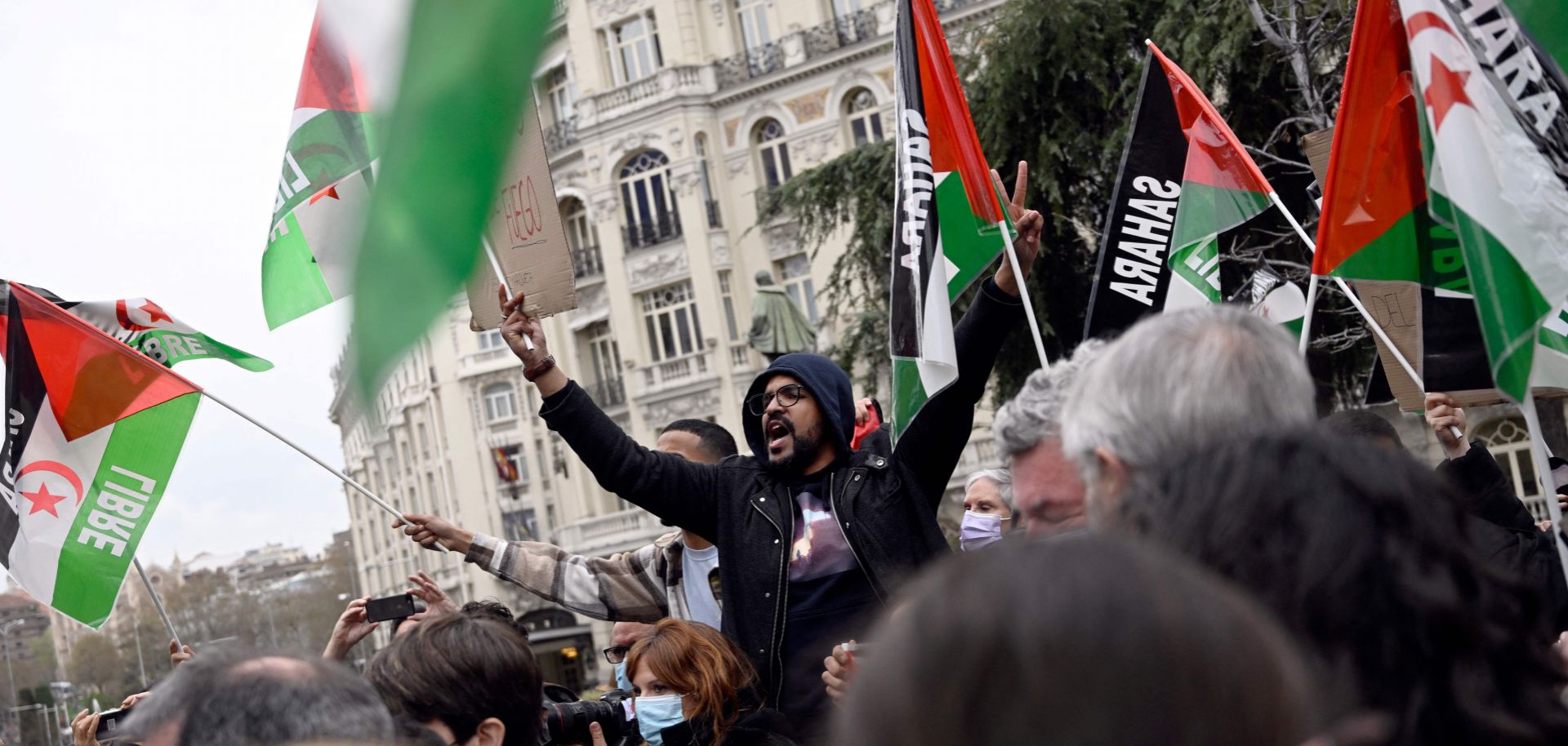
People take part in a ''Free Sahara'' rally in Madrid, Spain, on March 30, 2022, in protest of the Spanish government's recent move to recognize Morocco's autonomy plan for the disputed territory of Western Sahara.
Morocco and Algeria's cold war will deepen as the former gains international support for its territorial claims in the disputed region of Western Sahara. The ongoing conflict will further damage Morocco's economy, politically isolate Algeria and risk violent but largely low-level confrontations near the two North African countries' border. On March 18, Spain shifted its position on Morocco and Algeria's territorial dispute in Western Sahara by saying it supported Morocco's 2006 autonomy plan, which Rabat claims would grant the indigenous Sahrawi people autonomy but under Moroccan sovereignty. As a past participant in the Western Sahara conflict in the 1970s and as an economic partner of both Morocco and Algeria, Spain is an important voice in the decades-long dispute over the African territory. Madrid's move could thus see more European countries shift their diplomatic position on Western Sahara. The latest economic, political, and security aggravations between Morocco and Algeria also indicate both governments are willing to let their rivalry persist under the current uneasy status quo.
- In response to the March 18 announcement, Algeria recalled its ambassador to Spain and said it needed clarification on Madrid's stance on Western Sahara before it would reinstate the envoy. Algerian-backed Polisario forces — the militant arm of the Sahrawi Arab Democratic Republic — have since also severed ties with Spain. Polisario militants have increased their attacks on Moroccan forces in Western Sahara in recent weeks as well.
- Morocco and Algeria's rivalry is driven by ideological differences dating back to the era of French colonization in northwest Africa in the 20th century and, more recently, the two countries' differing opinions on the sovereignty of the territory.
- Spain's announcement follows the United States' move to recognize Morocco's ''full sovereignty'' over Western Sahara in December 2020. Increasing international support for Morocco's territorial claims grants political legitimacy to Rabat's control over Western Sahara, which could help Morocco convince more foreign companies to invest in the territory.
Increased tensions with Algeria over Western Sahara will risk further destabilizing Morocco's drought-stricken, import-reliant economy by prolonging disruptions to Rabat's natural gas supplies. In October, Algeria decided not to renew a contract that supplied Morocco natural gas. Rabat has since been scrambling to find new liquified natural gas (LNG) suppliers, as well as new ways to bolster its LNG import capacity, to avoid disruptions in its domestic electricity network. The surge in global energy prices amid the ongoing Russia-Ukraine war has only exacerbated the fallout from Algeria's gas cut-off in Morocco, which is also facing an ongoing regional drought that's expected to cut the country's agricultural output by 17.3% this year. Morocco is hoping its control over Western Sahara will eventually grant it access to the territory's lucrative natural resources, which include phosphates, offshore fishing reserves and potential energy reserves. It will take years, however, to attract the investment and build the projects needed to tap into those reserves. In the meantime, increased tensions in Western Sahara portend further disruptions to Rabat's future access to Algerian natural gas, as well as greater overall economic instability in Morocco.
- Morocco imports 90% of its energy and generates a growing share of its power with natural gas. About 10% of Morocco's electricity in 2021 was powered with Algerian gas.
- Morocco's economic growth is expected to slow to 1.1% in 2022 from 7.4% in 2021, according to the World Bank's latest forecast. The country's chronic labor woes — namely, chronic unemployment and underemployment — are also poised to worsen as the economy contracts.
- Spain is considering providing natural gas to Morocco via a pipeline once used to send Algerian gas to Spain via Morocco. But Algeria's energy ministry has pushed back against this idea, warning on April 27 that supplying any Algerian gas to Morocco would be seen as a breach of contract on Madrid's part.
Algeria, meanwhile, risks becoming more politically isolated as its continued opposition to Moroccan control of Western Sahara, as well as its close ties with Russia, place Algiers increasingly at odds with the international community. Efforts by the Algerian-backed Polisario have failed to keep Morocco from deploying more troops to Western Sahara and increasing its overall political and economic influence in the territory in recent years. This — combined with the uptick in global support for Rabat's economic investment and potential annexation aims in Western Sahara — is forcing Algiers to recalibrate whether it should continue providing Polisario armed forces with equipment and political support. Amid the war in Ukraine, Algeria's close political, economic and military relationship with Russia also risks coming under greater international scrutiny. If the Ukraine crisis results in additional sanctions on Russia that hamper Algiers' commercial ties with Moscow, it would further limit the extent to which Russia could support Algeria's cold war efforts against Morocco in Western Saraha. Algeria is constrained in how much leverage it can exact against any European countries that cooperate closely with Morocco as well, given that Europe is also home to some of the biggest consumers of Algerian natural gas.
- Russia is the main provider of military equipment to Algeria and has been a political ally since Algeria's independence from France. In October, Russia abstained from voting on a resolution to again delay the U.N.-mediated referendum on independence for Western Sahara. Morocco has been able to take advantage of the continued extensions of this long-awaited referendum to assume more de facto control over the territory.
- There are reports that Algeria's state-backed Sonatrach energy firm is considering adjusting the prices of its natural gas shipments to Spain in response to Madrid's changed position on the Western Sahara dispute. Algeria, however, is highly unlikely to fully cut off its natural gas contracts with Spain. Algeria also signed an agreement expanding gas exports to Italy in April, underscoring how important the European market is for Algeria's primary export.
While an outright military conflict between Algeria and Morocco remains unlikely, the ongoing conflict will make it all the harder for the two countries to de-escalate tensions, portending more incidents of low-level violence in Western Sahara, along with other secondary security implications. Despite the latest uptick in tensions, both Algeria and Morocco will still seek to avoid a major military conflict in Western Sahara given the large political, social and economic costs that waging such a war would entail. But the proxy conflict between Algerian-backed Polisario forces and Moroccan military forces will likely continue to slowly and steadily intensify, as the current environment of high tensions will increase the risk of small incidents and potential miscalculations triggering tit-for-tat escalations. The actual fighting will probably remain in Western Sahara, limiting the potential for collateral damage. However, continued violence in the region could eventually hamper Morocco's push to increase foreign investment in Western Sahara by fueling concerns about the territory's long-term stability and the future safety of any new commercial ventures. Growing anger over the trajectory of the conflict could also motivate Polisario militants to expand their attacks, which would risk distracting both Moroccan and Algerian forces from fighting against growing jihadist activity in the Sahel region of sub-Saharan Africa.
- Algeria did not directly retaliate against alleged Moroccan airstrikes in November and April that killed three Algerian truck drivers and injured three Algerian citizens, respectively — indicating Algiers' high threshold for serious military escalation. The deadly November airstrike did, however, push Polisario forces to conduct more attacks on Moroccan forces in border areas within Western Sahara. The April attack also prompted angry responses from the Algeria-backed militant group.
- Morocco and Algeria have amassed two of Africa's largest military arsenals over the last two decades, driven by their long-simmering rivalry and dispute over Western Sahara. This buildup of arms has sparked concern about the possibility of another large war breaking out between the two North African countries, which fought against each other in 1963 during the so-called Sand War and then in 1976 after Spain ceded control over Western Sahara.
