
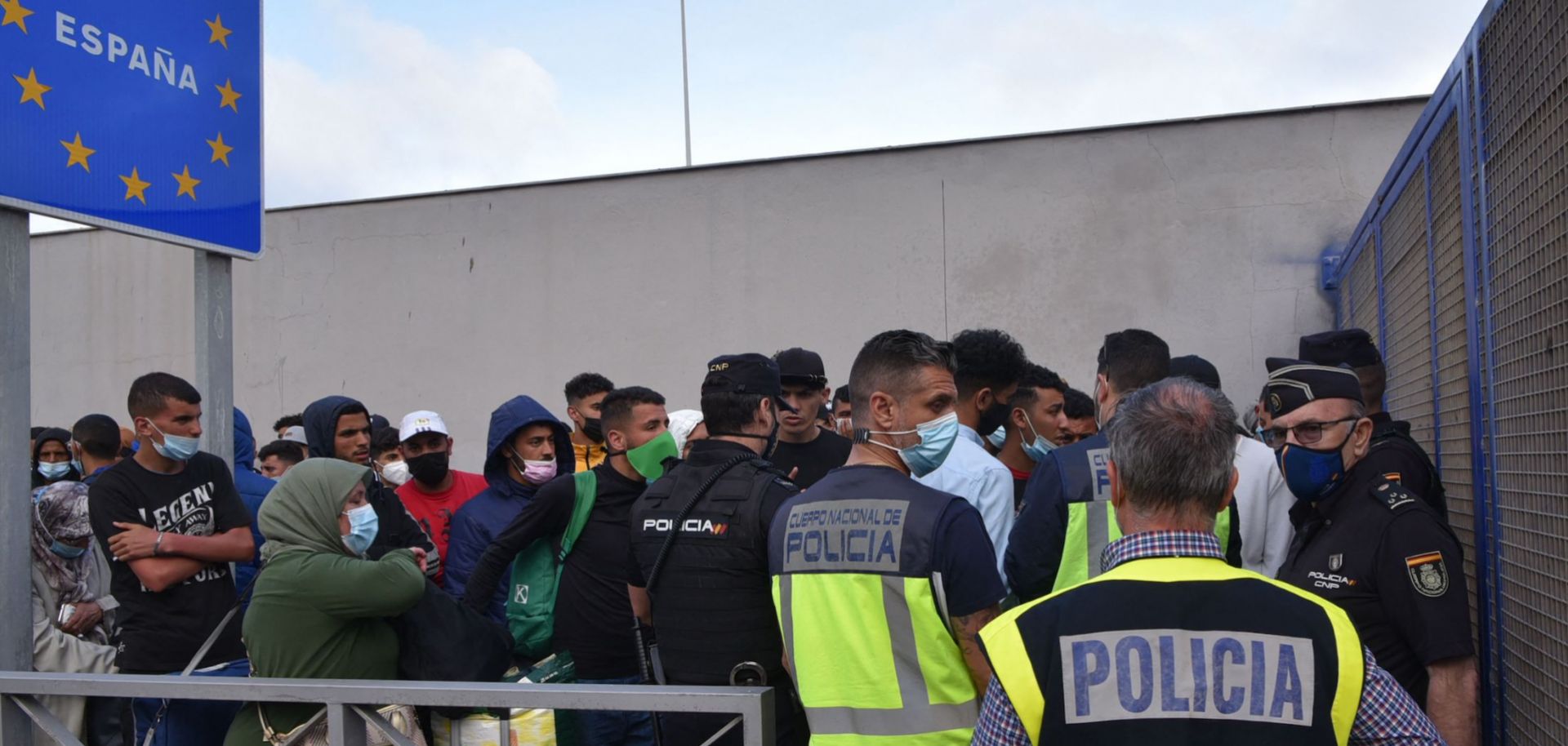
Spanish policemen stand next to migrants waiting to cross the border back to Morocco at the Spanish enclave of Ceuta on May 20, 2021.
Morocco’s willingness to use migrants as leverage to gain recognition of its Western Saharan claims will become a recurrent source of security and economic risk for Spain and other EU member states this summer. But this strategy will ultimately be limited by Rabat’s financial reliance on its European neighbors. Over the past two weeks, Rabat and Madrid have been wrapped up in a diplomatic dispute over the latter’s move to allow the leader of Western Sahara’s pro-independence movement to be treated for COVID-19 in the northern Spanish city of Logrono. Brahim Ghali, the head of the Polisario Front and president of the Sahrawi Arab Democratic Republic, was admitted to a Logrono hospital in mid-April. Then on May 17, Moroccan authorities — seemingly in retaliation — allowed between 8,000 and 10,000 people to cross the border at the Spanish-governed enclave of Ceuta for roughly two days. During his stay in Spain, Ghali testified before a Spanish court as a part of an investigation into human rights violations he allegedly committed. On June 1, a Spanish judge gave Ghali permission to leave Spain since he had not been charged with any crimes in the country.
- The Algeria-backed Polisario Front has fought for Western Sahara’s self-determination and independence from Morocco since the 1970s. Morocco claims sovereignty over the region and accuses Ghali of terrorism.
- Spain’s official position on the Western Sahara situation is that it must be resolved at the United Nations. However, some center-left Spanish politicians have shown sympathy with the Polisario cause in the past.
- A long-promised U.N. referendum on self-determination for the Sahrawi people indigenous to parts of Western Sahara has languished since the early 1990s. This has fueled grassroots support for efforts to claim the region by force, prompting recent Polisario agitations along the Western Sahara border.
Morocco’s leverage against Spain will increase in the coming months, as the warmer weather makes it easier for migrants to enter Spanish territories by sea and land. The May 17-18 event at the Ceuta border is not the first time that Morocco has used migrants to pressure Spain. In recent months, the Spanish Canary Islands have also seen a surge of people from Morocco and other African countries. This emulates a similar strategy by Turkey, which also uses the threat of letting migrants enter the European Union as leverage in its negotiations with Brussels.
Full U.S. recognition of its Western Sahara claims is likely also emboldening Rabat to push harder for Europe to follow suit. The administration of U.S. President Joe Biden has yet to reverse his predecessor’s controversial decision to formally recognize Morocco’s “full sovereignty” over Western Sahara in December. This is probably encouraging Rabat to more aggressively pursue European recognition, which is critical for Morocco to ever truly claim control of the disputed region.
- The status of Western Sahara has also triggered tensions between Morocco and other EU member states. In early May, Rabat recalled its ambassador in Germany after Berlin criticized the U.S. decision to recognize Moroccan sovereignty over the region.
Morocco, however, will be careful not to jeopardize the significant financial support it receives from Spain and the European Union, especially as it seeks to recover from the COVID-19 pandemic. Spain is Morocco’s main trade partner, accounting for around a quarter of Moroccan exports. The desire to protect these trade ties will also influence Rabat’s actions.
- Between 2014 and 2020, the European Union’s bilateral assistance to Morocco under the European Neighbourhood Instrument (ENI) amounted to 1.4 billion euros.
- In February, the European Union announced a plan to mobilize 7 billion euros in investment and grants for countries in Northern Africa. Morocco aspires to receive a significant part of those EU funds.
- Spanish Prime Minister Pedro Sanchez described Morocco’s recent move to relax its border controls as “an act of defiance” and a “show of disrespect” for the entire European Union.
For Spain, the ongoing dispute with Morocco will create some economic and security risks, but they will likely be modest. An increase in the arrival of migrants in Ceuta and other Spanish territories will create logistical and security problems that may force Spain to deploy additional security personnel in the areas at risk. Spanish law also makes it difficult to expel unaccompanied minors, which means that some of the migrants will remain in Spain and force Madrid to accommodate them. An increase in migration could create security problems for Ceuta’s port as well since many of the migrants will try to illegally enter ferries and trucks going to mainland Spain. Such efforts would put migrants’ lives at danger, forcing Spanish authorities to implement additional controls that could disrupt the port’s activity. Madrid’s disputes with Rabat could also increase public anger against Spain in Morocco, exposing Spanish companies in the North African country to potential boycotts, protests and acts of sabotage.
