
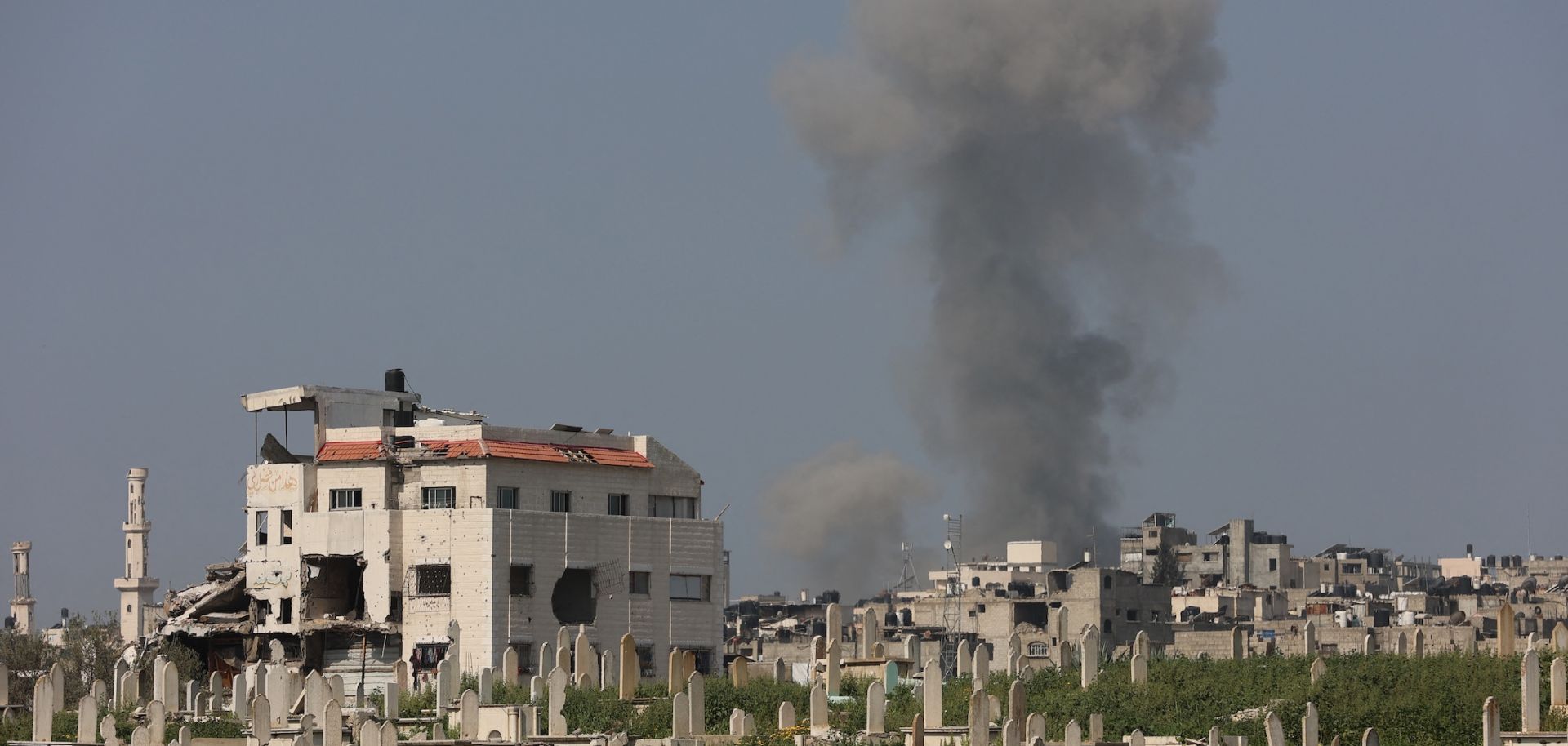
Following large-scale airstrikes in the Gaza Strip, Israel will likely ramp up military pressure on Hamas to restart negotiations designed to ultimately force Hamas to exit Gaza, but Hamas will resist this pressure, likely returning Gaza to an open-ended conflict that risks further regional escalations. Citing Hamas' refusal to release the remaining Israeli hostages it still holds, the Israeli government ordered airstrikes across the Gaza Strip on March 18, hitting militant sites affiliated with command-and-control, rocket production, launch sites and other locations the Israel Defense Forces (IDF) claimed were part of Hamas and other militants' military infrastructure. The Hamas-run Gaza Ministry of Health said up to 400 people were killed in the strikes, which Israeli Defense Minister Israel Katz vowed would continue and that the ''gates of hell'' would open if the hostages were not released. The IDF has since given evacuation orders along much of the Gaza buffer zone in preparation for further attacks. Israel reportedly got the green light from the White House to launch the operation, with U.S. President Donald Trump being informed of and approving the strikes beforehand, according to The Wall Street Journal. Hamas said that the deadly attacks constituted a major breach of the January truce, but did not formally abandon the ceasefire framework. However, the airstrikes marked the largest ceasefire violation yet and have effectively nullified the agreement.
- Later on March 18, far-right former National Security Minister Itamar Ben Gvir rejoined the Israeli coalition government led by Prime Minister Benjamin Netanyahu, after having quit over the truce and promising only to return when the war resumed. This signals that the Israeli government is preparing for an extended campaign in Gaza.
- The first phase of the ceasefire, which was formulated by the administration of former U.S. President Joe Biden, expired on March 1. The truce has since been in limbo because the second phase was meant to see Hamas release the remaining Israeli hostages in exchange for Israel releasing Palestinian prisoners and withdrawing its troops from Gaza. But Israel has refused to draw down its military presence in the Strip as long as Hamas retains a role there. The original three-phase deal did not directly address Hamas' future role in Gaza, though Israel has repeatedly said it would not accept a future with Hamas still in Gaza.
- Hamas offered to release an American-Israeli hostage to keep the truce going, but this offer fell flat as both the United States and Israel wanted more hostages freed. Trump has repeatedly called for the release of all remaining hostages, often beyond the framework of the ceasefire, which was meant to see a steady release of the hostages over time.
Due to Hamas' weakened conventional capabilities, Israel can conduct a more open-ended, largely aerial campaign to maintain pressure on the group, making the start of another mass Israeli ground invasion in Gaza unlikely. Over 16 months of war have largely exhausted Hamas' once vast rocket and missile arsenal, and the group has little ability to replenish its supply due to its geographic isolation from its main arms sponsor, Iran. While Hamas has reorganized some of its battalions and recruited fighters to replace losses, these fighters are largely limited to small arms and explosives suitable for ground combat rather than attacks on Israeli cities. With this shift in the military balance of power, the Israelis can conduct extensive airstrikes at will without serious risk of Hamas retaliation against Israeli population centers. Israel has also cut off all humanitarian aid and electricity to the Gaza Strip in an attempt to impose maximum pressure on the civilian population and, therefore, Hamas, to convince the group to release the remaining hostages without Israel having to concede to Hamas' demands for a military withdrawal from the Gaza Strip. Taken together, these factors mean that Israel is less likely to conduct the massive bombardment and invasion that began in late 2023 and lasted until early 2025.
- Before the Israel-Hamas war broke out in October 2023, Hamas had up to 30,000 rockets and missiles to use for retaliation against Israeli airstrikes, but most of these have since been fired or destroyed.
- Up to 45,000 Palestinians have been killed over the course of the war, many of whom were Hamas fighters, including senior leaders like Yahya Sinwar and Mohammed Deif. While these losses have substantially weakened Hamas' command, control and military structure, the group nonetheless has managed to reconstitute some battalions into relatively professional fighting forces in the wake of Israeli ground forces withdrawing to the outskirts of the Gaza Strip as part of the ceasefire process. Hamas thus continues to pose a threat to Israeli security, which Israel has used to help justify its ongoing attacks in Gaza.
In the coming days and weeks, Israel will likely carry out phased escalations and de-escalations to weaken Hamas' resolve to hold on to the remaining hostages, but this strategy will not address the root causes of the ongoing standoff. War-weary Israelis largely support securing the release of the remaining hostages over pursuing the longer-term goal of completely defeating Hamas. This weakens the political incentives for a mass Israeli military escalation similar to that in the fall of 2023 following Hamas' mass casualty attacks against Israel. As a result, Israel is unlikely to mobilize a large scale of reservists as it remains concerned about public support for the war, as well as the impact on its economy, preferring to rely on air power and intermittent ground raids to pressure Hamas into releasing hostages or successfully freeing them through military operations. Additionally, Israel is likely to continue leveraging its control over allowing international aid into the Gaza Strip to further weaken Hamas' resolve to hold hostages. Facing these pressures, Hamas may consider new hostage-for-prisoner deals that ignore the demand for Israel to withdraw from the Gaza Strip and may step outside the three-phase ceasefire framework. But while this may allow for partial pauses to Israeli combat operations and some humanitarian relief for the Gaza Strip, the underlying causes of the ongoing conflict would remain unaddressed.
- Of the 251 people Hamas abducted from Israel in its October 2023 attack, 147 have so far been released, including eight dead hostages, while 45 have had their bodies recovered by the Israeli military. The IDF assesses that fewer than half of the remaining 59 hostages in Gaza are still alive. As part of the ceasefire deal, Hamas intended to slowly release the remaining hostages weekly in exchange for further aid and a steady withdrawal of Israeli troops from Gaza.
- In February, Israel's public broadcaster Channel 12 reported that 70% of Israelis favored continuing the second phase of the ceasefire as long as it secured hostage releases. However, the public also widely supports removing Hamas from control of Gaza, even if sentiment generally favors the release of hostages first.
In any future negotiations, Israel will likely assert that it will only end its military campaign once Hamas and other militants exit Gaza — a demand that Hamas will resist, likely leading to an open-ended conflict that drags in other armed groups in the region and potentially permanently displaces more Palestinians. With strong U.S. backing, over time Israel's war hawks will probably gain the upper hand in strategic discussions on how to approach negotiations with Hamas, making Israel's war goal of removing Hamas from the Gaza Strip a central sticking point in further talks. This may lead to the unraveling of the three-phase ceasefire entirely as Israel tries to restart negotiations and push through terms favorable to its long-term security imperatives. However, Hamas is unlikely to concede to Israel's maximalist demands anytime soon, leaving Gaza mired in an open-ended conflict as Israel intermittently escalates and de-escalates to create pressure on the population and Hamas. Israel will also likely attempt more seriously to transfer some Gazans outside the Strip permanently in a bid to further weaken the demographic pillar that upholds Hamas' power in Gaza. As the Gaza conflict remains unstable and rife with violence, regional escalations are likely as well. Houthi militants in Yemen could conduct more solidarity attacks against Red Sea shipping and Israel itself, as well as against U.S. targets throughout the region. Violence may also worsen in the West Bank, where Hamas elements and other militants are attempting to conduct an underground insurgency against Israeli settlers and troops. Ultimately, a pattern of periodic escalation and de-escalation could drag out the conflict until the end of 2026, when Israel must hold elections in which current polls do not favor the Netanyahu government's survival. In the lead-up to the ballot, Israel's hawkish government will want to keep pressure on Hamas but will be hesitant to return to full-scale war as it eyes a larger threat from Iran and a wary public. Hamas, meanwhile, will likely seek to hold out before making any major concessions, calculating that a new Israeli government would be more inclined to compromise on its predecessor's demands that Hamas relinquish power in the Gaza Strip.
- Israel's elections are scheduled for October 2026, and current polling suggests that the coalition led by Netanyahu may lose its majority. This is due to the Israeli intelligence failures that preceded Hamas' Oct. 7, 2023, attack and Netanyahu's legal threats from corruption allegations, as well as the public perception that Netanyahu has politicized the military campaign against Hamas for his own career.
- Israel has yet to identify a serious location to relocate dozens of Palestinians, although Israel and the United States have reportedly explored Somaliland and Syria as possible options. This consideration arises from the U.S. leverage over Somaliland in the autonomous region's quest for independence and Syria's efforts to break free from U.S.-led economic isolation. Israel also has the option to transfer Palestinians to the West Bank relatively easily.
- On March 18, following the deadly Israeli airstrikes on Gaza, the Houthis fired a ballistic missile toward Israel in what was the group's first attack on Israel since January.
