
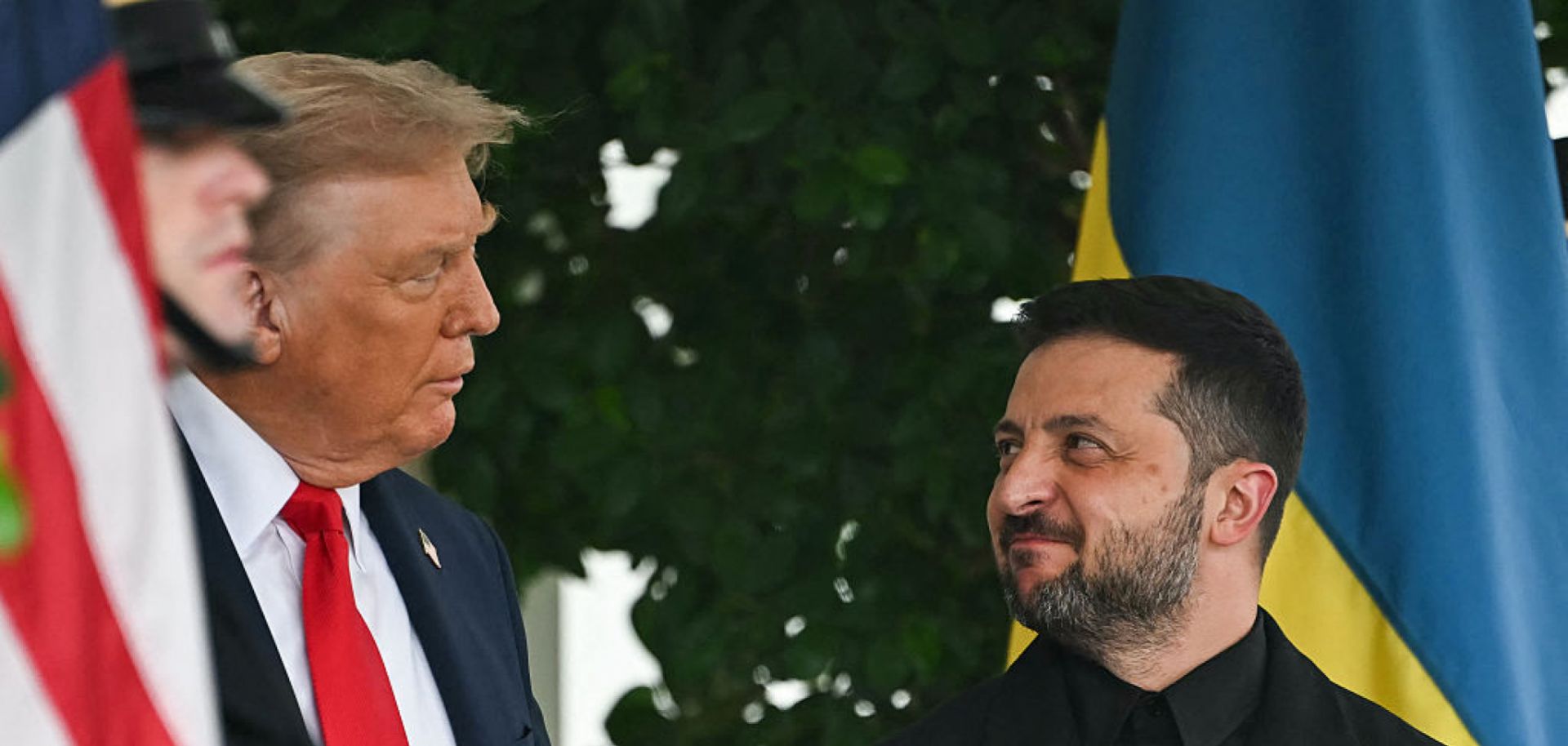
Additional rounds of negotiation between Russia and Ukraine are likely in the coming weeks, but a comprehensive peace agreement will remain elusive as Moscow maintains maximalist demands, the United States avoids firm security commitments for Ukraine and Kyiv resists territorial concessions absent stronger Western guarantees. On August 18, U.S. President Donald Trump met with his Ukrainian counterpart, President Volodymyr Zelensky, at the White House to discuss the war in Ukraine. After a bilateral meeting, the two presidents held a larger meeting with U.K. Prime Minister Keir Starmer, French President Emmanuel Macron, German Chancellor Friedrich Merz, Italian Prime Minister Giorgia Meloni, Finnish President Alexander Stubb, European Commission President Ursula von der Leyen and NATO Secretary-General Mark Rutte. During this meeting, Trump said that the United States would give "lots of help" to protect Ukraine after the war, though Ukraine's European partners would carry most of the burden. Trump said after the event that he had called Russian President Vladimir Putin to discuss a bilateral meeting between the Russian leader and Zelensky, which would be followed by a trilateral meeting between Trump, Putin and Zelensky. However, a Kremlin statement said only that Moscow remained committed to the peace process and did not give any details about a potential meeting with Zelensky.
- Speaking to reporters, Trump said that "when it comes to security, there's going to be a lot of help" from the United States. He then added that European countries "are a first line of defense because they're there, but we'll help them out." According to Zelensky, a pact on security guarantees for Ukraine will be "formalized on paper within the next week to 10 days."
- Commenting on Trump's social media post about a potential Putin-Zelensky meeting, Kremlin aide Yuri Ushakov said that Putin and Trump discussed "the possibility of raising the level of representatives from the Ukrainian and Russian sides ... participating in the mentioned direct negotiations."
- The Aug. 18 meeting took place three days after Trump and Putin met in person in Alaska. While the United States informed both Ukraine and its main European partners about the content of the meeting, Kyiv and its allies expressed concern about Trump and Putin reaching a deal without Zelensky's input.
The meeting focused on the crucial issue of security guarantees for Kyiv, including a potential deployment of international troops in or around Ukraine, NATO-like collective protection pledges and additional military assistance for Ukraine, but all options remain embryonic and subject to additional negotiations. While Ukraine's government will not say so in public, Kyiv probably understands that it will have to give up territory in order to achieve peace. But Kyiv is unlikely to do so unless it receives strong guarantees from the West that would deter additional attacks (and other forms of coercion) from Russia. The Aug. 18 meeting was significant in the sense that Trump gave his clearest reassurances yet that the United States will be involved in Ukraine's postwar protection. However, the U.S. president was very vague about what this participation would look like and stated that it would be up to Ukraine's European backers to carry most of the burden. There are currently three main options for security guarantees, which are not mutually exclusive. The first is the deployment of international troops on the ground to discourage another Russian invasion. The U.K. and France have been discussing this option for months, but which countries would participate, under which mandate and where troops would be deployed is still unclear. (While London and Paris have discussed a deployment in Ukraine proper, they have also discussed a deployment in surrounding countries such as Romania and Poland to offer air protection for Ukraine.) London and Paris have repeatedly asked for Washington's participation in an international deployment in or around Ukraine to give it more credibility, but the White House remains ambiguous on this issue. The second option, floated by Italy and recently mentioned by U.S. special envoy Steve Witkoff, would involve Ukraine's allies providing unspecified "Article 5-like" collective defense promises to Ukraine, similar to those offered by NATO, without Kyiv joining the alliance. However, what form these security guarantees would take, which countries would participate in them or whether they would be significant enough to deter future Russian aggression is again unclear. Finally, the United States and Ukraine's European backers are discussing providing additional military assistance to Ukraine, in line with a recent agreement according to which European countries buy weapons from the United States and then they transfer them to Ukraine. This is the most straightforward of the options currently in discussion, as a similar arrangement is already in place.
- In a post on Truth Social after his meeting with the European leaders, Trump said that the United States would "coordinate" security guarantees for Ukraine and did not make any explicit commitments about U.S. participation. According to Trump, "during the meeting we discussed Security Guarantees for Ukraine, which Guarantees would be provided by the various European Countries, with a co-ordination with the United States of America." During the presidential campaign and after taking office in January, Trump repeatedly said that the United States would not put boots on the ground in Ukraine.
- In the early hours of Aug. 19, Zelensky said that Ukraine, its European backers and the United States had discussed the purchase of $90 billion worth of U.S. weapons for Ukraine. On Aug. 18, the Financial Times reported that Ukraine and the United States would also strike a $50 billion deal to produce drones with Ukrainian companies.
- On Aug. 18, Russia's foreign ministry issued a statement saying: "We reaffirm our repeatedly stated position on the categorical rejection of any scenarios involving the appearance of NATO military contingents in Ukraine, which threatens uncontrollable escalation of the conflict with unpredictable consequences."
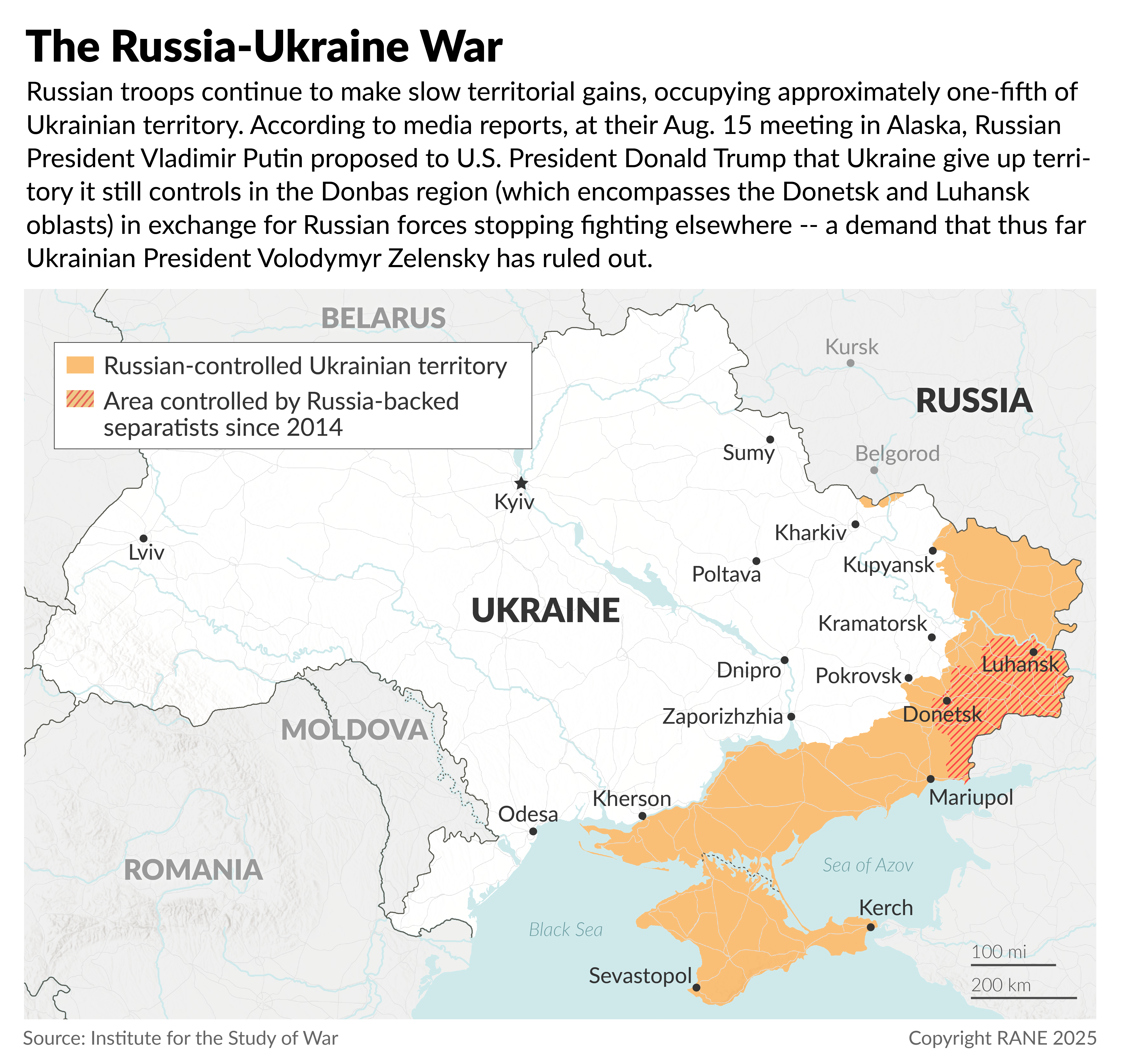
According to the leaders, the Aug. 18 meeting did not touch on the issue of territorial exchanges between Ukraine and Russia, but the question of land was central to the meeting between Trump and Putin and will be a significant obstacle to a peace deal. In recent weeks, the United States and Russia have been discussing a potential deal according to which Russia would stop its offensive and freeze the war at the current battlelines in exchange for Ukraine giving up the territories it still controls in Donetsk and Luhansk provinces, together known as the Donbas. According to media reports, Trump and Putin discussed this possibility in Alaska. While Ukraine supports the idea of freezing the fighting, it will strongly reject giving up territory under its control, which will pose a significant obstacle to a deal if there are direct negotiations between Ukraine and Russia. Moreover, the Donbas is not the only area under dispute, as Russia only controls a fraction of Zaporizhzhia and Kherson provinces, which are strategic because of their access to the Dnieper River, a key transport artery for goods, grain and raw materials moving between central Ukraine and the Black Sea ports and a formidable defensive line that is difficult for ground forces to cross without sustaining heavy losses. During eventual peace negotiations, Russia may demand full control of these two regions, to be able to limit Ukraine's access to the river, something that Kyiv will strongly oppose. Other issues, such as the status of Crimea — illegally annexed by Russia in 2014 — will also prove problematic, though they are not as crucial for Ukraine as the Donbas, Zaporizhzhia and Kherson.
- In several press statements and social media posts, Trump has mentioned that a peace deal between Russia and Ukraine would involve "land swaps" between the two. While on many occasions Trump suggested that Zelensky would need to make significant land concessions to end the war, on Aug. 18 he said that this was an issue for Kyiv and Moscow to decide.
In the coming weeks, Russia will keep the peace process alive and additional rounds of negotiation with Ukraine are likely, but without stronger U.S. pressure a ceasefire, let alone a peace deal, will remain elusive. Since taking office in January, the Trump administration has alternately threatened Russia and Ukraine with sanctions unless they agreed to enter, and then continue, a peace process. This has resulted in three rounds of direct negotiations between Russian and Ukrainian delegations in Istanbul (in May, June and July) and the face-to-face meeting between Putin and Trump on Aug. 15. While the Kremlin is confident that it can still make territorial gains in Ukraine during its ongoing summer campaign, it also wants to keep negotiations with the United States and Ukraine alive to avoid a substantial increase of U.S. assistance for Ukraine and/or an escalation of U.S. economic pressure against Russia. This means that there will almost certainly be new rounds of Russia-Ukraine talks, probably involving mid- or high-ranking delegations from the two countries, though a face-to-face meeting between Putin and Zelensky cannot be ruled out. So far, Russia has not given any indications that it is willing to give up on its maximalist demands, which include substantial territorial claims over Ukraine, demands of strict limits to Ukraine's military power, a ban on Ukraine's NATO accession and no deployment of Western troops to Ukraine. As a result, unless the United States significantly increases pressure on Russia — which the Trump administration has been reluctant to do — Moscow will not face any immediate pressure to make concessions. Moreover, the upcoming phase of Russia-Ukraine negotiations creates risks for Kyiv, because any Ukrainian opposition to give in to Russia's maximalist demands could result in the White House increasing pressure on Kyiv to accept a deal.
- Since the start of the peace process earlier this year, Ukraine has insisted that a ceasefire is a precondition to creating a conducive environment for a more stable peace deal. Russia, for its part, demands that the so-called "root causes" of the war, Kremlin jargon for its maximalist demands, must be addressed from the start, rejecting Ukraine's sequential approach. The United States has at times called for a ceasefire and at times called for a peace deal. If Russia believes that there is a clear and immediate risk of a significant escalation of U.S. pressure, then it could accept a multi-day or even a multi-week ceasefire. However, this arrangement would be fragile and subject to violations and eventual collapse, especially if no progress on the structural issues is made.
- In March, the United States temporarily suspended intelligence sharing and military aid for Ukraine after a tense meeting between Trump and Zelensky at the White House. While the U.S. reversed this decision a few days later, it serves as an example of the Trump administration pressuring Ukraine whenever it perceives that Kyiv is an obstacle to a peace agreement with Russia.
