
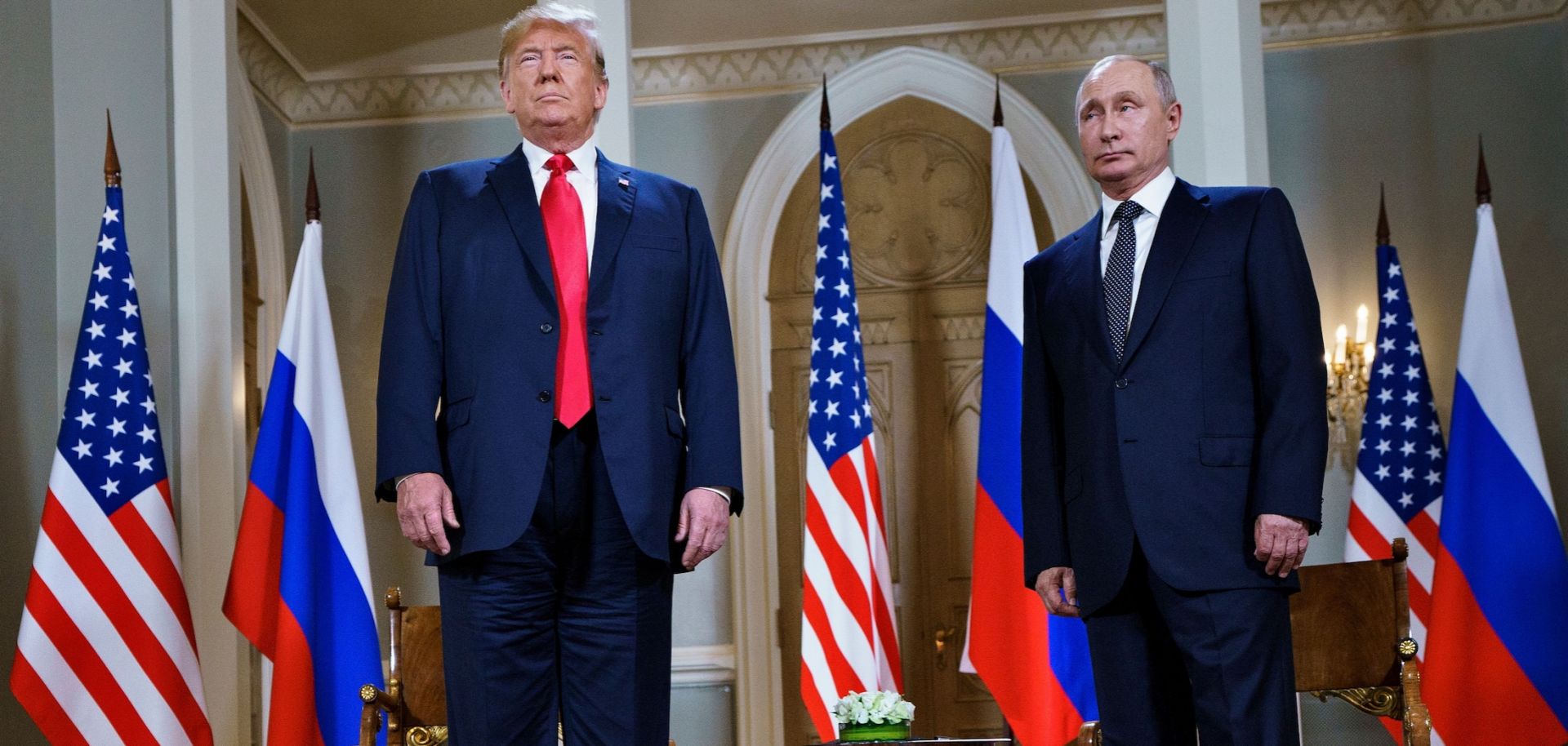
On Aug. 15, U.S. President Donald Trump will meet Russian President Vladimir Putin in Alaska to discuss the war in Ukraine and the possibility of a ceasefire that opens the door to a future peace deal, in addition to other bilateral issues. Media reports indicate Washington and Moscow are exchanging proposals that would let Russia retain most, if not all, of the territory it currently holds in return for halting its offensive and freezing the front lines. Trump has confirmed the talks, adding that ''there'll be some swapping of territories to the betterment of both.'' Uncertainty remains over whether Ukrainian President Volodymyr Zelensky will attend, as the White House has voiced support for his participation but also signaled Trump is willing to meet Putin alone. Putin, for his part, has said conditions are not ripe for talks with Zelensky, making his exclusion likely. In this context, the main risk for Ukraine connected to these talks is a U.S.-Russia deal that cements major territorial losses while offering weak security guarantees, leaving the country exposed to future Russian aggression.
The Evolving U.S. Approach to Ukraine
The timing for the Alaska meeting makes sense for both the United States and Russia. On the campaign trail, Trump promised that he would put a quick end to the war. His initial strategy was to improve ties between the United States and Russia while threatening to cut financial and military support for Ukraine to pressure Kyiv into accepting a deal. But this approach proved ineffective, primarily because Russia thought, correctly, that it could make additional territorial gains before negotiating a deal. Consequently, the White House shifted course, becoming friendlier toward Ukraine (including by authorizing additional weapons sales to European partners for transfer to Kyiv) and increasing economic pressure on Russia (notably, through imposing secondary tariffs on countries purchasing Russian oil, a threat that so far has only materialized in the case of India).
This change in U.S. strategy forced Russia to respond. Russia faces a relatively comfortable position on the battlefield, with its forces making slow but steady progress on the ground in Ukraine. However, the approaching autumn rains and the winter snows will make it more difficult for Moscow to make substantial territorial gains in the fourth quarter, and especially in the first quarter of 2026. Additionally, the Russian economy, while still resilient, is dealing with mounting problems (ranging from high inflation to a still large but shrinking sovereign wealth fund) that a potential cutoff from its main oil customers would make worse. Against this backdrop, agreeing to meet with Trump enables Putin to achieve multiple goals. The first is to send Trump the message that he remains engaged in the peace process, which reduces the risk of the United States imposing tariffs on other buyers of Russian oil (notably China) and the imposition of more damaging tariffs or sanctions. The second is to weaken Western unity, as a bilateral summit between Putin and Trump excludes Ukraine's staunchest supporters in the European Union and the United Kingdom. In fact, both the European Union and the United Kingdom spent the days following the announcement of the Alaska summit demanding a seat at the table, only to get the promise of a phone call with Trump on Aug. 12. The third, and arguably most important goal, is that direct U.S.-Russia talks open the door to a potential peace settlement in Ukraine that largely benefits Russia.
Kyiv's Nightmare Scenario
A peace deal between the United States and Russia that does not involve Ukraine is a nightmare scenario for Kyiv. Despite U.S. and European pressure, Moscow has not abandoned any of its maximalist war aims, which include control of the Ukrainian territories it occupies, a formal NATO commitment that Ukraine will never join the alliance, guarantees that Ukraine will have limited military capabilities and no nuclear weapons, the absence of any NATO troops to protect Ukraine after a ceasefire, and the ''de-nazification'' of what Moscow calls Ukraine's illegitimate government (in other words, Zelensky's removal).
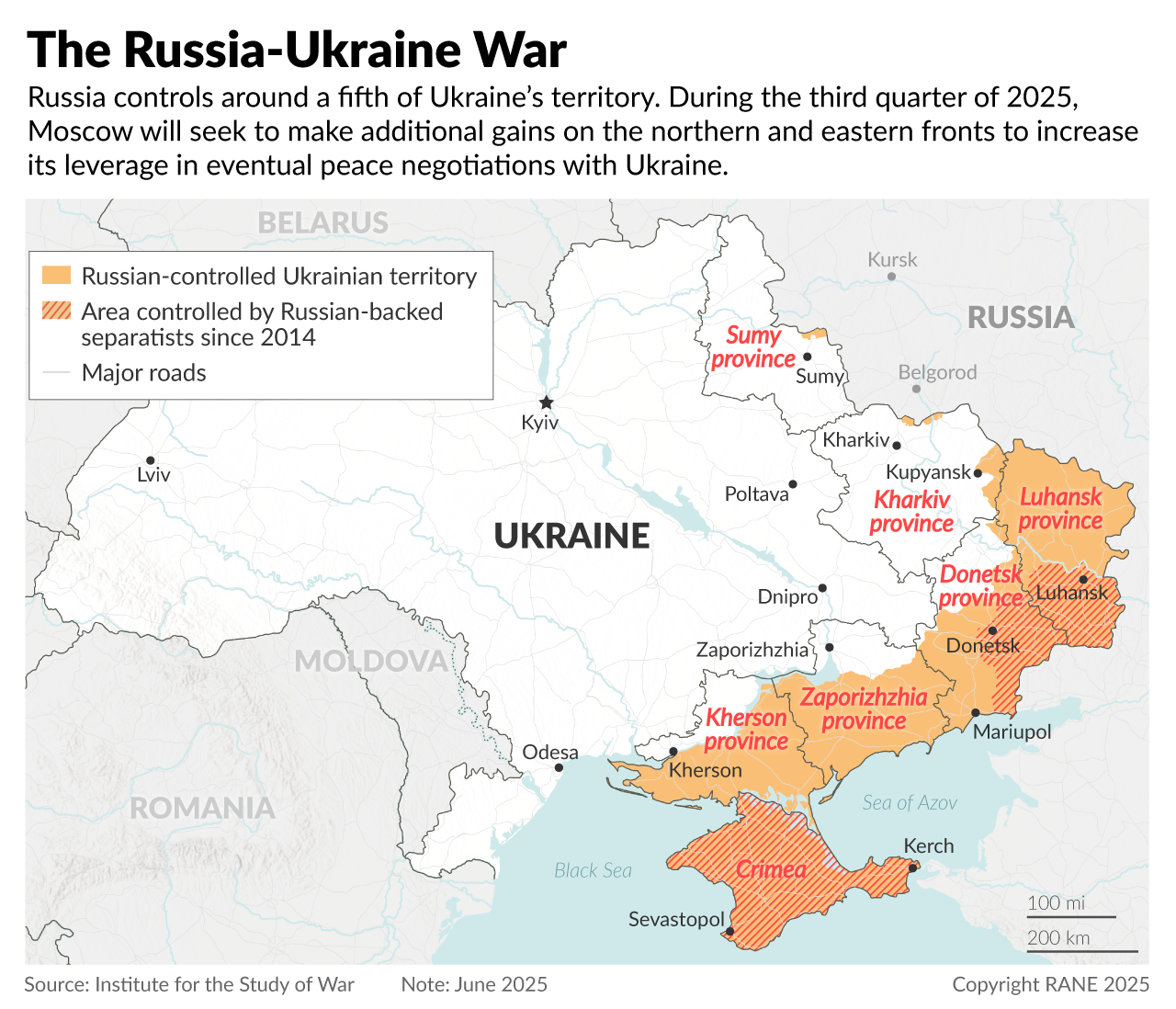
The United States has already shown a willingness to accept many of these demands. In its early conversations with Russia, the Trump administration said it would be willing to recognize Crimea (which Russia illegally annexed from Ukraine in 2014) as Russian territory. The White House has also repeatedly said Ukraine would need to give up territory in order to achieve peace. While the United States has not explicitly spoken against the presence of European forces to protect Ukraine after the war, the White House has excluded a meaningful U.S. military presence in Ukraine. And earlier in the year, U.S. government officials met with prominent Ukrainian opposition figures to test the waters for the outcome of a potential post-Zelensky government. Having made so many concessions before the proper negotiations with Russia even began makes it hard to believe the Trump administration will now be willing to push harder to defend Ukraine's territorial integrity and sovereignty. With the White House focused on the Middle East and Asia Pacific, and seeking quick political victories at home, the administration is likely more interested in claiming that it ended the war in Ukraine than in securing a deal that is particularly beneficial to Kyiv.
This situation creates a significant risk for Ukraine. If the United States and Russia reach a deal (either at the Alaska summit or at some other point in the future) that includes minimal territorial changes from the current frontlines and no U.S. presence on the ground in Ukraine to deter future Russian invasions, there is a risk Washington could coerce Kyiv into accepting it by threatening to withdraw financial and military aid. This would leave Kyiv with only bad options. One of them would be to accept the deal, which would stop the war but leave the country highly vulnerable to future Russian invasions. The other would be to reject the deal, which could result in Ukraine losing U.S. aid and having to rely only on European support. This would prolong the war for several more months, or even years, but would open the door to more substantial Russian progress on the ground and an eventual peace deal under even worse territorial conditions.
If a deal is struck between the United States and Russia, the issue of security guarantees would thus likely be as crucial, if not more so, than territorial concessions. Three and a half years into the war, most Ukrainians have come to terms with the fact that Russia will keep most of the territory it has occupied. While significant territorial concessions would almost certainly trigger protests and political volatility in Ukraine, large segments of the Ukrainian society and political establishment see them as inevitable.
The real question that will define the future viability of Ukraine as a sovereign state is not necessarily whether Russia keeps the Donbas region (most of which is under Russian control) or the Crimea peninsula. The negotiations over the Kherson and Zaporizhzhia regions (which Russia occupies only partially) will be far more relevant because they offer access to the strategically important Dnieper river, but the future of these areas will not seal Ukraine's fate. What will be crucial for Ukraine's viability as a sovereign state is whether it can realistically deter future Russian coercion. Russia's goal is to prevent Ukraine from ever joining NATO (and to a much lesser extent, the European Union) through political, economic and military coercion. While Ukraine's military is far stronger now than it was before the February 2022 invasion, a constant and credible threat of Russian aggression will be enough to make Ukraine's membership in either entity unviable and undermine the country's political stability and economic prosperity, even if the re-invasion never materializes. Consequently, the negotiation that will define both the end of the war and the possibility of another war in the future is that of security guarantees.
There is some hope for Ukraine on this crucial issue. The United States does not want American boots on the ground in Ukraine, but it probably also does not want another Russian invasion by the end of the decade. This could see the Trump administration pressure Russia to accept a European peacekeeping force in Ukraine, which would enable the United States to simultaneously limit its engagement in a deterrence force (some degree of U.S. logistical support would still be necessary), while making it costlier for Russia to re-invade the country. The White House could use a combination of carrots and sticks to achieve this goal. For the carrots, it could offer to lift sanctions against Russia and pressure Europe to do the same in exchange for Russia accepting a European presence in post-war Ukraine. And for the sticks, the Trump administration could threaten to increase military and financial support for Ukraine (in addition to imposing tougher sanctions on Russia) if Moscow rejects European security guarantees for Kyiv. Russia may very well be amenable to this U.S. pressure, as a European tripwire force in Ukraine (which France, the United Kingdom and others have discussed for months) would not be nearly as deterring as a U.S. peacekeeping force.
Alaska Is Not the End
It is also entirely possible that the Putin–Trump meeting in Alaska produces no concrete decisions, offering only broad promises to keep the peace process alive and continue discussions. Another potential outcome is a loosely defined framework deal that Moscow and Washington interpret in conflicting ways, which would be in line with many of the trade agreements that the White House has recently concluded. A third scenario is a ceasefire intended to create space for substantive negotiations, but which collapses within days or weeks, forcing all parties to rethink their strategies. Yet in every case, the underlying trajectory of the war is similar: Ukraine is on course for significant territorial losses and weak security guarantees. This means that, regardless of the immediate outcome of the Aug. 15 meeting, the most probable scenario in the coming months or years is a territorially reduced Ukraine still facing the persistent risk of renewed Russian aggression — whether the terms are set in Alaska or in talks held further down the line.
