
Initial market reactions to U.S. President Donald Trump's July 7 announcement of higher tariffs on more than a dozen countries, including Japan and South Korea (the United States' fifth and seventh largest source of imports), were muted, as were the reactions to his July 9 announcements of tariffs on 7 other countries. This stands in stark contrast to the market rout observed in early April, following Trump's announcement of high tariffs on nearly all of the United States' primary trading partners. In fact, the most significant reaction was a 25% surge in U.S. copper prices following the unanticipated July 8 announcement of a 50% tariff on copper imports.
Markets seem to believe that Trump will eventually back down and curb his tariff ambitions, despite his willingness to carry out a risky airstrike on three Iranian nuclear facilities in June. From the market perspective, Trump's decision to announce higher tariffs on only 21 countries (including several inconsequential partners such as Myanmar, Serbia and Bosnia and Herzegovina), while leaving out some of the United States' larger import partners (like the European Union and India), coupled with the delay of the tariff enforcement date from July 9 to Aug. 1, demonstrate the president's flexibility to reach trade deals and his potential waning willingness to move forward with high tariffs that could damage the U.S. economy. However, Trump's July announcements of higher tariffs are far from marking the end of trade uncertainties or even trade negotiations with U.S. partners. This is because Trump has clearly found leverage with tariffs and will continue to wield them for other, sometimes non-trade concessions on various foreign policy objectives.

An Unchanged Strategy
With that in mind, it is worth stepping back and looking at the extent to which Trump's trade doctrine (which I outlined in March prior to the announcement of the so-called Liberation Day tariffs) has changed, if at all. In that column, I summarized four key lessons on trade that the first two months of Trump's second term had taught us. The first lesson was that Trump is somewhat concerned about the impact of U.S. trade policy on markets. The second was that Trump is far more risk tolerant over implementing a broad array of tariffs at once that could undermine the economy. The third was that Trump is not concerned about disrupting relations with long-standing allies. And the fourth was that the second Trump administration is far more united on trade policy than the first Trump administration.
Four months later, all of these observations remain true. Trump ultimately backed down from the sky-high ''reciprocal'' tariffs announced in April, soon after a market rout, particularly in the U.S. bond market, leaving the tariffs in place for only 24 hours. Still, Trump has implemented a broad 10% tariff on virtually all U.S. trading partners, in addition to an ever-expanding list of goods subject to national security tariffs, including broadening out steel and aluminum tariffs to include derivatives like washing machines and canned beer. Trump's July announcements were headlined by the United States announcing a plan to increase tariffs on Japan and South Korea — its two most important defense allies in East Asia — to 25%. This demonstrates that he is still willing to implement tariffs on key U.S. allies, regardless of whether it disrupts relations. Finally, while some administration officials, such as Vice President J.D. Vance, have sought to steer Trump toward backing a trade deal that is more pointed in its targeting of China, virtually no one in the administration has spoken out against Trump's tariff policies, at least publicly, and there are few signs that internal opposition is significantly blunting the White House's use of tariffs over ideological grounds. Indeed, many Trump administration officials have spent the last three months trying to explain that an overabundance of goods and options is not necessary for the U.S. consumer, infamously saying that girls only need two dolls instead of 30.
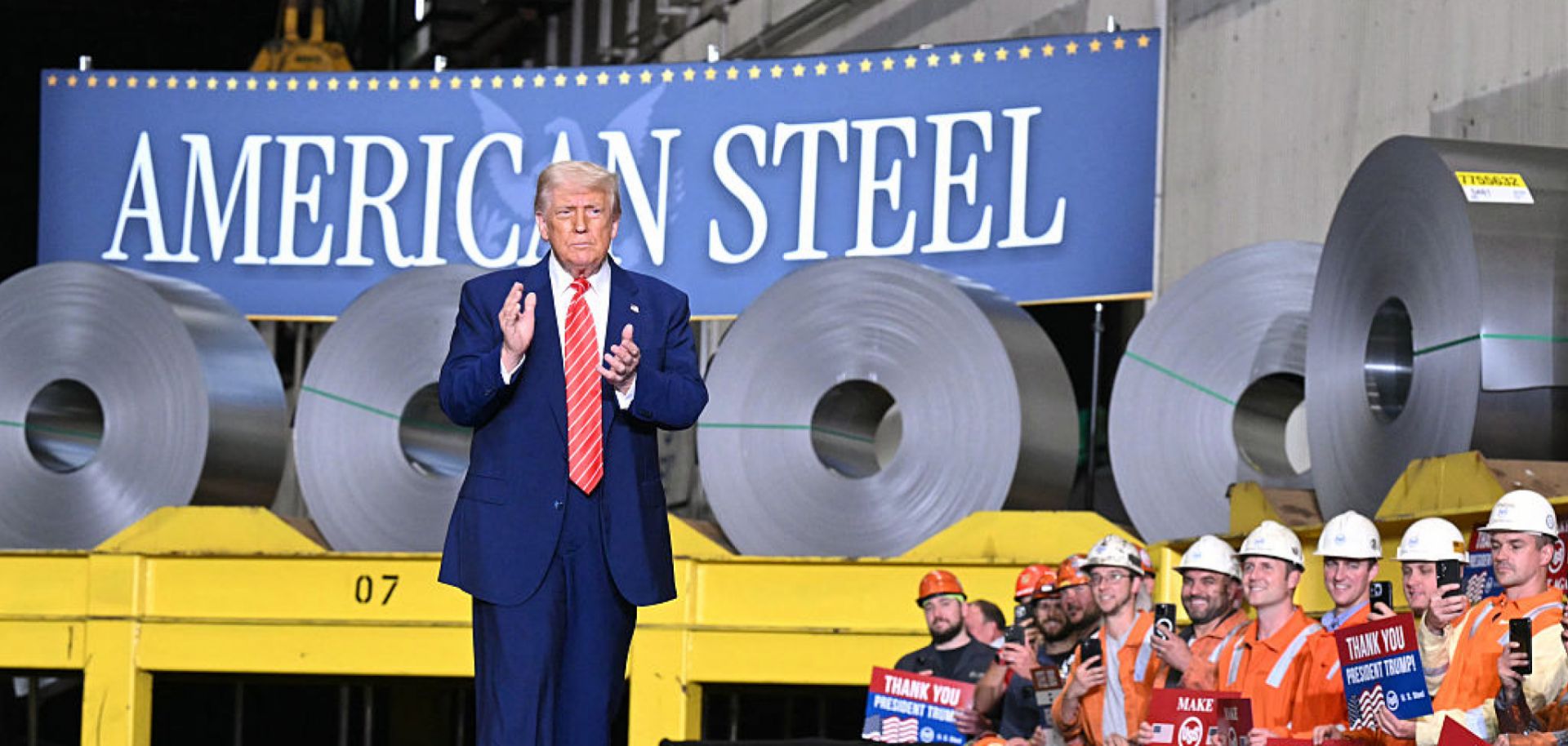
The column I wrote in March also explained Trump's goal of revitalizing the U.S. manufacturing sector and shielding it from international competition. That goal has not changed. Not only has Trump continued to protect the steel industry, but his administration has also widened tariffs on steel and aluminum derivatives multiple times in an effort to protect U.S. industries dependent on steel and aluminum that were struggling to compete with international competitors not facing the structurally high prices that have emerged in the U.S. market after steel and aluminum producers petitioned the administration for protection. Trump also continues to use the United States' trade deficit with a given country as the primary determinant of whether Washington is ''winning'' that trade relationship.
The final point of the doctrine I laid out in March has only become more salient: the White House is willing to negotiate with trading partners, but deals will need to include restrictions on exports (such as quotas or smaller tariffs) to the United States and promises to buy more U.S. goods to reduce the bilateral trade deficit. Perhaps the one lesson the last three months have taught us is that Trump is even more drawn to the allure of trade deals, even if, in practice, negotiating those deals has proven far more difficult than he or his trade advisors previously imagined.
The Spoils of Trade Wars
The Trump administration has so far signed trade deals with the United Kingdom and Vietnam. The White House is also reportedly on the verge of finalizing agreements with India, as well as the European Union (which, as a bloc, is the largest destination for U.S. exports and the largest source of U.S. imports).
These deals achieve the ultimate goal of Trump's trade doctrine: to restrict, not increase, trade. The signs of this policy were clear from the moment the United States and the United Kingdom reached a deal in May. From Trump's perspective, the U.S.-U.K. trade relationship was already fair since the United States had an $11.3 billion trade surplus with the United Kingdom in 2024 and has not had a trade deficit with the United Kingdom since 2015. Yet, the final deal saw the United States keep a 10% tariff on British goods and created quotas for aluminum, steel and automobile tariffs. The United Kingdom has already struggled to comply with the steel quota, in particular, given that it requires steel to be ''melted and poured'' in the United Kingdom (i.e., excluding all steel derivatives made using steel produced outside of the United Kingdom). This is by design, as the deal is aimed at restricting U.S. imports from the United Kingdom.
The new U.S. deal with Vietnam is aimed at doing the same. The United States agreed to increase tariffs on Vietnam to 20%, making it the first trade deal explicitly designed around one party increasing tariffs on the other party. For Vietnam, 20% was far better than the 46% tariff that Trump had originally threatened, and Hanoi appears to have decided that reaching a deal to limit the tariffs was less risky than trying to call Trump's bluff and hope that he backed down from tariffs again. As part of the deal, Vietnam also agreed to remove tariffs on many imported U.S. goods, but this appears unlikely to trigger a surge in U.S. exports to Vietnam. For one, the deal did not touch digital trade or the non-tariff barriers that the United States had originally negotiated with Vietnam and other countries as a part of the Trans Pacific Partnership. Secondly, outside of agricultural products and energy, many high-value U.S. goods will remain too expensive for the Vietnamese to purchase in large quantities. This also means that the U.S.-Vietnam trade deficit will remain and might even grow if the 20% tariff level does not erase Vietnam's comparative advantage against other countries, including several ASEAN countries like Indonesia, Malaysia and Laos that received letters threatening tariffs above Vietnam's 20% level from Aug. 1.
Leaked details about the White House's draft trade deal with the European Union indicate the agreement is similar to those reached with Vietnam and the United Kingdom, in that it centers on restricting exports to the United States and only has modestly higher opportunities for U.S. exports outside of energy and agricultural exports. The White House has reportedly offered to keep most tariffs on EU goods set at 10%, instead of raising them to 20% or 50% as Trump has previously threatened. The Trump administration has also even offered to exempt EU exports of aircraft and certain alcohol. However, it has refused to budge on reducing steel, car and aluminum tariffs. Given that the European Union is a much larger exporter of those goods than the United Kingdom, U.S. demands will likely focus more on either keeping the tariffs in place or getting Brussels to agree to quotas that are even more restrictive than the ones imposed on the United Kingdom. Details about the U.S.-India trade deal have been sparser, but it will likely be similar in nature.
The Challenges of Trade Talks
While the European Union and Vietnam appear to be making the political decision to take the least bad deal rather than call Trump's bluff, the Japanese and South Korean governments have taken a more hard-line approach, partly due to political constraints amid election cycles in both countries. In June, Lee Jae-myung of the Democratic Party won South Korea's presidential elections, shifting government control from the People Power Party. Japan, meanwhile, will hold upper house elections on July 20 that will determine whether Prime Minister Shigeru Ishiba's political standing strengthens or weakens.
Fears of angering voters ahead of these ballots restricted South Korea and Japan's willingness to offer trade concessions to the United States, and forced them to maintain hard-line positions on sensitive issues, as evidenced by Tokyo's push for agricultural protections and lower automotive trade barriers in its negotiations with Washington. However, South Korean and Japanese officials still met with U.S. officials many times in recent months, in the hopes of securing at least some relief from U.S. tariffs.
Of particular concern are the sectoral tariffs that the Trump administration imposed on all imported cars and car parts. This is due to Japan and South Korea's high economic dependence on car exports to the United States, with transportation sector goods (including heavy and light-duty vehicles) accounting for approximately one-third of the two countries' total exports to the United States.
However, it remains unclear whether the Trump administration will be willing to offer them concessions on these tariffs. For one, the White House has so far shown little desire to offer widespread exemptions for countries whose vehicles do not use significant amounts of U.S. content, like those made by Japanese and South Korean carmakers. Japanese and Korean cars are also among the most affordable and popular options in the U.S. market, which makes them a broader threat to American automakers' bottom lines and, as the Trump administration's thinking goes, American autoworkers' salaries and jobs.
Ongoing U.S. reviews and investigations into other various sectors are also expected to lead to more sectoral tariffs, similar to those the Trump administration has already imposed on auto, steel and aluminum imports. The Trump administration's investigation into the semiconductor industry, in particular, could lead to U.S. tariffs not only on semiconductor chips themselves — a key South Korean export — but also on derivative products, such as certain electronic goods that contain semiconductors. With the steel and aluminum tariffs, the United States has progressively broadened the scope of covered goods to include those far down the value chain from primary steel and aluminum products, such as major household appliances like stoves and refrigerators (of which South Korea is a major exporter). Should the White House take a similarly broad approach with semiconductor tariffs, many Japanese and Korean electronics products could face higher tariffs, regardless of whether Seoul and Tokyo reach trade deals with Washington. For both South Korea and Japan, extensive U.S. tariffs on the electronics sector could result in over half of their total exports to the United States being subject to sectoral tariffs (i.e., those not covered by a future trade agreement with the White House).
The looming threat of U.S. tariffs on semiconductor and electronics goods thus creates a high degree of uncertainty for Japan and South Korea, giving them even less incentive to offer major concessions now without knowing which of these potential tariffs will actually be imposed. Indeed, these future tariffs will likely be implemented concurrently with the country-specific Liberation Day tariffs, meaning any agreement on the country-specific tariffs should not be considered a barrier to the imposition of additional sectoral tariffs. To that point, the deals with the United Kingdom and Vietnam, and leaked information regarding the deal with the European Union, lack assurances that the United States will exempt these trading partners from future sectoral tariffs imposed by the White House.
The 25% tariff that the United States is now threatening on South Korea and Japan does not cover sectoral tariffs, which reduces the potential benefits of any agreement for both nations, as well as the economic repercussions for Japan and South Korea should the United States impose 25% tariffs on other sectors. Amid the uncertainty over future sectoral tariffs, it is hard for Japan and South Korea to offer substantial concessions to the United States, as the deal may not offer medium- or long-term respite from tariff threats.
This illustrates another emerging concern among countries negotiating with the United States: there's no promise that Trump will not renege on a trade deal. For South Korea, this point is already clear, as its success in renegotiating its free trade agreement with the United States during Trump's first term has not stopped Trump from imposing more tariffs on South Korean goods during his second term. The same can also be said for Mexico and Canada, given that the United States-Mexico-Canada Agreement signed in 2018 has done little to protect either country from Trump's renewed tariff threats. In effect, the tariffs on South Korea, Mexico and Canada thus demonstrate to these nations and other U.S. trading partners that any deals signed with Trump may offer only a temporary reprieve from his trade threats and can be abandoned if he so chooses.
In his second term, Trump has also increasingly used tariffs or tariff threats as a foreign policy tool to gain concessions on matters beyond just trade issues, as evidenced by his recent threat to place a 10% tariff on countries collaborating with the BRICS bloc of developing nations on ''anti-American'' policies. This — combined with Trump's willingness to abandon trade deals signed in his first term, as well as his blunt approach to foreign policy negotiations with other countries — suggests that even if he signs various new trade deals this year, Trump will likely continue to frequently wield tariffs as a means to advance U.S. interests on both trade and non-trade matters over the next three and a half years. This is especially likely if U.S. trade deficit continues to widen, as is probable with certain countries due to U.S. spending habits, capital inflows to the United States and the U.S. federal government deficit.
The Impact on the U.S. Economy
In the column I wrote after Trump announced his Liberation Day tariffs in April, I argued that several factors would hinder his trade strategy from achieving its core aim of revitalizing U.S. manufacturing and boosting U.S. exports of manufactured goods. These include a U.S. workforce now concentrated in the service sector, delayed investments due to high U.S. economic uncertainty, and elevated tariffs increasing costs for U.S. companies, thereby eroding their industrial competitiveness.
Each of these constraints remains. In fact, the deals that are being reached with countries are enshrining tariffs at a higher level, lengthening out the related risks. Vietnam and the United Kingdom agreed to higher tariffs as part of their deals, and the European Union may be on the verge of doing the same. The enshrining of these tariffs will also make it more politically difficult for Trump's successors to remove them, even if they want to. Domestic industries that are protected by the tariffs (such as the U.S. auto industry) will lobby for them to remain in place and, more importantly, the next U.S. president will need to demonstrate ''wins'' in talks that remove them, meaning gaining more concessions from trading partners.
The tariffs that the Trump administration has already imposed since taking office in January, plus the new ones it threatened on July 7 to place on 14 more countries starting Aug. 1, will have long-term repercussions for the U.S. economy and could eventually erode the United States' competitiveness against China. In a July 7 report, the Budget Lab at Yale estimated that the new tariffs announced on July 7 and all of the tariffs implemented thus far will reduce long-term U.S. GDP by 0.5%, increase the effective tariff rate to levels not seen since the 1930s, cost the average American household more than $2,300 in real disposable income, increase price levels by 1.7% and cost the United States about $400 billion in long term government revenue. And as discussed, the Trump administration is not done yet with sectoral tariffs and may announce new, higher Aug. 1 tariffs on other countries that it is not close to reaching a trade deal with, meaning the economic impacts of Trump's final trade policy will likely eventually outstrip these Budget Lab projections.
That said, the market's muted reaction to Trump's latest tariff threats suggests that the worst of the trade war may be over. Instead of broad, global tariff threats, his future tariff threats may be more targeted, focusing on specific countries or goods, similar to the copper tariffs Trump also announced. But while these narrower tariffs will not trigger the immediate systemic crisis that the sweeping tariffs Trump announced in April may have, they will still have negative long-term implications for the U.S. economy and the United States' economic strength vis-a-vis China and the rest of the world.