
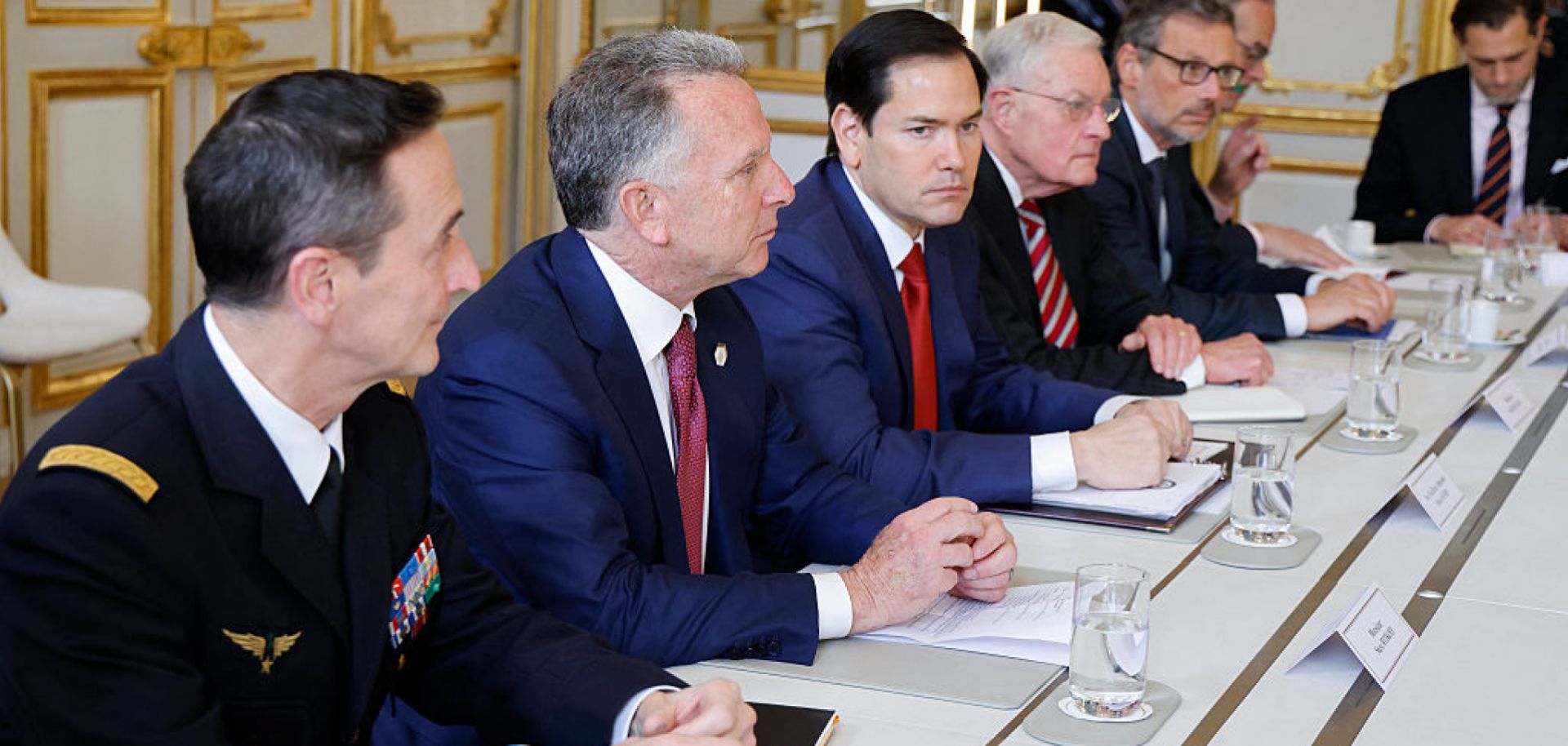
Growing U.S. pressure to wind down the war in Ukraine will force Kyiv to choose between compromising on its supposed red lines to de-escalate the conflict, or risk losing U.S. support and its battlefield position by refusing to cede. On April 23, the United Kingdom downgraded planned talks in London among Ukrainian, European and U.S. officials from a higher ministerial to a lower working level after U.S. Secretary of State Marco Rubio and U.S. envoy Steve Witkoff said they could no longer attend. Rubio and Witkoff reportedly withdrew from the talks upon learning that the Ukrainian delegation wanted to discuss options for a ceasefire, instead of the U.S. peace framework that Rubio presented to his European and Ukrainian counterparts during an April 17 meeting in Paris. According to multiple Western media outlets (including Axios, Bloomberg and The Wall Street Journal), the proposed U.S. plan envisions granting Russia de jure U.S. recognition of its control over Crimea; unofficial U.S. and European recognition of the Russian-occupied parts of the Ukrainian regions of Donetsk, Kherson, Luhansk and Zaporizhzhia; a promise that Ukraine will never join NATO; the eventual easing of economic sanctions on Russia; and more U.S. economic cooperation with Russia. In return, Ukraine would get a promise of ''a robust security guarantee,'' seemingly in the form of a still emerging plan for a European-led military deployment and no limit on the number of troops and capabilities of the Ukrainian military; the return of a small portion of the Kharkiv region occupied by Russian troops; guaranteed free passage on the Dnieper River (which in some place runs along current frontlines); and general promises of financial support and other help to rebuild the war-torn country.

- While the U.S. plan would reportedly see Washington recognize Russia's control of other parts of the wider Zaporizhzhia region under its control, the Zaporizhzhia nuclear plant would still be considered Ukrainian territory (and, according to some media reports, the area immediately around it would be neutral territory). But the plant would be operated by the United States, which would provide both Russia and Ukraine with electricity.
- The White House's peace framework also incorporates the expected signing on April 24 of a delayed plan for a U.S.-Ukrainian economic deal that, if media leaks are accurate, would create a joint investment fund into which Ukraine would deposit half the revenues accrued from natural resources and infrastructure projects, and from which the United States would have the first claim on profits.
- Despite explicitly ruling out Ukraine's NATO membership and making no reference to U.S. support for a European military deployment, Washington's plan reportedly does not negate the possibility of Ukraine one day joining the European Union, nor does it explicitly remove Kyiv's sovereignty to make decisions about joining other blocs or inking various deals with other countries.
Over the past week, Washington has dramatically increased its pressure on Kyiv and Moscow to reach some sort of a deal amid signs from both sides that, despite hurdles, there may be room for talks. After the summit in Paris, Rubio on April 18 told reporters that the United States could ''move on'' from its mediation role if Russia and Ukraine did not make tangible progress to wind down the war in the near future. Later that day, U.S. President Donald Trump then echoed this sentiment by saying Washington would ''take a pass'' on mediation absent quick progress toward de-escalation. Since then, both Trump and Rubio — as well as a host of other top U.S. officials, including Vice President J.D. Vance — have made similar statements. Against this backdrop, Axios reported on April 22 that the White House has positioned its proposed peace framework as its ''final offer'' before it pulls out of mediation efforts. Though top Russian and Ukrainian officials have continued to emphasize the challenges in reaching a long-term settlement of the war, there have been signs of potential openings for discussions amid this mounting U.S. pressure. Most significantly, Kremlin spokesperson Dmitry Peskov told reporters on April 22 that, while no firm plans are in the works, Russian President Vladimir Putin was prepared to evaluate an offer from Ukrainian President Volodymyr Zelensky to stop attacks against civilian infrastructure. Later the same day, the Financial Times, citing unnamed sources familiar with the discussion, reported that Putin told Witkoff during an April 11 meeting that Russia was also ready to freeze its invasion along the current frontlines, and give up its demand for official recognition of the complete portions of the four eastern Ukrainian regions it unilaterally annexed in 2024 — marking the first alleged indication that the Kremlin may be willing to soften its stance on at least some territorial recognition demands.
- On April 23, Trump issued a blistering critique of Zelensky in a Truth Social post in which Trump alleged that Zelensky was sabotaging efforts to de-escalate the conflict by refusing to discuss the status of Crimea. Trump said Zelensky has ''no cards to play'' and told him to ''GET IT DONE,'' a reference to agreeing to the U.S. framework.
- According to media reports, some unnamed European, Russian and Ukrainian officials believe that the United States' stepped-up pressure is meant to achieve some sort of a deal by April 30, which would be Trump's 100th day in office and thus a highly symbolic victory for the president.
For Ukraine, agreeing to the proposed U.S. framework would entail very painful and risky compromises, but it would also open the door to de-escalating the war. Washington's plan forces Kyiv to make a very tough choice. As currently framed, Ukrainian officials say the U.S. framework is far too slanted toward Russia, particularly the proposal to officially recognize Russian control over Crimea, which Zelensky has repeatedly said is a red line that would contravene Ukraine's constitution. Moreover, in agreeing to the framework, Ukraine would be gambling that the United States and Europe make good on their commitments (including the nebulous promise for ''a robust security guarantee''), which are much vaguer than the comparatively more concrete concessions and other promises made to Russia in the U.S. plan. Accepting the framework would also grant Russia some level of leverage over Ukraine in the future by requiring Kyiv to abandon its NATO membership ambitions. This would leave Ukraine without the formal protection of NATO's Article V mutual defense clause, even though Russian troops would likely maintain a strong presence in the eastern parts of Ukraine they would continue to occupy, thereby keeping the threat of another offensive on the table. Nonetheless, Kyiv may feel it has no other option than to agree to the plan, as it faces the prospect of the United States not merely abandoning mediation efforts but potentially removing crucial military, intelligence, financial and other forms of support. Doing so would open the door to establishing a ceasefire, which would offer a path to de-escalate the conflict, even if it may be limited in time and/or scope, and would be at constant risk of breaking down. Finalizing the terms of an eventual peace deal would also face significant hurdles, and a high risk of either side of violating the process with military operations. But this scenario would still put Russia and Ukraine on a path toward winding down the conflict.
- A U.S.-Ukrainian economic deal could somewhat allay Kyiv's concerns about Washington's long-term interests in Ukraine, as the agreement would give the United States a stake in the future stability and security of the country in order to realize its economic benefits.
If, by contrast, Ukraine rejects the U.S. framework, the White House would almost certainly back away from its mediation efforts and could also pare back its support for Ukraine, which would imperil the country's battlefield position. Despite the United States' intensifying pressure campaign and implicit threats of further reducing support, Ukraine ultimately may conclude that the terms of the proposed framework are simply too high to accept, at least for now. At least rhetorically, Ukraine's leaders are signalling this is their current position, with Deputy Prime Minister Yulia Syvrydenko saying on April 23 that the country was ''ready to negotiate, but not to surrender.'' Should they stick to this stance and reject the framework, the United States would almost certainly make good on its threat to remove itself as a mediator. At a minimum, this would return the situation to the status quo ante before Trump took office in January, in which Russia was making slow but steady gains on the battlefield. However, in drawing ire from the Trump administration, Ukraine would also risk the United States curbing its military, intelligence, financial or other support for Kyiv — something that the White House has already proven willing to do after it cut Ukraine off from crucial intelligence sharing following Trump's contentious Oval Office meeting with Zelensky on Feb. 28. The end of U.S. mediation, let alone a decrease in U.S. support for Ukraine, would harm Ukraine's battlefield prospects over time. While European states would likely initially increase their military, intelligence and financial support to Ukraine to help offset the U.S. aid cuts, they may struggle to sustain elevated aid levels on their own beyond the next few months amid persistent internal divisions and the risk of more governments drifting toward more critical positions like those of Hungary and Slovakia. In this scenario, Ukrainian forces would likely lose more territory amid ongoing Russian advances, and Kyiv could find itself in an even more precarious negotiating position in the future that would entail even deeper compromises than those currently envisioned in the U.S. proposal.
- In the scenario in which Ukraine rejects the U.S. peace framework, it is also possible that Kyiv, feeling increasingly cornered and no longer caring about the opinion of the United States, becomes much more risk-tolerant on the battlefield. This could translate to a higher pace of brazen Ukrainian operations in Russian territory, such as the start of a sustained assassination campaign against top Russian officials or lethal attacks carried out by saboteurs in major Russian cities — a development that could inch closer to a NATO-Russia conflict in Europe if Russia responds in a tit-for-tat fashion.