
While the U.S.-Ukraine minerals deal faces significant logistical and economic challenges that will limit its financial impact, it also opens the door to renewed conversations over the United States' continued financial and military support for Ukraine that could impede ceasefire negotiations with Russia. On Feb. 26, Ukrainian Prime Minister Denys Shmyhal said his country had reached an agreement with the United States to jointly develop Ukraine's mineral resources. The deal involves creating a joint investment fund where Ukraine will transfer 50 percent of the revenues from future projects to exploit state-owned mineral resources (including oil, natural gas and minerals). This fund will be jointly controlled by the United States and Ukraine and used to finance investment projects within Ukraine. The published version of the agreement mentions that the United States supports Ukraine's efforts to obtain the security guarantees necessary to ensure lasting peace and that the two sides will identify any necessary steps to protect mutual investments. However, it does not offer Kyiv any concrete U.S. security guarantees. According to the Ukrainian government, the deal has been approved by the country's justice, economy and foreign ministers, but it will be put to a vote at the Ukrainian parliament in the coming days. Ukrainian President Volodymyr Zelensky is expected to travel to the United States on Feb. 28, where he and U.S. president Donald Trump could sign the deal.
- Ukraine's natural resources include lithium, titanium, zirconium, graphite, nickel, cobalt, copper and rare earths, which are used in batteries, electric vehicles and high-tech industries. The country has deposits of 22 of the 50 materials that the United States has identified as critical to its economy, though it is uncertain how many of these deposits are commercially viable (none of Ukraine's rare earths, for example, are known to be commercial). Ukraine first suggested the idea of granting the United States privileged access to these resources in late 2024 as a part of a deal that would keep Washington involved in the country's security amid Russia's ongoing invasion.
- After taking office, Trump insisted on reaching a deal that ensures Ukraine ''pays back'' what the United States has spent on the country's defense since the start of Russia's full-on invasion in 2022. For weeks, Trump insisted that his goal was for Ukraine to transfer $500 billion to the United States over several years. However, this figure was removed from the final version of the deal, which made it easier for Kyiv to sign it.
- According to the deal, the Ukrainian and U.S. governments ''intend to establish a Reconstruction Investment Fund'' under the stated aim of ''achieving lasting peace in Ukraine.'' This fund will ''collect and reinvest revenues contributed to [it]'' and will also ''earn income from the future monetization of all relevant Ukrainian Government-owned natural resource assets.'' The document then clarifies that ''such future sources of revenues do not include the current sources of revenues which are already part of the general budget revenues of Ukraine.'' The deal also establishes that the U.S. government ''supports Ukraine's efforts to obtain security guarantees needed to establish lasting peace,'' and notes that the participants will ''seek to identify any necessary steps to protect mutual investments, as defined in the Fund Agreement.''
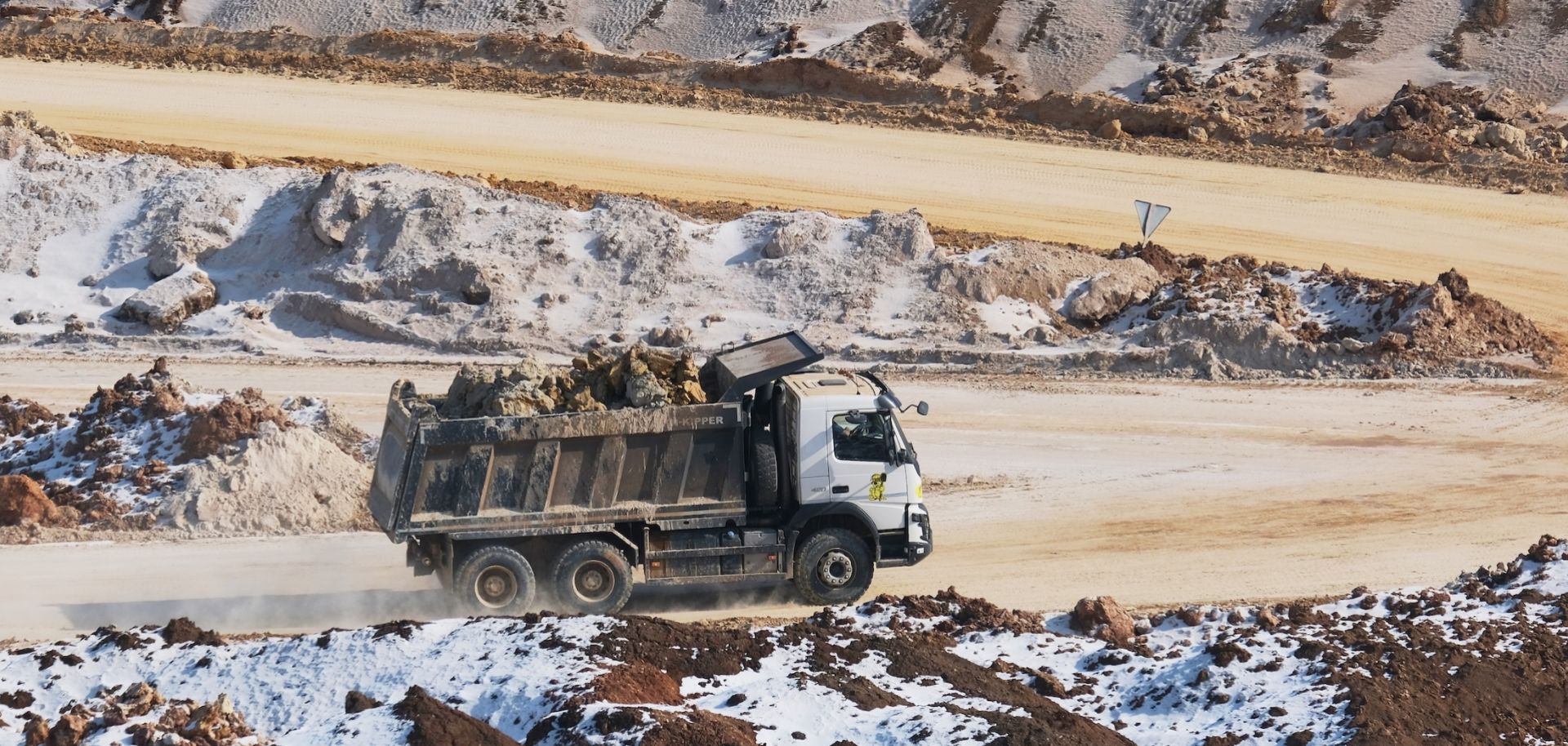
Significant challenges to accessing Ukraine's minerals — including outdated surveys, energy shortages, security risks and the proximity of key resources to conflict zones — raise questions about the plan's economic viability. Ukraine's raw materials are not particularly unique, as mineral reserves elsewhere are likely more economically viable. But the Trump administration has nonetheless shown interest in accessing Ukraine's resources as a way to diversify U.S. mineral supplies — particularly away from China, which has used its control over some of these crucial minerals as leverage against the United States. However, any plan to increase U.S. access to Ukrainian minerals will face several obstacles. For one, it is unclear just how vast Ukraine's mineral resources actually are, as all the assessments on the sector were conducted during the Soviet era, meaning the only maps available are 30-60 years old. Second, Ukraine likely lacks the resources to undertake mining on a grand scale as mining, and especially processing, consumes a lot of energy, and roughly two-thirds of Ukraine's electricity-generating capacity has been either destroyed or severely damaged by Russian attacks. Third, some of Ukraine's resources are in territories currently under Russian control, while others are on the Ukrainian side but close to the frontline. And finally, mining is a long-term investment, and companies are unlikely to invest in Ukraine as long as there are significant security risks. Given these various obstacles, the Feb. 26 deal is effectively a declaration of intent, as it cannot come to fruition without additional deals between the United States and Ukraine and significant investments over a long period. At this point, the deal thus instead appears to be primarily political, as it enables the White House to claim the United States will get some of its money back from Ukraine, while enabling Kyiv to remain engaged with the Trump administration at a time when the United States is in talks with Russia to end the war.
- The minerals deal comes after weeks of worsening relations between the United States and Ukraine. On Feb. 18, U.S. and Russian delegations met in Saudi Arabia to discuss ending the war in Ukraine and improving bilateral ties. The talks generated fear in Ukraine and Europe that the United States and Russia would negotiate a deal neglecting Ukraine's interests. On Feb. 18, Zelensky warned that Trump was spreading Russian disinformation. The next day, Trump called Zelensky ''a dictator'' for refusing to hold presidential elections, increasing concerns that the growing rift between Ukraine and the United States was beyond repair.
The minerals deal, while largely political for now, could influence the course of the war by justifying continued U.S. financial and military aid to Ukraine, potentially delaying any ceasefire with Russia. While at this point the U.S.-Ukraine minerals deal is primarily political, it could ultimately have a concrete impact on the evolution of the war for at least two reasons. The first is that this deal could make it politically easier for the Trump administration to justify the continuation of financial and military assistance to Ukraine. If the White House believes there is room for economic gains in Ukraine (however vague and far in the future they currently seem) — and especially if it believes U.S. companies will be involved in Ukraine's reconstruction and mining — the Trump administration may decide to give Ukraine additional resources to protect itself and create a better environment for foreign companies. The second is that the deal opens the door to at least a conversation between Kyiv and Washington over more concrete security guarantees for Ukraine, which seemed very unlikely only a month ago. Trump has repeatedly said that, in the case of a ceasefire, the United States would not deploy troops to defend Ukraine against renewed Russian aggression. However, the fact that the White House is interested in Ukraine's natural resources and reconstruction efforts suggests there could be some degree of U.S. security involvement in a ceasefire, if only to provide a conducive environment for U.S. companies to participate in those reconstruction and mining efforts. This does not necessarily mean that the United States will deploy troops to patrol the new Ukraine-Russia border, as the White House would prefer Ukrainian, European and perhaps international forces to take on that role. But options such as using U.S. security contractors or providing logistical or technical assistance to international troops in Ukraine cannot be ruled out. And given that the U.S.-Ukraine deal is, for now, primarily a declaration of intent, its future (as well as its impact on the war) will also depend on the follow-up agreements that the White House and the Kremlin will negotiate in the coming weeks. However, if these future deals result in concrete U.S. interest and involvement in Ukraine's reconstruction and safety, it could see the United States take on a greater security presence in Ukraine than what is currently being discussed. This would, in turn, increase both Washington and Kyiv's leverage during ceasefire negotiations with Moscow, potentially complicating an agreement to end the war.
- The text of the U.S.-Ukraine agreement does not explicitly mention the participation of American companies in any reconstruction or mining efforts in Ukraine. However, in an op-ed published by the Financial Times on Feb. 22, U.S. Treasury Secretary Scott Bessent said that the terms of the deal ''would also ensure that countries that did not contribute to the defense of Ukraine's sovereignty will not be able to benefit from its reconstruction or these investments.'' This suggests that future U.S.-Ukraine agreements to reflect this are possible.
- U.S. officials have said that a minerals deal between the United States and Ukraine would include de facto security guarantees for Ukraine, as it would show the United States' long-term commitment to Ukraine's security and prosperity. On Feb. 20, U.S. National Security Advisor Mike Waltz noted that such a deal would be ''the best security guarantee they could ever hope for, much more than another pallet of ammunition.''
- During a joint press conference with Trump on Feb. 24, French President Emmanuel Macron said that European countries were ''ready to send troops to verify that peace is respected,'' but that they ''need[ed] American protection.'' Trump, for his part, said that Russian President Vladimir Putin ''has no problem'' with a European troop deployment in Ukraine. However, a Kremlin spokesperson later said that Moscow's opposition to a European deployment has not changed. Discrepancies over the role (and nationality) of foreign troops in Ukraine could delay or even derail an agreement to end the war.
- On Feb. 26, Trump described the minerals agreement as a ''great deal for Ukraine,'' because ''they get us over there, we are going to be working over there.'' Still, he also said that he was '' not going to make security guarantees beyond very much,'' and added that ''we're going to have Europe do that'' because ''Europe is the next-door neighbour.''
