
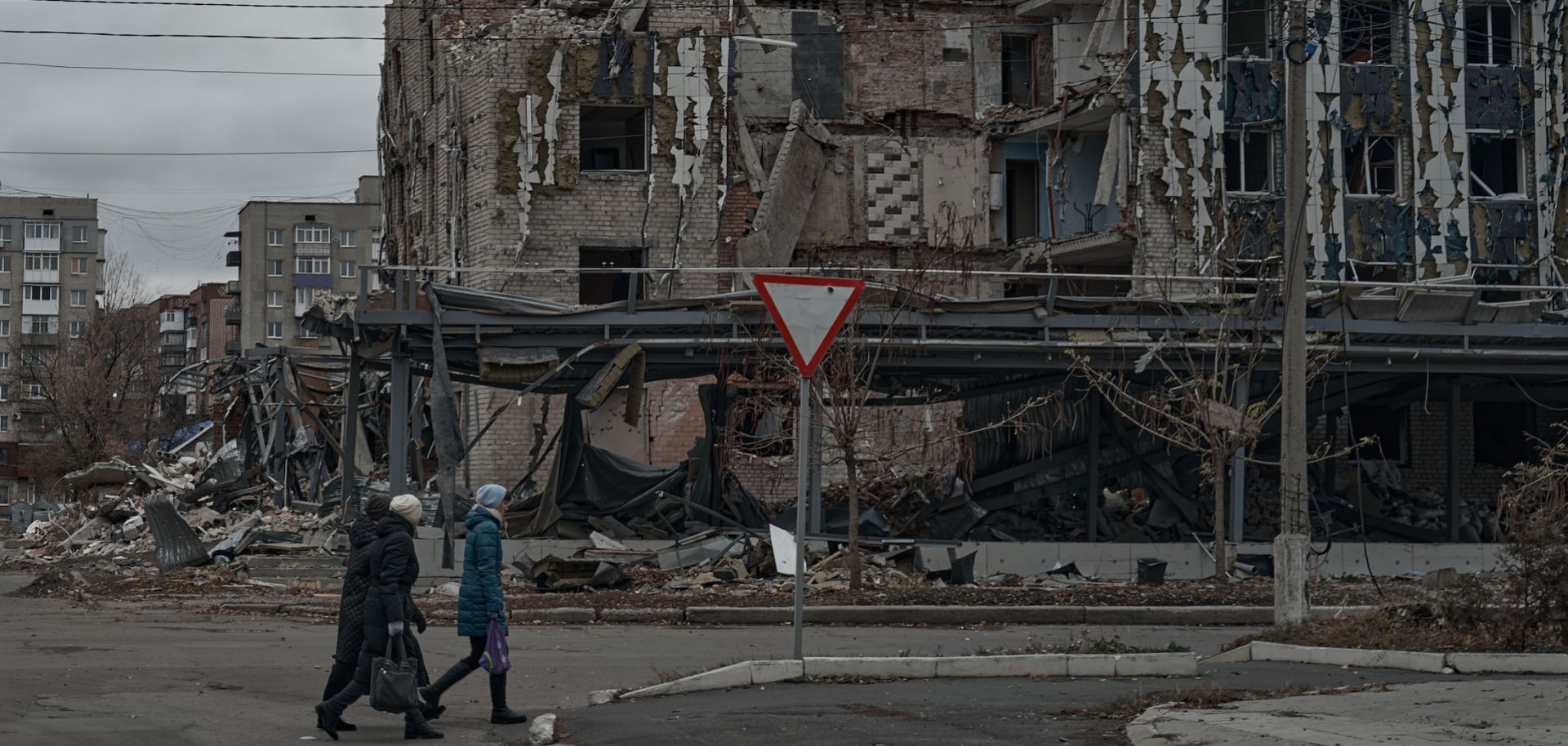
Since the U.S. presidential election, there has been significant speculation about what Donald Trump's victory means for the war in Ukraine. Trump's campaign pledge to end the war quickly, combined with his veiled threats of suspending U.S. financial and military aid for Ukraine to force Kyiv to negotiate with Moscow, have raised questions about whether the conflict could end in 2025. While it is impossible to predict exactly when the war will end, Trump's victory has accelerated the timeline, with a cease-fire now more likely than ever. It is also becoming increasingly evident that a cease-fire will likely happen on terms that benefit Russia and may not necessarily lead to sustainable peace, even if it halts active fighting.
Breaking Ukraine's NATO Dreams
To understand the reasoning behind these assertions, we need to understand Russia's goals in Ukraine. Above all, Russia wants to maintain a buffer between itself and NATO, to limit the military alliance's influence and reach on its western border. There are other goals at play, such as securing President Vladimir Putin's domestic legitimacy and legacy, increasing Russian access to Black Sea ports, and exploiting divisions between Western countries. But Moscow's core goal is to prevent NATO, which has already absorbed all the former Soviet satellites and has moved dangerously close to Russia since the 1990s, from doing the same in Ukraine. Before Ukraine's Maidan protests of 2013-2014 (which toppled the country's pro-Russian government), Moscow used energy exports, money, propaganda, coercion and corruption to prop up pro-Russian or neutral governments in Kyiv. Since the Maidan revolution, Russia has resorted to military aggression, first by annexing Crimea and pursuing a low-intensity war in eastern Ukraine in 2014, and then by launching a full invasion in 2022.

Russia does not need to fully occupy Ukraine to make sure Kyiv does not join NATO. In fact, a point could be made that annexing Ukraine or turning it into a puppet state like Belarus is a very inefficient and resource-expensive way to neutralize Ukraine. Whether the Kremlin likes it or not, most of Ukraine's population is now fiercely anti-Russian, which means that occupation, annexation or ''puppetization'' would force Russia to permanently invest massive resources in constantly cracking down on an unruly population. Moreover, a full Russian occupation could turn what currently is a conventional war between two armies into an insurgency war, as many Ukrainians would turn to insurgent tactics to fight their new overlords. A permanent occupation would also prolong Russia's standoff with the West, delaying any normalization efforts.
Because Russia's main goal is to prevent Ukraine from joining NATO, all the Kremlin has to do is turn Ukraine into a failed state. A Ukraine that is economically devastated, demographically weakened and territorially crippled is a Ukraine that cannot aspire to join NATO in the short-to-medium term. The same would apply to joining the European Union, though this is not a particularly red line for Russia. Neither organization is likely to accept a country that is not in control of what it claims to be its official territory, faces prolonged political disputes after more than a decade of war, and has lost a significant part of its manufacturing base, arable lands and ports. The European Union, in particular, is also unlikely to accept a country that would drain the bloc's financial resources for decades. And, perhaps more importantly, NATO and the European Union are unlikely to accept a country where the threat of another Russian invasion remains latent despite a cease-fire.
A Cease-Fire on Russia's Terms
This is why 2025 will be a pivotal year for the war. If the United States suspends or severely reduces financial and military aid for Ukraine, Kyiv won't be able to keep defending itself for much longer. Pre-approved U.S. support from the Biden years and continued help from the European Union and other NATO states will enable Ukraine to continue fighting for several months. But Kyiv will have to become much more prudent in how it uses its resources, and will eventually be forced to seek a cease-fire. Moreover, the United States does not need to actually end all assistance for Ukraine for this scenario to materialize — the threat of potential future cuts alone will force Kyiv to reassess its position.
Against this backdrop, cease-fire negotiations are becoming increasingly likely, and could start as early as late 2025. When they happen, Russia will likely eventually agree to a deal for several reasons. First, Moscow will likely keep most if not all of the territories that it has occupied since the start of the war, which means that Russia's strategic depth (the distance between NATO and Russia's core territories) will be larger than it was before the invasion. Second, keeping these territories will enable Russia to achieve its goal of a broken Ukraine that cannot aspire to join NATO. Third, a cease-fire deal would open the door to a progressive lifting of Western sanctions and a slow normalization of Russia's ties with the European Union and the United States. And fourth, ending the war would free up resources for Russia's other strategic concerns, which range from competition with other superpowers in the Arctic to China's expansion in its far-east.
A deal under these circumstances would be painful for Ukraine, but there would be some silver linings. The most obvious would be the end of the war, which would enable millions of Ukrainians to regain some sense of normalcy after years of destructive and deadly conflict. Indeed, surveys show a large number of Ukrainians want the war to end, with many accepting the loss of territory as the price to pay for it. Moreover, the European Union and many other international organizations will be ready to help with Ukraine's economic and social recovery (in part because Western companies will get many of the contracts related to reconstruction efforts), which would generate some economic opportunities.
An eventual cease-fire agreement would likely be vague on an existential issue for Ukraine: security guarantees against future Russian aggression. Ukraine wants explicit promises of NATO membership or, at the very least, promises that NATO would protect it against future invasions. But such guarantees are a non-starter for Russia, which will have the upper hand in negotiations. Both the United States and large EU member states like Germany are also skeptical of the merits of accepting Ukraine in NATO. The cease-fire's wording on this issue would thus likely be ambiguous and focused on the long term. In a best-case scenario for Kyiv, NATO could promise future training and equipment for Ukraine, but not membership. The same applies to bilateral promises of military support from individual NATO countries. Facing the prospect of a protracted war that is inevitably turning in Russia's favor, Ukraine will have little choice but to accept vague promises of foreign support in exchange for retaining the territories that it still controls.
A viable cease-fire would also include the creation of a demilitarized zone between the territories under Ukrainian and Russian control. This could be done in several ways. In a more likely scenario, Ukraine and Russia would patrol their own sides of the demilitarized zone (as South Korea and North Korea have done for decades). In a less likely scenario, some European countries (such as the United Kingdom, France and many Central and Eastern European nations) could agree to send troops to patrol this zone, though Russia may oppose this for fear it would represent a NATO presence through a backdoor. A third option may involve a U.N.-led peacekeeping mission, as has been the case in Cyprus since the mid-1960s.
The eventual process to end hostilities will likely be long, complex and full of false starts. It could involve temporary promises that are broken, threats of escalation that temporarily derail the talks, and seemingly contradictory behavior from all the parties involved. There is also a significant chance that a cease-fire may just do that: stop the active fighting without actually resulting in a proper peace treaty or an end to unconventional forms of aggression between Russia and the West. The war will leave a myriad of issues unresolved, and a proper peace treaty may never happen, as many other wars (such as Korea) have shown. Still, the upcoming negotiations (whether they happen in 2025 or afterward) will offer millions of Ukrainians the first real chance to regain some sense of normalcy after years of a heavily disruptive war.