
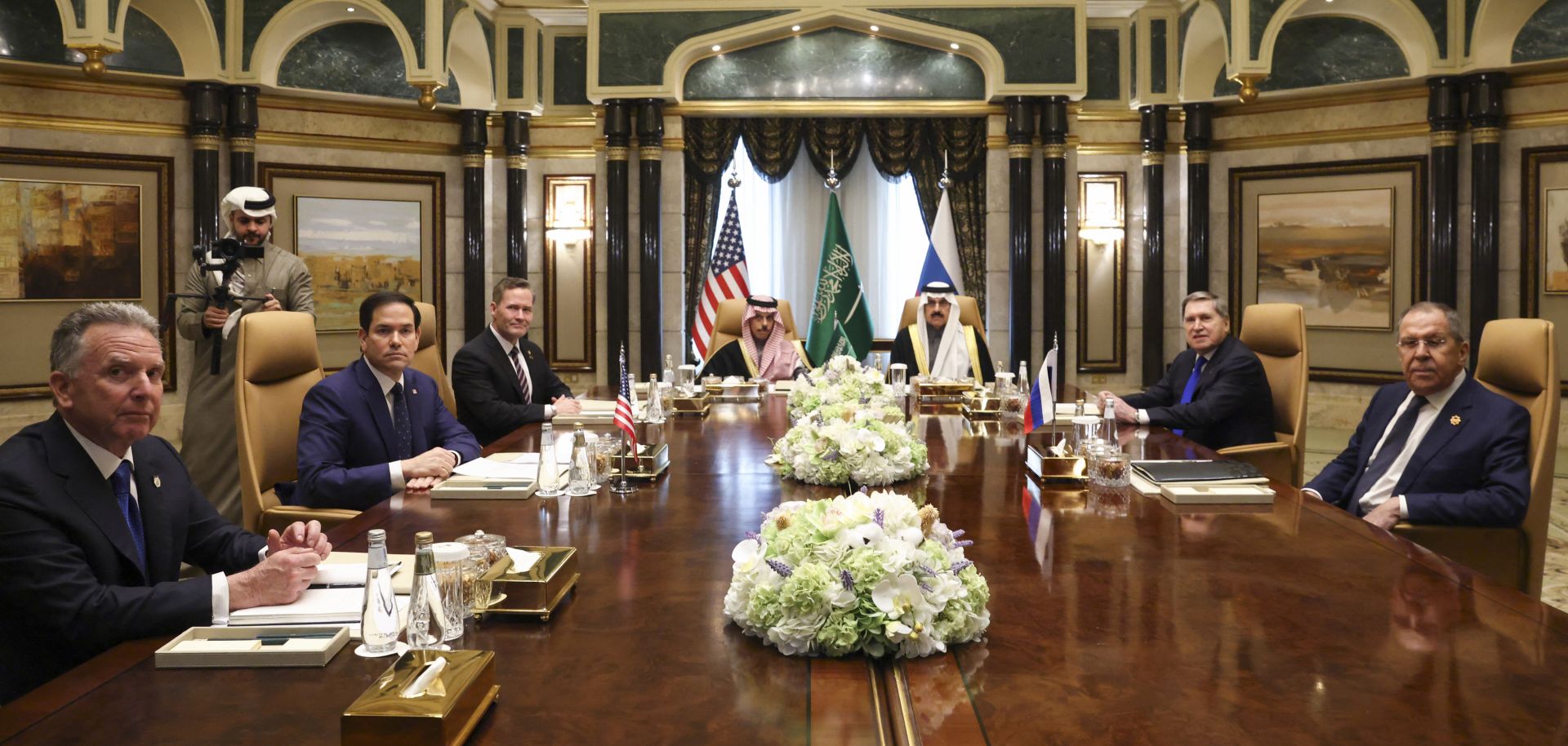
The launch of U.S.-Russia talks opens the door to a ceasefire in Ukraine, though the exclusion of Ukraine and Europe from the negotiations creates the risk of a deal that is not enforced and fails to end the fighting. High-profile delegations from the United States and Russia met in Saudi Arabia on Feb. 18 to discuss the future of the war in Ukraine. The U.S. delegation included Secretary of State Marco Rubio, National Security Advisor Mike Waltz and Middle East envoy Steve Witkoff, while the Russian delegation included Foreign Minister Sergei Lavrov and President Vladimir Putin's foreign affairs adviser Yuri Ushakov. Saudi Foreign Minister Prince Faisal bin Farhan also attended. Notably, no representatives from the Ukrainian government or the European Union attended the meeting. Separately, on Feb. 17 the leaders of Germany, the United Kingdom, Italy, Poland, Spain, the Netherlands and Denmark met in France to discuss the U.S. government's decision to exclude European representatives from Ukraine-related negotiations with Russia. NATO's secretary-general and the presidents of the European Council and the European Commission also attended the meeting.
- On the campaign trail, U.S. President Donald Trump repeatedly promised to quickly end the war in Ukraine if elected. On Feb. 12, Trump announced that he had agreed with Putin to hold a meeting between U.S. and Russian officials to explore ending the war. Trump also said that Ukraine would not join NATO, that no U.S. troops would be deployed to Ukraine to preserve a peace agreement, and that it was up to European governments to eventually send peacekeepers to Ukraine.
- After the Feb. 18 meeting, Ushakov said the talks ''went well'' and included ''a serious conversation on all issues.'' He added that new U.S.-Russia negotiations would happen in the future, but declined to provide a date for a potential summit between Trump and Putin.
- On Feb. 18, Rubio said that ''in order for a conflict to end, everyone involved in that conflict has to be okay with it, it has to be acceptable to them.'' In the meantime, Waltz said that the White House would ''continue to push back on this notion that our allies haven't been consulted: they're being and they are being literally almost on a daily basis, and we'll continue to do so.''
- According to Fox News, the U.S. and Russian delegations discussed a three-stage peace plan that would include a ceasefire, elections in Ukraine and a final peace agreement. However, the details of the talks have not been officially announced.
Ukraine's territorial integrity and security guarantees will be the biggest obstacles to a deal. Negotiations over Ukraine will probably take months, considering the complexity of the situation on the ground and the conflicting interests of all the players involved. There will be at least two large obstacles to overcome. The first will be Ukraine's territorial integrity. While Kyiv officially demands the return of all the lands it controlled before Russia's 2014 annexation of Crimea, this seems virtually impossible given the vast amount of territory Russia has seized since launching its 2022 invasion (roughly 20% of Ukraine's formal territory). U.S. officials have said that Ukraine should hold no hope of returning to its pre-2014 borders, but recent statements by the White House requesting privileged access to Ukraine's mineral wealth (a large part of which is in disputed territories) in exchange for U.S. financial aid suggest that the Trump administration may be willing to pressure Russia to accept the current borders and push back against any additional territorial concessions for Moscow. While Ukraine's post-war borders will be a point of contention, Ukraine will likely accept giving up most of the land it has lost to achieve peace. The second, and considerably more problematic issue, is Ukraine's demand for Western security guarantees against a future Russian invasion. The West is unlikely to offer Ukraine NATO membership for the foreseeable future because the United States and several high-profile European NATO members (such as Germany) oppose the idea. As a result, negotiations over peace guarantees will revolve around the prospect of sending troops to protect the eventual new border between Russia and Ukraine.
Speaking after the meeting, Lavrov said the Russian side had informed its American interlocutors that the presence of NATO troops in Ukraine was unacceptable, presumably a reference to reports of European countries sending forces to Ukraine after a ceasefire.
To secure a potential ceasefire, European NATO members may eventually agree to send troops to Ukraine, though this may not be enough to deter future Russian aggression against the country. The Feb. 17 summit underscored the divisions between European leaders, especially on the issue of sending troops to Ukraine if there is an agreement to end the war. The leaders of France and the United Kingdom said they would be willing to deploy troops, but also asked for the United States to participate in such an endeavor. The leaders of the Netherlands, Sweden and Denmark said they would consider sending troops. Finally, the leaders of Poland, Germany and Spain said that they are not considering sending troops to Ukraine at the moment. These divisions mean at least two things. The first is that should the United States maintain its current opposition to boots on the ground in Ukraine, France and the United Kingdom will struggle to convince a significant number of European countries to participate in an eventual deployment. The second is that, regardless of the U.S. position, any European deployment to Ukraine will likely not take the shape of a NATO- or EU-led mission but rather a multilateral agreement between only some members of either organization. Especially without U.S. involvement, European militaries would probably be unable to send enough troops to provide Ukraine with security guarantees strong enough to replace NATO membership. As a result, European governments are unlikely to send a large deterrence force with a mandate to fight if Russia were to invade again. A more likely alternative would be a ''tripwire'' force on parts of the frontline, with Ukrainian troops deployed on the more problematic parts of the shared border. Finally, Europe could send a limited number of forces to provide logistical and training support for Ukrainian forces. But while this would provide some degree of deterrence (as European troops would be present in Ukrainian land in the case of another Russian attack), these forces may not have the mandate to engage in case of a re-invasion.
- Ahead of the Feb. 17 summit, U.K. Prime Minister Keir Starmer said that London is ''ready and willing'' to send troops to Ukraine. But after the summit, he added that ''there must be a U.S. backstop, because a U.S. security guarantee is the only way to effectively deter Russia from attacking Ukraine again.''
- Polish Prime Minister Donald Tusk said Warsaw did not have the resources to simultaneously protect Poland and help Ukraine, noting ''if I can't defend myself…if the European Union can't defend itself, how can we provide guarantees to others?''
- German Chancellor Olaf Scholz said it was ''highly inappropriate'' to discuss sending troops to Ukraine before a ceasefire deal has been reached.
- On Jan. 21, Ukrainian President Volodymyr Zelensky said enforcing any peace deal in Ukraine would require the presence of ''at least 200,000'' Western troops. According to a Feb. 15 report by The Washington Post, European countries are considering deploying approximately 25,000 to 30,000 troops to Ukraine to enforce a potential peace agreement. However, no government has officially suggested any figures. Most European militaries lack rapid deployment capabilities for a conflict zone like Ukraine, in addition to defense industrial base limitations. Such a mission would require extensive U.S. airlift, intelligence and logistical support. For reference, during the peak of the NATO-led mission in Afghanistan in 2011, European forces deployed to the South Asian country totaled around 40,000.
Possible Outcomes of U.S.-Russia Talks
Against this backdrop, there are at least three ways U.S.-Russia negotiations could evolve in the coming months:
The U.S. and Russia reach a ceasefire deal without significant Ukrainian and European involvement (45% likelihood). In this scenario, the United States and Russia reach a deal that neglects most of Kyiv's requests in terms of territorial integrity or security guarantees. The United States may do this to pressure Europe to accelerate a decision on peacekeepers ahead of the U.S.-Russia agreement entering into force. In this scenario, Ukraine would have to decide between agreeing to a ceasefire with significant territorial losses and minimal security guarantees, or continuing fighting without U.S. support and with insufficient European backing. The Europeans, meanwhile, would have to decide between deploying troops to Ukraine or leaving Ukraine to defend itself. Should a coalition of European forces agree to deploy troops, a ceasefire with modest security guarantees would still be possible, though this would not prevent Russia from reigniting hostilities at a time of its choosing. If, on the other hand, Europe does not deploy troops, Ukraine would likely continue fighting on its own for a few more months before eventually accepting a ceasefire under much worse circumstances. At any time in this scenario, Ukraine could experience significant political and social unrest, as a U.S.-Russia ceasefire would deepen already visible divisions within the war-torn country's political and military establishment, as well as Ukrainian society, over the terms under which to end the war. A forced settlement could lead to a collapse of Zelensky's government, internal unrest or even military insubordination. As a result, a U.S.-Russia deal perceived as a betrayal could lead to Kyiv refusing to comply or even shifting toward more radical military strategies, such as launching larger ground operations into Russian territory, escalating cyberattacks on Russian institutions or infrastructure, and expanding sabotage operations inside Russia.
U.S.-Russia talks collapse without a ceasefire deal (35% likelihood). While both the White House and the Kremlin have expressed interest in reaching a deal, several developments could collapse their ongoing negotiations. Russia, for example, is ready for continued hostilities and will probably refuse to freeze the conflict under potentially restrictive conditions. This could see Moscow refuse to accept a settlement that requires withdrawing from occupied areas; Russia may also demand additional territorial concessions beyond what it currently controls (such as the rest of Ukraine's Donetsk and Luhansk administrative regions), or may reject any Western security guarantees for Ukraine (even if they are weak and exclude U.S. troops). On the U.S. side, domestic political opposition (especially from Congress) could limit Trump's ability to make concessions to Russia. The White House may refuse to substantially remove sanctions on Russia without sufficient Russian guarantees that it would respect a ceasefire. Disputes over control of Ukraine's mineral wealth, infrastructure investments and reconstruction funding could also increase frictions between the two delegations. Additionally, European concessions to the United States (on issues ranging from defense spending to trade deals) could prompt Washington to shift its strategy and abandon talks with Russia that exclude European and Ukrainian participation. Should any of these factors cause U.S.-Russia negotiations to collapse without a deal, Ukraine would keep fighting against Russia with the help of European and limited U.S. support, while Russia would continue military operations to solidify control over occupied areas and expand its control over new ones. But this scenario would not preclude new rounds of negotiations in the future.
The United States and Russia reach a ceasefire deal with Ukrainian and European involvement (20% likelihood). In this scenario, the White House and the Kremlin reach a ceasefire agreement that Ukraine and its European allies accept. This could happen either because Kyiv and Europe are officially included in the negotiations or because the White House agrees to represent European countries' positions in talks with Russia. Such a deal would see Russia retain control over much of its occupied territories but promise to end hostilities, while the West would start the process of progressively lifting its sanctions on Russia. A coalition of European (and possibly non-European) peacekeepers would also be deployed to monitor the new border, potentially with limited U.S. logistical and financial support. Ukraine would not be given formal NATO membership, but it would continue to receive financial and military support from the West. But while the ceasefire would end the active phase of fighting, the deal would remain fragile because of international peacekeepers' potentially insufficient capacity to decisively deter Russia from re-invading Ukraine in the future.
