
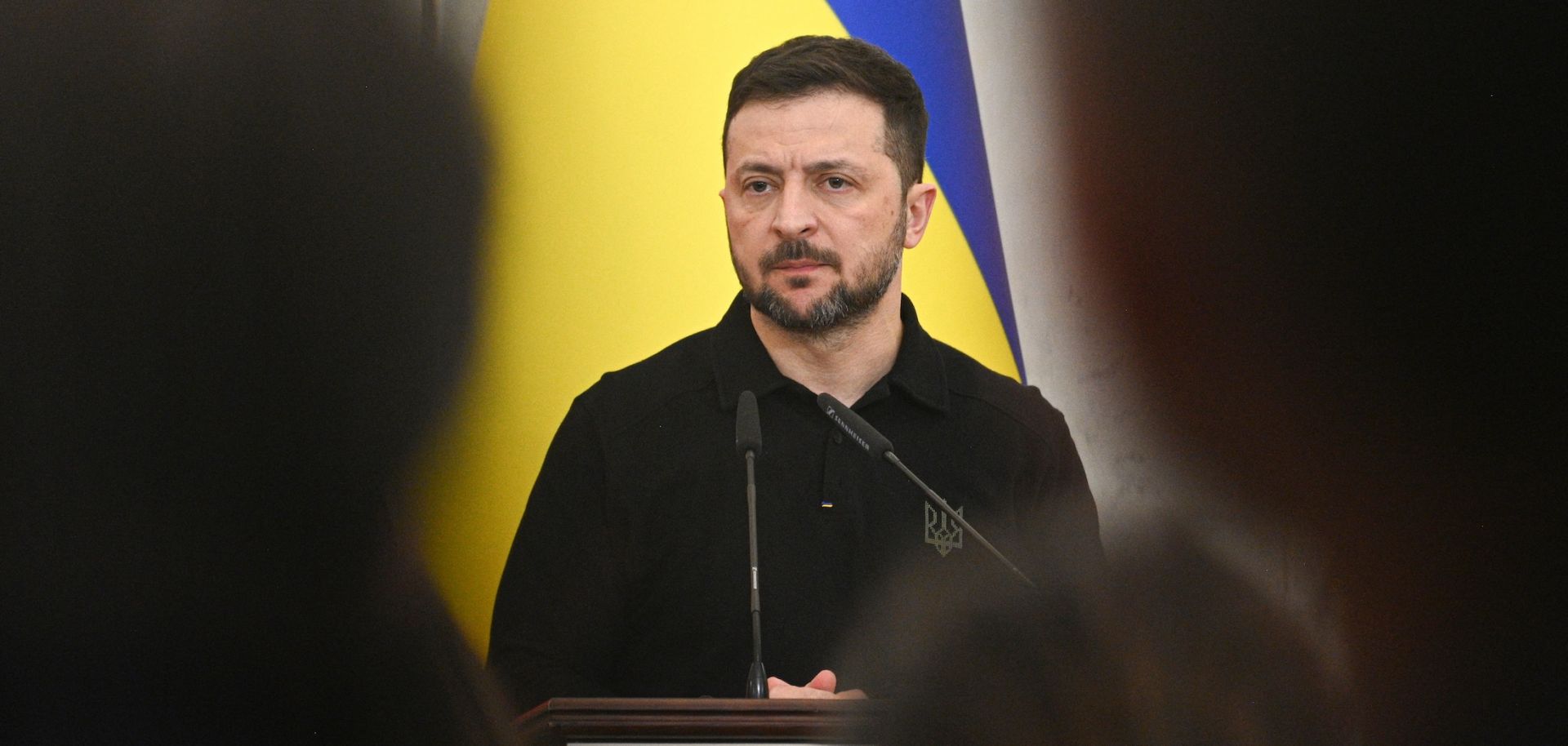
Over the next year, Ukrainian President Volodymyr Zelensky will likely face increasing internal and external pressure to hold new elections that could oust him, but his removal from power and replacement with a more Moscow-aligned figure remains unlikely, despite Russian efforts. Speaking to Russian state television on Jan. 28, Russian President Vladimir Putin said that Moscow is open to negotiations involving Zelensky, but that Moscow does not consider him a legitimate leader capable of signing a final peace agreement, or any other documents, such as the cancellation of a decree Zelensky signed in September 2022 barring Ukrainian negotiations with Putin. Putin said he would appoint a delegation for any such negotiations with Kyiv, akin to the delegation that conducted talks with Ukraine in the war's opening weeks in 2022. Putin went on to say that ''any legal issue'' preventing talks can be resolved, but this would involve the participation of Ukraine's parliament, the Rada. Putin concluded by emphasizing that the war would end in only two months if Western military support for Ukraine ceased, and that thus ''Ukraine's sovereignty is almost zero. If their Western sponsors want to achieve peace, well, the path is very simple.'' The comments were just the latest sign that Moscow is conducting negotiations with Washington rather than with Kyiv, as Russia believes its peace terms are unlikely to be acceptable to Ukraine and some EU members, and will, in turn, have to be imposed on them under coercion from the United States. Days later on Feb. 1, Keith Kellogg, the U.S. special envoy for Ukraine and Russia, apparently reacting to signals from Moscow, said that Ukrainian presidential and parliamentary elections ''need to be done'' by the end of the year, noting that ''Most democratic nations have elections in their time of war. I think it is important they do so.'' Kellogg will reportedly present Washington's plan to settle the war during the Munich Security Conference on Feb. 14-16.

- On Feb. 3, U.S. President Donald Trump said that ''very serious'' talks with the Kremlin on Ukraine were underway, adding ''We've made a lot of progress on Russia, Ukraine, we'll see what happens. But a lot of progress has been made.'' On Feb. 5, Kremlin Press Secretary Dmitry Peskov stated that contacts between Russia and the United States on Ukraine are being conducted through individual departments and have recently ''intensified.''
- Parliamentary elections in Ukraine were scheduled for October 2023, while presidential elections were scheduled for March and April 2024. But these elections could not take place due to the state of martial law in the country. Adjustments to martial law would be required for elections to be held, which is unlikely without a ceasefire. Since 2022, Putin has used several arguments to insist that Zelensky is illegitimate, claiming his term ended in 2024.
- In an interview published on Jan. 5, Zelensky said that he believed elections in Ukraine would take place 90 days after the end of martial law, but that would require the war to end first. He said Ukrainian society was against conducting elections during the war and that Ukraine lacked the infrastructure to do so anyway.
Despite his falling popularity and war fatigue in Ukraine, Zelensky's position will likely remain secure domestically due to strong public support for his stance on peace terms, and the lack of any serious political challengers willing to destabilize the country by ousting him. Numerous polls indicate that popular support for Zelensky has declined over the course of the war, particularly over the past year as Russian forces made their largest territorial advances since launching their full-scale invasion of Ukraine in February 2022. Large new Russian gains this year, which will become more likely as the West's military support for Ukraine stalls, would put further pressure on Zelensky, whose popularity could also be dented further if he again lowers the military mobilization age to address the country's manpower shortage. Nonetheless, a majority of Ukrainians continue to strongly support Zelensky's position regarding the terms acceptable to Ukraine in a peace settlement. Specifically, Zelensky insists that in exchange for losing its territory to Russia and having to accept other Russian terms, including prohibitions on NATO membership and changes to its domestic laws and limitations on its army, Ukraine should receive a strong package of measures that constitute a Western security guarantee to prevent Russia from reinvading in the future. There is little serious discussion in Ukraine to soften this policy, and any alternatives are not endorsed by any popular politicians or influential parliamentary factions. Therefore, a majority of Ukrainians and Ukraine's political establishment will likely continue to broadly back Zelensky's approach to negotiations and remain dubious of alternative proposals. Accordingly, it is extremely unlikely that large numbers of Ukrainians would take to the streets in opposition to Zelensky's proposals; moreover, there is not a clear power center that is likely to move against Zelensky in opposition to this idea and seek his removal via a palace coup or military coup. Furthermore, Gen. Valery Zaluzhny, Zelensky's biggest political challenger by far, is very unlikely to endorse a significantly different policy platform. This is because Zaluzhny — who currently serves as Ukraine's envoy to the United Kingdom — likely believes that endorsing another platform would severely undermine national unity by dividing the country between supporters and critics of accepting a Trump-negotiated deal contrary to Kyiv's goals, increasing the internal tensions that Moscow could then use to resume the invasion on more favorable terms. Against this backdrop, many Ukrainian citizens will also continue to view urgent elections in wartime merely to remove Zelensky, as demanded by Putin and potentially the Trump administration, as pointless and potentially unnecessarily destabilizing.
- In a Kyiv International Institute of Sociology (KIIS) poll published on Jan. 7, 52% of Ukrainians said they trusted Zelensky, while 39% said they did not trust him. Trust in Zelensky has dropped seven percentage points from October 2024 and 12 points from February 2024. But while trust indicators have worsened over the year, the balance of trust to distrust remains solidly positive at over 13%.
- In February 2024, Zelensky dismissed Zaluzhny, who had served as Commander-in-Chief of the Armed Forces of Ukraine, amid increasing tension between the two leaders. A sociological study by the SOCIS Center published on Jan. 22 found that Zaluzhny would likely handily win a presidential election— defeating Zelensky by around ten percentage points in the first round and receiving nearly 70% of the vote in the second round, a similar margin of victory to Zelensky's own landslide victory over Petro Poroshenko in 2019.
- By the end of this year, Russian forces could besiege the Slovyansk-Kramatorsk area, Ukraine's final stronghold in the eastern Donbas region. The potential loss of this area would increase calls inside Ukraine for a ceasefire in order to prevent even further Russian advances. Similarly, Russian forces entering another region of Ukraine, namely the Dnipropetrovsk region amid Russian advances around Pokrovosk and Velyka Novosilka, would trigger similar calls within and outside Ukraine. Ukraine will face pressure to lower its mobilization age to slow these advances, which will likely also be needed to receive further support from the United States. But this will nonetheless further decrease Zelensky's approval rating amid doubts about whether Ukraine will receive an acceptable peace settlement in exchange for putting the lives of increasingly younger Ukrainians on the line.
In its contacts with U.S. officials, Moscow will continue to insist on Zelensky's illegitimacy and the need for new elections in Ukraine, hoping to rouse currently dormant Ukrainian political forces interested in concessions to Russia. Moscow's focus on Zelensky's alleged illegitimacy is intended to frame him personally and his government more broadly as the obstacles to peace in Russia's impending talks with the Trump administration — using the topic as an excuse to slow-walk ceasefire negotiations, and as a way to increase tensions between Kyiv and Washington. If the Trump administration were to endorse this narrative and further the idea that Zelensky is the barrier to peace talks, it would risk severely destabilizing Ukraine, as Ukrainians would be more likely to conclude Zelensky's government is now incapable of securing the vital Western support on which the country relies. To this end, in talks with the Trump administration, Moscow could agree to a ceasefire under the condition that Ukraine holds elections as soon as possible. Russia calculates that elections occurring amid a ceasefire within a peace settlement in which Ukraine does not receive strong Western security guarantees would result in Ukrainians realizing Zelensky's efforts to decisively orient toward the West in 2022 have failed, and would therefore support the emergence of political forces disenchanted with the West and primarily focused on not antagonizing Moscow in hopes of preserving the ceasefire. Even if such anti-West forces do not assume power, the normalization of these views would grant Moscow more leverage over Kyiv. This would be particularly the case should hundreds of thousands of younger Ukrainians flee to Europe and should those already there remain, leaving an electorate of older Ukrainians potentially nostalgic for their country's previously less confrontational relationship with Moscow. Ultimately, the Kremlin hopes soft pro-Russian forces in Ukraine would gain clout and tilt the government's stance toward Moscow, or even eventually assume political power — similar to what happened after Russia's 2008 invasion of Georgia, where the Georgian Dream party came to (and remains) in power on a platform of minimizing conflict with Moscow after winning the country's first post-invasion election in 2012.
- Moscow's efforts to achieve its goals in Ukraine via Zelensky's removal began in the opening days of its invasion. On Feb. 25, the second day of Russia's invasion, Putin addressed the Ukrainian military and told them to ''take power into [their] own hands,'' claiming it would ''be easier for us to come to an agreement with you than with this gang of drug addicts and neo-Nazis who have settled in Kyiv and taken the entire Ukrainian people hostage.''
Zelensky will attempt to enlist European partners to resist U.S. efforts to coerce Ukraine into an unacceptable settlement, and while the Trump administration could push for elections and Zelensky's potential removal at Moscow's request, Ukrainian elections are unlikely unless a ceasefire is reached. Despite pressure, Zelensky will resist proposals he believes are political suicide for him and an affront to the national interest. This means he is unlikely to alter martial law and hold elections if he believes the terms of a peace settlement, ceasefire and elections would destabilize Ukraine and risk reigniting the war. It also means Zelensky will not accept a peace deal negotiated by the Trump administration with minimal Ukrainian input and lacking meaningful security guarantees for Kyiv. Should he be presented with such a deal, Zelensky would attempt to enlist at least temporary support from European states to decline the unacceptable terms imposed on Ukraine by the White House. The Ukrainian public and government would also support the Zelensky administration's efforts to resist the settlement, even if the Trump administration threatens to end U.S. support to Ukraine if Kyiv refuses to sign the deal. European states will press the Trump administration to continue backing Ukraine, but the White House will be hesitant to do so, claiming that economic pressure on Russia, rather than increased military support to Kyiv, is the only way to avoid further escalation and the war's continuation. After months of discussions with Ukrainian and Russian officials, the Trump administration may conclude that Zelensky's desire for security guarantees and continued U.S. and NATO military support are preventing the administration from achieving its goal of a negotiated settlement. This could, in turn, prompt the White House to join Russian efforts to condition further support on new elections in Ukraine after a ceasefire, which could see Zelensky's removal. However, the Trump administration openly insisting on Zelensky's removal for refusing its settlement with Moscow would destabilize Ukraine and further reduce U.S. leverage vis-a-vis Russia by leaving Ukraine less capable of resisting Russia and fueling the rise of pro-Russian politicians. Because this would run counter to Trump's stated goal to end the war and invite domestic blowback from more hawkish Republicans concerned about Russia, a U.S. policy openly calling for Zelensky to step aside is less likely compared to a more concerted U.S. push for Ukraine to hold elections after a ceasefire but without directing Zelensky to step aside.