
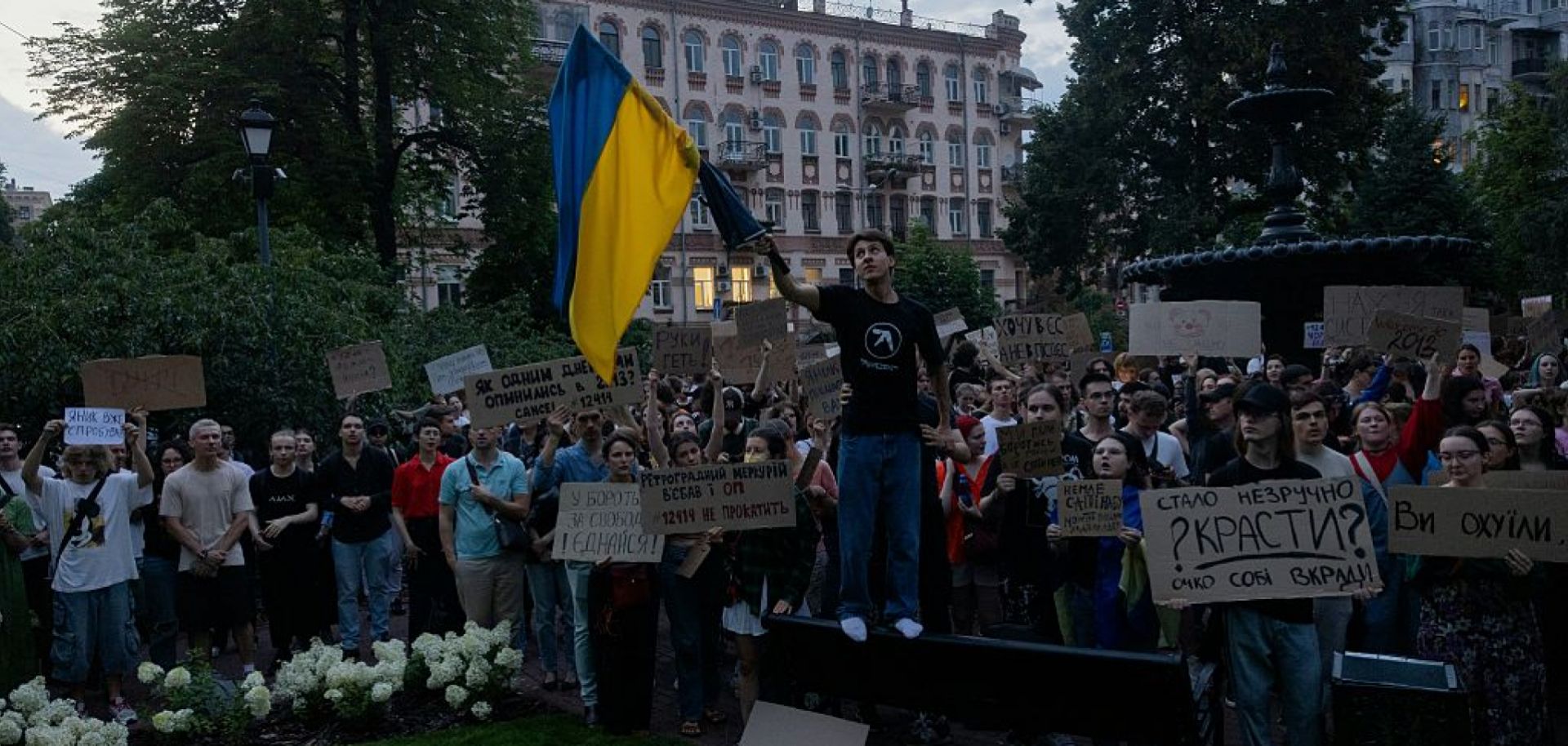
A protester holds a Ukrainian flag in downtown Kyiv on July 22, 2025, during a demonstration calling for President Volodymyr Zelensky to veto a law that reduces the powers of Ukraine's anti-corruption agencies.
(TETIANA DZHAFAROVA/AFP via Getty Images)
A protester holds a Ukrainian flag in downtown Kyiv on July 22, 2025, during a demonstration calling for President Volodymyr Zelensky to veto a law that reduces the powers of Ukraine's anti-corruption agencies.

Ukraine's move to place anti-corruption agencies under executive control will weaken Kyiv's case for continued Western support, complicate Ukraine's EU accession, and increase the risk of domestic unrest that could destabilize the government and undermine its war effort. Thousands of Ukrainians took to the streets of the country's largest cities (including the capital of Kyiv, the western city of Lviv and the southern city of Odesa) on July 22 to protest against a reform that weakens the independence of Ukraine's main anti-corruption agencies. The demonstrations were a reaction to President Volodymyr Zelensky's decision to sign into law a parliamentary bill that put the formerly independent National Anti-Corruption Bureau (NABU) and the Special Anti-Corruption Prosecutor's Office (SAPO) under the supervision of Ukraine's prosecutor general, who is appointed by the president. While Zelensky argued that the reform would improve the fight against corruption, critics both within Ukraine and in the European Union expressed concern about the executive branch's increased oversight of previously independent agencies.

  • In a post on Telegram published in the early hours of July 23, Zelensky said that ''the anti-corruption infrastructure will work…NABU and SAPO will work'' and added that the reforms were needed to prevent Russian infiltration in Ukraine's anti-corruption agencies. 
  • In a joint statement issued on July 23, the NABU and the SAPO said the legislative changes ''significantly undermine[d] the independence'' of both institutions, and that deprived them of ''the guarantees that previously enabled them to effectively fulfill their mandate in combating high-level corruption.''
  • The European Union's Enlargement Commissioner Marta Kos posted on X that she was ''seriously concerned'' about the reform, noting that ''independent bodies like NABU & SAPO [were] essential for Ukraine's EU path,'' and that rule of law issues remained ''in the very center'' of the country's EU accession negotiations. EU Defense Commissioner Andrius Kubiliu warned that ''in war, trust between the fighting nation and its leadership is more important than modern weapons — difficult to build and to keep, but easy to lose with one significant mistake by the leadership.''

While Kyiv argues that the reforms are critical to strengthening Ukraine's anti-corruption fight and safeguarding national security, critics contend they reflect an increasingly opaque and centralized power structure aimed at curbing institutional oversight. According to the Ukrainian government, the July 22 reforms are necessary to prevent Russian infiltration in the country's anti-corruption agencies and improve the overall fight against graft. In fact, on July 21, the Ukrainian Security Service launched a series of raids on NABU and SAPO offices and detained at least 15 staff members; two high-ranking NABU officials were later accused of sharing information with Russia. This comes as Ukraine is facing pressure from the European Union to intensify its anti-corruption efforts, a key condition for the country's eventual membership in the bloc. A stronger anti-graft campaign is also essential for Kyiv to convince its Western allies, particularly the currently skeptical U.S. government, to continue providing financial and military support. However, critics of the Ukrainian government argue that, in recent months, Zelensky has adopted an increasingly centralized and opaque decision-making process, in which the president relies on a handful of allies and advisors to make crucial decisions with insufficient institutional supervision. These critics also argue that Ukraine has been delaying other anti-corruption measures requested by the European Union. Additionally, critics claim that the evidence against the arrested NABU officials is insufficient and that the raids were an excuse to put the anti-corruption agencies under direct government control at a time when the agency was investigating high-ranking government officials.

  • Since the start of the conflict with Russia, Ukraine has faced multiple corruption scandals, many of which were linked to its war effort. In early 2023, several high-ranking officials, including Deputy Defense Minister Vyacheslav Shapovalov, resigned after Ukrainian media reported on procurement overpayments exceeding $300 million for food supplies. As the procurement-related corruption scandals connected to the Defense Ministry continued, Defense Minister Oleksii Reznikov resigned later that year. Many Ukrainian businessmen have also been arrested because of fraud accusations involving contracts for the supply of goods such as clothing and food. 
  • On July 11, the Ukrainian Security Service raided the home of Vitaliy Shabunin, the head of the Anti-Corruption Action Center, Ukraine's most prominent nonprofit focused on fighting graft. Given Shabunin's open criticism of the Ukrainian government, opposition figures have decried the raid as politically motivated.
  • In June, the NABU named Ukrainian Deputy Prime Minister Oleksii Chernyshov, a close Zelensky ally, as a suspect in a high-profile illegal land grab case. While Chernyshov denied any wrongdoing and claimed he was targeted by a ''smear campaign,'' government critics now argue that Zelensky's decision to weaken the independence of the NABU and the SAPO is connected to the ongoing investigations against members of his government.

Ukraine's actions risk alienating Kyiv's Western allies, potentially complicating future financial and military support, as well as Ukraine's EU accession prospects. Zelensky's July 22 decision triggered an unusual wave of criticism in the European Union, which has been Ukraine's staunchest supporter since the start of the war. According to EU officials, Brussels warned Kyiv not to put the NABU and the SAPO under government control, but Kyiv did it anyway. Despite this, the European Union and its largest members, including Germany and France, are unlikely to cut financial or military aid to Ukraine due to their geopolitical interest in defending the country from Russian aggression. However, the perceived weakening of Ukraine's anti-corruption efforts will provide ammunition for the various political parties and groups across the bloc that are opposed to helping Ukraine, making it politically costlier for the pro-Ukraine European governments to sustain such support. In addition, corruption will remain one of the many obstacles to Ukraine's accession to the European Union, and Brussels will likely pressure Kyiv to reverse the July 22 decision. EU member states critical of Ukraine, such as Hungary and Slovakia, will also likely cite the July 22 decision as further reason to delay future EU financial assistance for Kyiv or sanctions against Moscow, which could further complicate the bloc's already complex decision-making process on both of these matters. Similarly, in the United States, Vice President JD Vance and other White House officials who are critical of financial and military support for Ukraine will likely use this latest episode to question future assistance. U.S. President Donald Trump's ambiguous and at times contradictory stance on Ukraine means he could leverage corruption concerns to justify any future decisions against Ukraine as well. 

However, the main risks associated with Zelensky's reform are domestic, as his moves will increase the probability of growing anti-government unrest and give Russia more opportunities to weaken Kyiv. The July 22 protests defied Ukraine's martial law and night curfew, and occurred at a time when the country is under intense air attacks from Russia, most of which happen at night. This shows how sensitive the issue is for many Ukrainians, given the legal and safety risks of taking to the streets. Indeed, after over three years into the war, surveys and anecdotal evidence suggest that while support for President Zelensky remains high, many Ukrainians are exhausted with the war and increasingly worried about pervasive corruption in the country and an increasingly opaque government. Ukraine has a long history of social unrest leading to drastic political change, including the 2004-2005 Orange Revolution against the rigging of the 2004 presidential election results and the 2013-2014 Euromaidan protests, which ousted pro-Russian President Viktor Yanukovych. The sentiment of national unity created by the war — along with martial law, the pervasive risk of Russian air attacks, and the mobilization of thousands of Ukrainian men to the warfront — somewhat limits the potential for large anti-government demonstrations. However, another mass protest movement cannot be ruled out against the backdrop of a war-exhausted and demoralized Ukrainian society. Zelensky's position could be threatened if protests escalate and endure, if his government fails to address public grievances, and especially if security forces crack down on demonstrators. Russia, for its part, will exploit Zelensky's political weakness by promoting propaganda and misinformation in Ukraine that centers on government corruption, with the aim of fostering further social unrest. Additionally, Russia will continue to spread narratives that Zelensky is an illegitimate president because Ukraine did not hold elections in 2024. Meanwhile, in the West, Russia will insist on Zelensky's removal as a precondition to reach a peace deal, a narrative that far-right and pro-Russia political parties across Europe will support. Should domestic and foreign pressure significantly threaten Ukraine's war efforts, Zelensky may eventually reverse or soften the July 22 reform, though he will likely delay such a decision as long as possible to avoid the extra political costs associated with such a U-turn.

  • According to a poll by the Kyiv International Institute of Sociology (KIIS), Ukrainian support for Zelensky stood at 65% in June, a drop of 11 points from the previous survey in May. 
  • Ukraine should have held presidential elections in early 2024, but martial law — which was imposed after Russia's February 2022 invasion and remains in place amid the ongoing war — prevented the vote from taking place. Russia has repeatedly accused Zelensky of being an illegitimate president, and on many occasions has demanded his removal as a precondition to reach a peace agreement. Against this backdrop, Zelensky has been ambiguous about his political future, at times implying he might resign if that is what is needed for peace, and at other times suggesting he may seek another term whenever the next presidential election takes place.
  • In March, members of the Trump administration secretly met with some of Zelensky's main political opponents, including former Ukrainian Prime Minister Yulia Tymoshenko and members of former President Petro Poroshenko's political party. During the meetings, the U.S. officials reportedly discussed the possibility of a quick presidential election in case of a political crisis in Ukraine. In a low-probability but high-impact scenario, Washington could pressure Kyiv to hold a presidential election as part of a peace deal with Russia.
  • On July 23, Ukrainian lawmakers from the opposition Holos party said they had begun collecting signatures to launch a constitutional review process of the new law placing the NABU and the SAPO under government control. Filing this petition only requires support from 45 lawmakers, which is possible considering that Zelensky's Servant of the People party only controls 231 of the 456 seats in Ukraine's unicameral legislature. However, the review process will likely be slow, especially under wartime conditions and likely political pressure to delay a ruling. 
  • On July 23, Zelensky met with anti-corruption and security officials and promised to unveil a comprehensive plan to fight corruption within the next two weeks. When asked about the protests, he said ''we all hear what society says'' and that ''we see what people expect from state institutions to ensure justice and the efficiency of each institution.'' 
RANE
SUBSCRIBERS ONLY

Expert analysis when it matters most.

Get access to RANE's decision-grade geopolitical intelligence.