
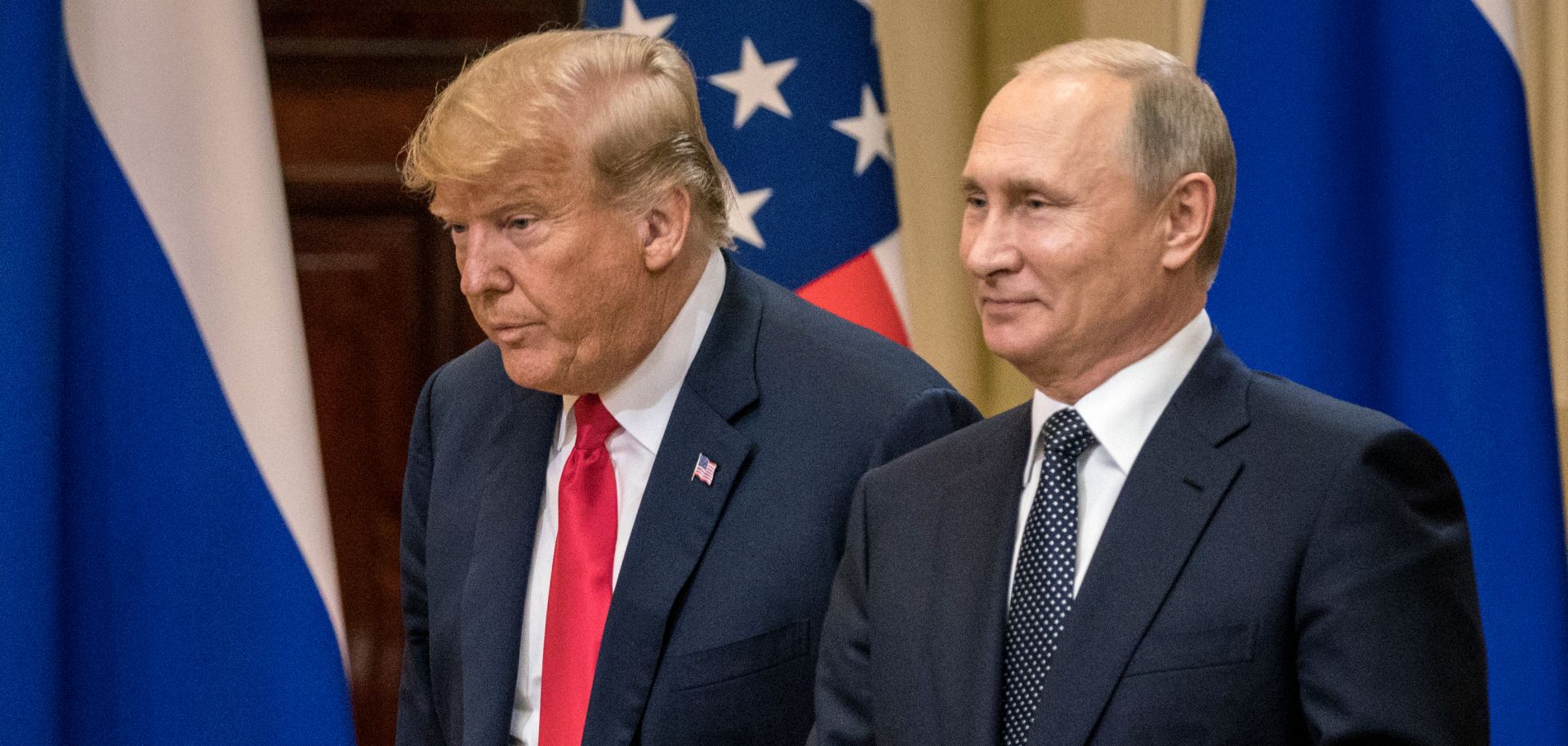
U.S. President Donald Trump (left) and Russian President Vladimir Putin arrive at a press conference after their summit on July 16, 2018, in Helsinki, Finland.
(Chris McGrath/Getty Images)
U.S. President Donald Trump (left) and Russian President Vladimir Putin arrive at a press conference after their summit on July 16, 2018, in Helsinki, Finland.

The upcoming Trump-Putin summit risks sidelining Ukraine, fracturing Western unity and creating space for Russia to delay sanctions, consolidate battlefield gains and promote a U.S.-Russia framework that advances Russian strategic interests. On Aug. 7, the Kremlin and the White House confirmed that Russian President Vladimir Putin and U.S. President Donald Trump are preparing to meet ''within days.'' The announcement came just hours ahead of an Aug. 8 deadline set by Trump, who has threatened to impose secondary tariffs on countries buying Russian oil unless Moscow makes significant progress on the peace process in Ukraine. According to Yuri Ushakov, Putin's foreign policy aide, the leaders ''essentially'' agreed to a one-on-one summit, their first since 2018, at the ''suggestion of the American side.'' This development followed closed-door talks between Putin and U.S. special envoy Steve Witkoff in Moscow on Aug. 6, which both sides described as ''productive'' and ''constructive,'' though no details were disclosed. U.S. Secretary of State Marco Rubio said the Trump administration now has ''a better understanding'' of Russia's conditions for ending the war and cast Trump as the ''ultimate closer.'' While the United States reportedly requested that Ukrainian President Volodymyr Zelensky also be included in the summit, Putin downplayed the possibility, saying the necessary conditions for such a trilateral meeting ''do not yet exist.'' On Aug. 7, Trump confirmed he would still proceed with a summit even if Putin did not commit to meeting with Zelensky, walking back earlier suggestions that such a commitment would be a prerequisite.

  • The Trump-Putin meeting will most likely be held in the United Arab Emirates, although Italy, Hungary, Turkey and Switzerland have also been mentioned as potential summit locations.
  • In Russia, markets and pro-Kremlin commentators celebrated the news of the summit, with pro-Kremlin war blogger Yuri Podolyaka saying Putin had ''spun Trump into a carousel of negotiations.''

The meeting will offer Putin an opportunity to convince Trump to walk back his threats to impose tariffs on Russian oil buyers, while the exclusion of Ukraine and its European allies will enable the Kremlin to exploit Western divisions and marginalize Kyiv. Trump's initial strategy to end the war in Ukraine was to court Moscow and pressure Kyiv to accept a deal. But after this approach failed to yield significant progress, he pivoted to increasing economic pressure on Russia instead. In late July, Trump threatened to impose 100% tariffs on countries buying Russian oil unless the Kremlin demonstrated real movement toward a ceasefire by Aug. 8 (the original deadline was for early September, but Trump decided to move it forward). On  Aug. 7, he partially followed through on that threat by imposing an additional 25% tariff on Indian goods, citing New Delhi's continued purchases of Russian oil. He has also threatened further duties on China, the main purchaser of Russian oil. These new threats to Russia's crucial oil revenues come at a time when the country is already facing fiscal pressures from its summer offensive in Ukraine and the tightening of European oil price caps scheduled to take effect in early September. However, the new U.S. tariffs on India are not scheduled to take effect until Aug. 28, which signals that the White House may still suspend or amend the measures if Moscow shows tangible progress in the coming days. Against this backdrop, a meeting with the U.S. president serves multiple goals for the Kremlin. First, it could buy time by potentially convincing Trump to delay or soften his tariff threat. Second, it could fragment Western unity, given the exclusion of the European Union and the United Kingdom from the meeting. And third, it could isolate Ukraine, as the United States is probably willing to make concessions to end the war that do not necessarily align with Kyiv's strategic goals.

  • Trump's threatened tariffs on Russian oil importers like India and China could roil global oil markets and raise fuel prices within the United States, which gives Trump an incentive to grant a short reprieve if he can point to diplomatic progress.
  • According to Bloomberg, Russia's oil and gas revenues, a key pillar of its federal budget, fell 27% year-on-year in July, contributing to a widening budget deficit and prompting a drawdown of gold reserves for the first time since December 2024. The National Welfare Fund's reserves, though still sufficient to cover this year and much of 2026 at 5.9% of GDP, are set to shrink further, heightening the urgency of finding a financial off-ramp.
  • Russia is coming off of its most successful offensive in Ukraine of 2025, with recent gains around Chasiv Yar, a fortified hinge‑town west of Bakhmut, and sustained artillery and airstrike pressure mounting on the logistic hubs of Kostiantynivka and Pokrovsk. Since May, Russia has seized control of an additional 500 square kilometers of Ukrainian territory. But these gains have been slow-going, resource-intensive and insufficient to decisively alter the war's trajectory, reinforcing the Kremlin's motivation to seek a diplomatic pause with Washington.

The Trump-Putin summit could result in a limited ceasefire that allows Russia to delay further sanctions and consolidate battlefield gains, but a comprehensive peace deal remains highly unlikely. The announcement of new U.S. tariffs on Indian goods suggests the Trump administration is moving to enforce its threat (at least for some countries). But the delayed implementation of those tariffs will leave room for diplomatic maneuvering, particularly if the Kremlin offers limited concessions that the White House deems acceptable, such as a temporary ceasefire or an agreement to continue negotiations. A comprehensive peace agreement remains highly unlikely, as Moscow is showing no signs of abandoning its maximalist demands. However, the exclusion of Ukraine and its European allies from the Trump-Putin meeting will heighten the risk that any post-summit peace framework developed by Washington and Moscow will primarily reflect Russian strategic interests to the detriment of Ukraine's. In parallel, Moscow will also continue to actively shape its negotiating posture to appeal to U.S. economic and political interests. This will involve promoting joint investment opportunities in critical sectors like rare-earth minerals, Arctic infrastructure and space cooperation, with the implicit suggestion that dialogue could ease the path toward commercial re-engagement and create incentives for softening sanctions. 

  • In response to the summit announcement, Ukraine has intensified its diplomatic campaign to rally European allies against any negotiated outcome that would sideline Kyiv or reward Russian territorial gains. 
  • On Aug. 7, European Commission spokeswoman Arianna Podesta confirmed the European Union had not received an invitation to participate in any U.S.-Russia-Ukraine negotiations, stating that ''there has been no request.'' 
  • On Aug. 7, Kirill Dmitriev, Putin's special envoy for economic and investment cooperation, emphasized that renewed U.S.-Russia dialogue could open investment opportunities for American firms — especially in rare earth minerals, given Russia's position as the world's fifth-largest holder of these reserves, according to the U.S. Geological Survey.
  • Moscow will likely point to the NASA-Roscosmos meeting on July 31, the first since 2018, as evidence that U.S.-Russia technical cooperation on issues like the International Space Station and lunar exploration remains viable, despite broader geopolitical tensions.
  • According to an Aug. 8 report by Bloomberg, citing unnamed sources familiar with the U.S.-Russia talks, Washington and Moscow are currently discussing a ceasefire in Ukraine that would formalize Russia's control over occupied areas. Russia reportedly wants full control of the entire Donbas region (most of which is already under its control) and the recognition of its 2014 annexation of Crimea. In exchange, Russia is willing to halt its offensive in the Kherson and Zaporizhzhia regions (which it partially occupies). The goal of such an agreement would be to freeze the war and create a conducive environment for peace talks. According to the report, the United States will try to convince Ukraine to accept this deal, which would be very politically costly for Zelensky.
RANE
SUBSCRIBERS ONLY

Expert analysis when it matters most.

Get access to RANE's decision-grade geopolitical intelligence.
