
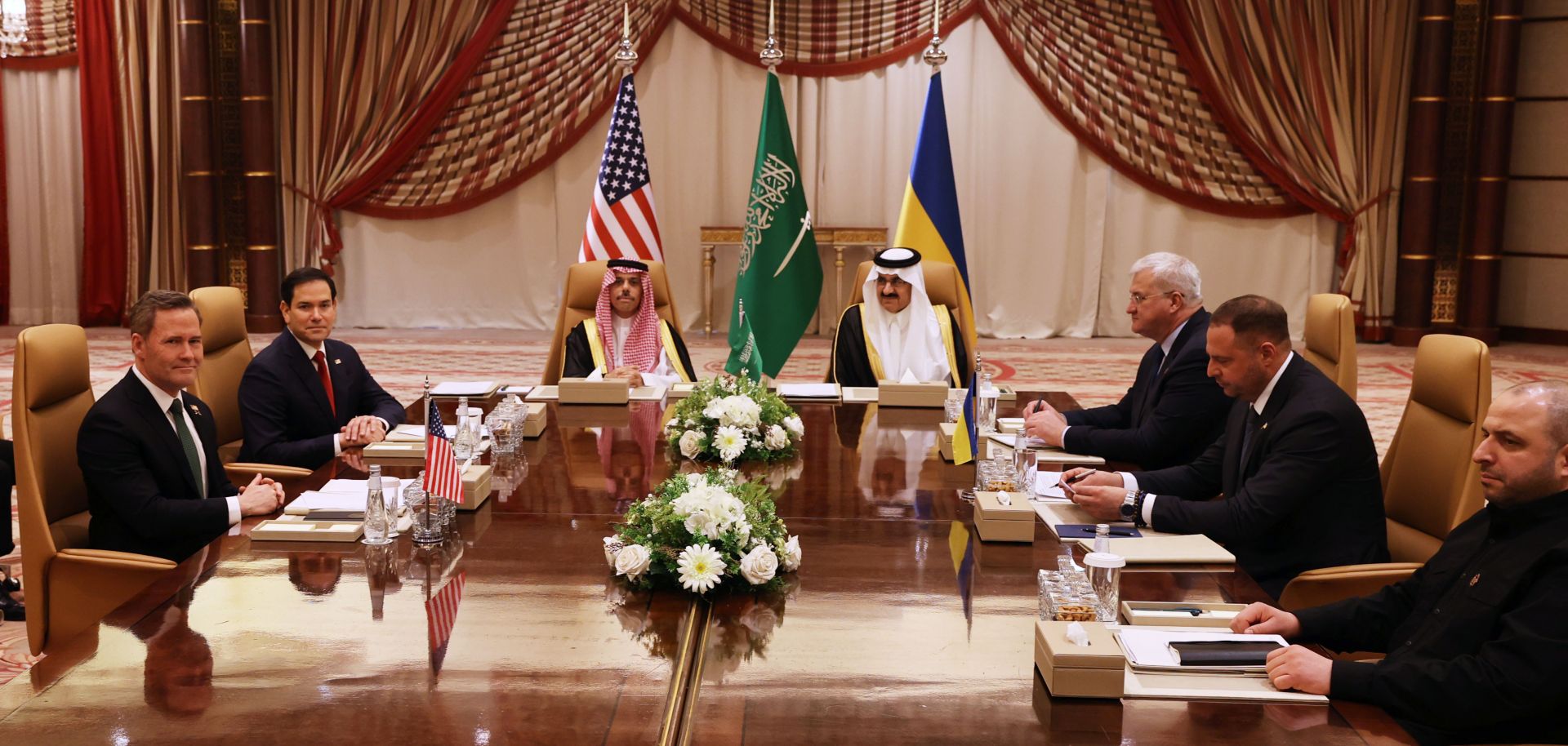
The U.S.-Ukraine ceasefire proposal will open the door to a temporary halt in hostilities, but unresolved issues and Russia's battlefield position raise doubts about Moscow's willingness and the plan's long-term effectiveness in securing a lasting peace. On March 11, Ukraine agreed to a U.S. plan for a 30-day ceasefire to de-escalate the war in Ukraine. According to a joint statement by the two governments, the ceasefire will enter into force if and when Russia accepts it. The deal was reached during a meeting in Jeddah, Saudi Arabia, that included U.S. Secretary of State Marco Rubio and President Volodymyr Zelensky's chief of staff, Andriy Yermak. In a statement on X, Zelensky said the deal would stop attacks both in the Black Sea and along the entire front line. U.S. envoy Steve Witkoff is expected to meet with Russian President Vladimir Putin in Moscow in the coming days to discuss the ceasefire.
- After announcing the deal, Rubio said that the United States would present the proposal to Russia and that "the ball is in their court." On March 12, Kremlin spokesperson Dmitry Peskov said: "We assume that state secretary [Marco] Rubio and [national security] adviser [Michael] Waltz through various channels in the coming days will inform us on the negotiations that took place and the understandings reached."
In the immediate term, the most relevant consequence of the agreement is the resumption of U.S. intelligence sharing and military support for Ukraine. The March 11 deal has led to the immediate resumption of U.S. intelligence sharing and military support for Ukraine, reversing a pause imposed after a tense Feb. 28 meeting between President Trump and Zelensky. On March 12, Poland's government confirmed that U.S. aid deliveries reaching Ukraine through Polish territory had resumed to previous levels. This is significant for Ukraine's war efforts, as the United States supplies Kyiv with signals intelligence, satellite imagery and targeting data to aid in striking Russian positions. This intelligence allows Ukraine to prepare for incoming Russian attacks and track the movements of Russian troops and equipment to launch attacks against them. Since the pause, Ukraine's European allies have struggled to fill the gap because their intelligence resources are considerably more limited than those of the United States. While the pause in the delivery of military support would have taken longer to produce a concrete impact on Ukraine's war effort, its resumption means that, for now, Kyiv does not face an immediate risk of running out of supplies and that European countries have more time to come up with a plan to cope with another potential U.S. suspension.
If accepted by Russia, the proposed ceasefire would temporarily halt hostilities and facilitate prisoner exchanges, but it leaves key issues unresolved, raising doubts about its durability and effectiveness in leading to a lasting peace agreement. If approved, the ceasefire would end all fighting for 30 days, which would allow for the exchange of war prisoners and the release of detained civilians. However, the plan has left several questions unanswered. To begin with, this is not a peace deal. If Russia accepts the ceasefire, this would only open the door to eventual peace negotiations that would likely be complex and full of pitfalls. Notably, the ceasefire does not seem to reference the kind of security guarantees that Ukraine wants in a peace settlement, which the United States has been reluctant to offer. The agreement also does not seem to include any references to European countries offering security guarantees (which is something that European nations themselves are still debating). Similarly, the ceasefire does not include any Ukrainian commitments to giving up territory, which Russia will likely demand amid peace negotiations. Finally, the ceasefire proposal is happening against the backdrop of Russian progress on the battlefield, which may incentivize Moscow to delay any ceasefire talks because it may be able to gain additional leverage in the coming weeks and months. Against this backdrop, in the coming days, the United States could pursue a combination of offers (such as lifting some sanctions) and threats (such as increasing military support for Ukraine or expanding sanctions or tariffs) to convince Russia to accept the ceasefire. Even if Russia accepts the ceasefire, the magnitude of the unresolved issues means that while a ceasefire would increase the likelihood of a peace deal, it would by no means guarantee it. Frequent violations could result in a premature ending of the ceasefire, and even if the initial 30-day ceasefire holds, extensions will probably be needed, considering the magnitude of the issues to discuss before a peace deal can be achieved. This would create constant opportunities for the peace process to be derailed and for the fighting to resume.
- Ukraine and Russia reached multiple ceasefires between Russia's annexation of Crimea in 2014 and the start of the full invasion of the country in 2022. The most notable ceasefires include the Minsk (September 2014) and Minsk 2 (February 2015) agreements. In all cases, violations occurred almost immediately, and fighting decreased but never entirely stopped.
- While Ukraine's government will probably accept giving up territory in exchange for a peace deal, the issue of security guarantees will prove considerably more complex to agree on. The United States has consistently rejected any military presence in Ukraine, and while European countries are currently discussing ways to protect Ukraine in the event of a ceasefire, their effectiveness (and even willingness to participate in a plan) will be diminished without U.S. involvement. Moreover, Russia has so far not given any signals that it would tolerate a European deployment in Ukraine to secure a ceasefire. Moscow could also make additional demands (such as holding presidential elections in Ukraine, as it argues that Zelensky is an illegitimate president) to keep a negotiation alive (and delay any eventual U.S. retaliation) without agreeing to the ceasefire and making additional territorial gains.
