
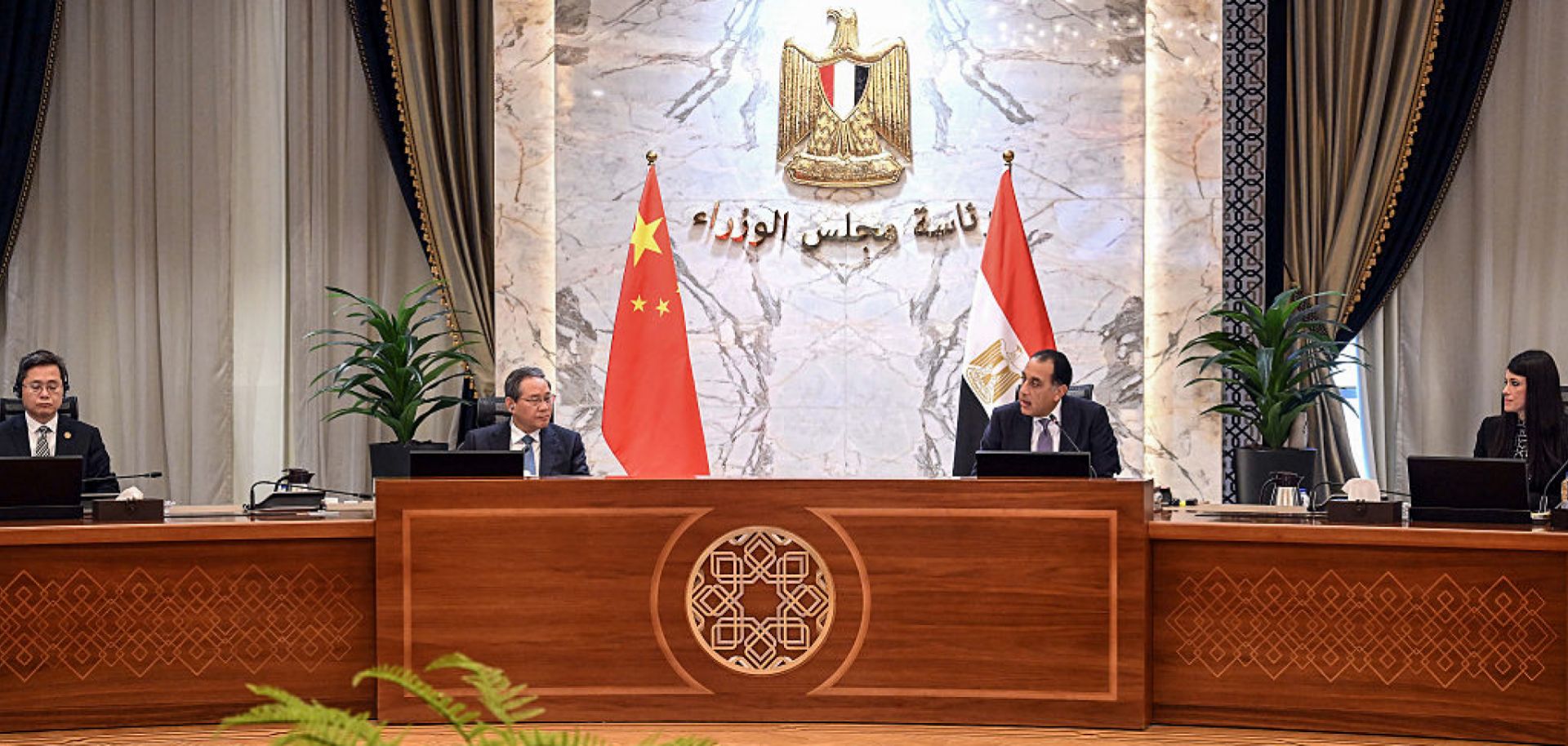
Egypt will continue to expand its economic and investment relationship with China — especially through infrastructure, development financing, and technology transfers — but Cairo will maintain its strategic alignment with the United States due to enduring military dependencies and regional security needs. On July 10, Egyptian and Chinese economic development officials signed a memorandum of understanding to begin the first phase of a debt-for-development swap initiated in 2023. The memorandum of understanding reached in 2023 outlined a framework in which a portion of Egypt's foreign debt owed to China would be swapped for interest-free loans to finance development projects across several fields, including renewable energy, healthcare, connectivity, education and industrial localization. As part of the deal, around $1.2 billion of the roughly $8 billion in external debt that Egypt owes to China will reportedly be swapped in phases. The agreement to commence the first phase was signed during Chinese Premier Li Qiang's July 9-10 visit to Cairo. Li and Egyptian Prime Minister Mostafa Madbouly also reached agreements to expand bilateral cooperation in numerous sectors, including e-commerce and green energy. Additionally, Li's visit coincided with a meeting between the governors of Egypt and China's central banks, where they signed three deals aimed at fostering greater economic cooperation and expanding the acceptance of Egyptian and Chinese payments in each other's countries.
- According to the Central Bank of Egypt, Egypt's external debt stood at 38.8% of GDP in June 2024, after peaking at 42.6% in December 2023.
- Egypt signed similar debt-for-development deals with Italy and Germany in 2001 and 2013, respectively.
In recent decades, Egypt has increasingly turned to Chinese trade and investment to support its economic modernization goals and diversify its partnerships. Egypt's longstanding ties with the United States are rooted in strong bilateral defense cooperation. This is evidenced by the fact that military aid comprises the bulk of U.S. foreign assistance to Egypt (in 2023, the last fully reported year, the United States provided $1.5 billion in foreign aid to Egypt, with $1.2 billion allocated for military funding). But past U.S. administrations, including the Biden administration, have periodically withheld some of this assistance due to Egypt's human rights record. While U.S. President Donald Trump is less likely to prioritize such human rights concerns, the unpredictable nature of his foreign policy decisions nonetheless sustains the threat of sudden aid cuts, which will continue to incentivize Egypt to reduce its economic reliance on the United States through diversified partnerships. Additionally, aligning with Cairo's Vision 2030 plans for economic modernization, Cairo has pursued increased investment and business opportunities from other countries to help finance infrastructure projects, create jobs and upskill Egypt's labor force. To that end, Egypt has increasingly looked to China for trade and investment in recent decades, leading to an expansion of bilateral ties. Indeed, over the past 20 years, the volume of China-Egypt bilateral trade has more than quadrupled, growing from $4 billion in 2005 to over $17 billion in 2024, fueled mainly by surging Chinese exports to Egypt. For China, investing in Egypt's economic development and port infrastructure (especially in the Suez Canal Economic Zone) has also become essential in advancing Beijing's Belt and Road Initiative by granting it access to African markets. While trade and investment by far remain the largest components of their relationship, China and Egypt have also begun deepening military ties, as evidenced by Egypt's acquisition of Chinese air defense systems and drones over the past several years. Finally, Egypt views China as a strategic diplomatic ally that shares Cairo's vision of a more multipolar world order in which developing nations in the Global South have a stronger voice. As part of this strategy, Egypt became a ''dialogue partner'' of the Shanghai Cooperation Organization (a forum primarily for non-Western, Eurasian countries) in 2022, and then became a formal member of the BRICS bloc of developing nations in 2024.
- In August 2024, the Chairman of the Suez Canal Economic Zone said that in the previous two years, the zone had received $6 billion in foreign direct investment, 40% of which came from China.
- In May 2025, the CEO of Egypt's General Authority for Investment and Free Zones said that nearly 3,000 Chinese companies operate in Egypt, and have together invested over $8 billion in the country.
- In April-May 2025, Egypt and China conducted their first joint air force drills. Egypt is also reportedly in discussions to purchase Chinese J-10C fighter jets, which participated in the drills.
- According to Boston University's Chinese Loans to Africa Database, China has provided 19 loans worth $9.7 billion to Egypt to finance some of the country's development projects. China issued over half of the loans, valued at more than $5 billion, to support Egypt's financial sector, but has provided smaller amounts to key sectors aligning with China's BRI goals, including $1.2 billion to transportation and $690 million to energy sectors.
- The debt-for-development deal only swaps a fraction of the debt Egypt owes to China, and even a smaller portion of the external debt that Egypt owes. However, the interest-free loans will support financing for some of Egypt's development projects, which also align with China's BRI and economic influence aims, including connectivity, industrial localization and digital economy. In addition, the transfer of Chinese technology and Chinese business investments in Egypt's industrial sector will promote worker upskilling and job creation.
But Egypt will still seek to sustain its strategic defense and diplomatic partnership with the United States, even as Cairo deepens its economic and investment ties with Beijing. The debt-for-development deal, along with the various economic cooperation deals signed during Li's recent trip to Egypt, will likely increase U.S. concerns over China's growing influence, as well as potential threats to Washington's strategic partnership with Cairo and regional security cooperation efforts more broadly. However, Egypt will still seek to balance its deepening ties with China with those it already has with the United States. For one, China's growing influence in the Middle East has so far not extended to quelling regional conflicts, despite Beijing's success in brokering the normalization pact between Saudi Arabia and Iran in 2023. China has offered rhetorical support and urged de-escalation, even backing Egyptian-led proposals for post-war governance in the Gaza Strip, but it has shown little interest in becoming embroiled in these conflicts, unlike the United States. To advance its own interests, Egypt will thus likely continue to rely on the United States to exert diplomatic pressure on regional actors, such as Israel (whose military operations risk destabilizing nearby Gaza and the broader Middle East) and Ethiopia (whose Grand Ethiopian Renaissance Dam on the Nile risks affecting crucial water flows to Egypt). Egypt will also remain heavily dependent on U.S. military assistance for the foreseeable future, especially amid persistent regional uncertainty. The United States has historically been Egypt's largest military supplier, and was one of only two exceptions (the other being Israel) to the Trump administration's near-total freeze on foreign aid in January 2025. So while Cairo will likely continue to purchase some Chinese military equipment and diversify its suppliers away from the United States, Egypt will also continue to acquire weapons compatible with the U.S. systems it has already purchased. U.S.-Egypt military ties are thus expected to remain robust.
- According to the Observatory of Economic Complexity, U.S. goods comprised just over 5.2% of Egypt's imports in 2023. By contrast, Chinese goods constituted 16.6% of Egypt's total imports that year. Nevertheless, Egypt runs a significant trade deficit with China, with Chinese exports to Egypt far outpacing Egyptian exports to China.
- Driven by the comprehensive strategic partnership agreement it signed with China in 2014, Egypt will likely continue to increasingly award development project contracts to Chinese companies. The value of those contracts grew from $3.34 billion between 2005 and 2013 to $16.6 billion from 2013 to 2023, according to the American Enterprise Institute's China Global Investment Tracker. Chinese companies have been particularly integral in developing the central business district within Egypt's New Administrative Capital.
