
While most of Brazil's main exports to the United States are exempt from Trump's newly announced 40% tariff, the additional levies — along with Brazil's impending economic retaliation and the likely arrest of former President Jair Bolsonaro — will further strain bilateral ties. On July 30, U.S. President Donald Trump signed an executive order adding 40% tariffs on Brazil, which are set to take effect on Aug. 6, on top of the current 10% the country currently faces. This is in line with Trump's earlier threats to impose 50% tariffs on Brazilian goods, which he justified by citing, among other things, an alleged political persecution of former Brazilian President Jair Bolsonaro and several court rulings against U.S. tech companies. Since Trump made that threat on July 9, the two countries have not engaged in any formal negotiations on the tariffs, with the highest-level engagements being phone calls between Brazilian Industry and Trade Minister Geraldo Alckmin and U.S. Commerce Secretary Howard Lutnick. On July 28, a multi-party commission of Brazilian lawmakers arrived in Washington for meetings with U.S. legislators and business representatives and heard from U.S. government officials that Trump has not authorized trade discussions with Brazil, according to Brazilian media.
- On June 26, Brazil's Supreme Court ruled that social media companies can be held legally responsible for content posted by users, including hate speech, incitement to violence or ''anti-democratic acts.'' U.S. companies such as X and Rumble had previously been ordered to block U.S.-based user accounts, fined and even temporarily banned from operating in Brazil for failing to comply with court rulings, which Trump has criticized as violating free speech.
- On July 15, the United States Trade Representative (USTR) launched a Section 301 investigation into Brazil's trade practices and their potential unfair restriction on U.S. exports and companies. The probe will cover Brazil's tariff policy and digital trade and electronic payment services, as well as anti-corruption interference, intellectual property protection, ethanol market access and illegal deforestation.
- On July 18, the U.S. Department of State then suspended the visas of eight of Brazil's 11 Supreme Court justices and their family members. On July 30, the U.S. Treasury Department also imposed sanctions on Justice Alexandre de Moraes, who is overseeing Bolsonaro's trial. The sanctions were enacted under the Global Magnitsky Act, which usually targets individuals and entities involved in serious human rights violations or corruption and can include asset freezes and visa bans.
- The executive order also cites Brazilian threats to the U.S. economy, foreign policy and human rights. The document notably does not mention bilateral trade relations; the United States has had a trade surplus with Brazil since 2009.
- Since Trump's ''Liberation Day'' tariff announcement on April 2, Brazil has faced the baseline 10% U.S. tariff. On Aug. 1, the tariffs that Trump briefly imposed on other countries will also be re-imposed. The U.S. trade partners that have reached framework agreements with the White House ahead of this deadline will face tariffs ranging from 10% to 20%. Trump said tariffs for countries that have not closed deals yet will range between 15% to 20%, leaving Brazil as the only country facing 50% tariffs under the U.S. International Emergency Economic Powers Act (IEEPA).
The tariffs come as U.S.-Brazil relations have deteriorated over the past year due to ideological rifts between the right-wing Trump administration and the left-wing administration of Brazilian President Luiz Inacio Lula da Silva. Trump's July 9 letter announcing the 50% tariffs came two days after Brazil hosted the BRICS+ summit, where Lula defended the de-dollarization of global trade even though the event's communique had no provisions on the matter. After winning the U.S. presidential election in November 2024, Trump threatened to impose 100% tariffs on all BRICS+ countries over their efforts to replace the U.S. dollar. On July 7, he also threatened to enact 10% tariffs on countries associated with the bloc, citing its alleged ''anti-American'' policies. But while the BRICS+ summit likely acted as a catalyst for Trump's tariff threats against Brazil, the announcement also came amid a broader deterioration of bilateral relations. During his first term, Trump fostered a close relationship with then-Brazilian President Jair Bolsonaro and endorsed the far-right leader ahead of Brazil's 2022 election, which Bolsonaro ultimately lost to Lula. Lula, in turn, expressed support for Trump's challenger, Kamala Harris, in the 2024 U.S. presidential election. Lula has also publicly criticized Trump's protectionist policies and defended multilateralism and a more prominent role for developing countries from the so-called Global South, in opposition to U.S. hegemony in international affairs. Since Trump returned to the White House in January, there has been no direct communication between him and Lula, or their respective foreign affairs ministers, via meetings or phone calls, which indicates these ideological differences have constrained diplomatic engagement between the United States and Brazil.
- Media reports indicate that Trump's displeasure with the BRICS+ summit was the tipping point behind his decision to impose tariffs on Brazil.
Although the United States has exempted some critical items from the new tariffs, additional exceptions are unlikely in the short term. The United States' current unwillingness to negotiate and Brazil's reluctance to make concessions on matters perceived as impacting national sovereignty, such as the independence of its judiciary, mean the two sides are highly unlikely to reach an agreement that reduces, suspends or postpones the tariffs before they enter force on Aug. 6. Amid pressure from U.S. importers, the Trump administration exempted oil, fuels, natural gas, metals, wood and pulp, machinery, orange juice and aircraft from the additional 40% tariffs announced on July 30. Amid concerns of inflation, the White House is also considering exempting some products, especially food items not produced in the United States, from the upcoming round of tariff increases scheduled for Aug. 1. While not directly targeted at Brazil, such caveats could benefit Brazilian coffee or fruit exporters in the medium term. The White House may also heed calls from U.S. firms operating in Brazil for tariff exemptions for intra-company imports over the coming months. But even with such exemptions, the impending tariffs will still reduce some Brazilian exports to the United States, especially those of coffee, fruit and beef. But while Brazilian sectors and companies heavily dependent on exports to the United States will be particularly affected, the broader impact on the Brazilian economy will likely be limited. While the tariffs may fuel currency fluctuation, the fallout is unlikely to lead to significant financial turmoil or a severe macroeconomic crisis in the country over the coming months. The Brazilian government will likely also provide subsidized credit and relax rules to preserve companies and jobs, with mechanisms similar to those adopted during the COVID-19 pandemic, which will likely alleviate an economic downturn but will add pressure to the country's fiscal position.
- Out of Brazil's top 10 exported items to the United States, only coffee, vegetables and some fruits and meat were not exempted from the additional 40% tariffs.
- In 2024, the United States purchased 12% of Brazil's total exports, representing 2% of the country's GDP, while intra-company transactions accounted for 33% of all Brazilian exports to the United States that same year.
- There are currently 4,000 U.S. companies operating in Brazil, and the United States accounts for 20.8% of the country's foreign direct investment stock, according to the United Nations' 2024 World Investment Report.
- On July 29, U.S. Commerce Secretary Howard Lutnick said the White House may exempt food items not produced in the United States from the tariffs set to take effect on Aug. 1, such as coffee, cocoa and some fruits. But he did not directly mention Brazil when making that statement.
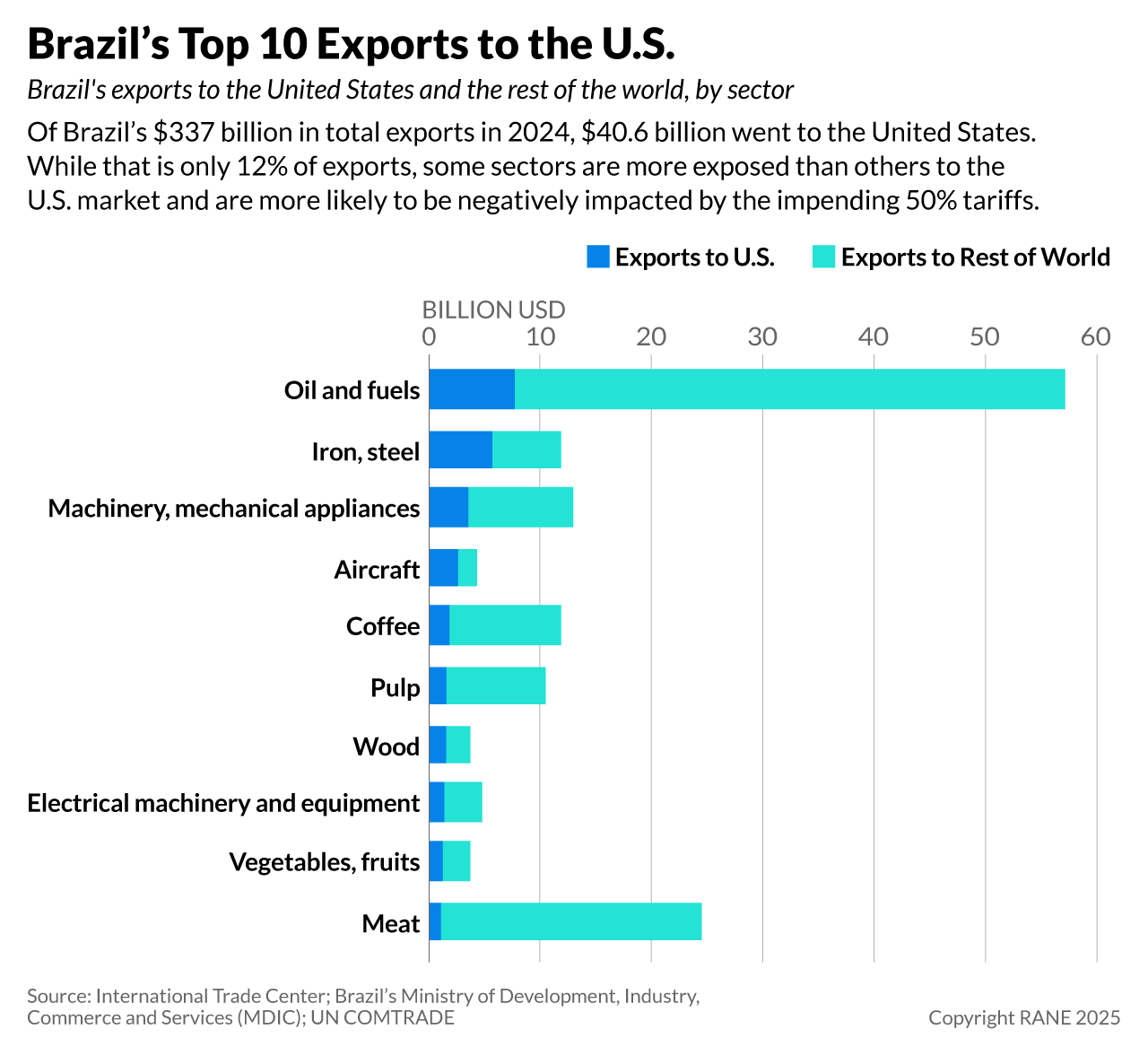
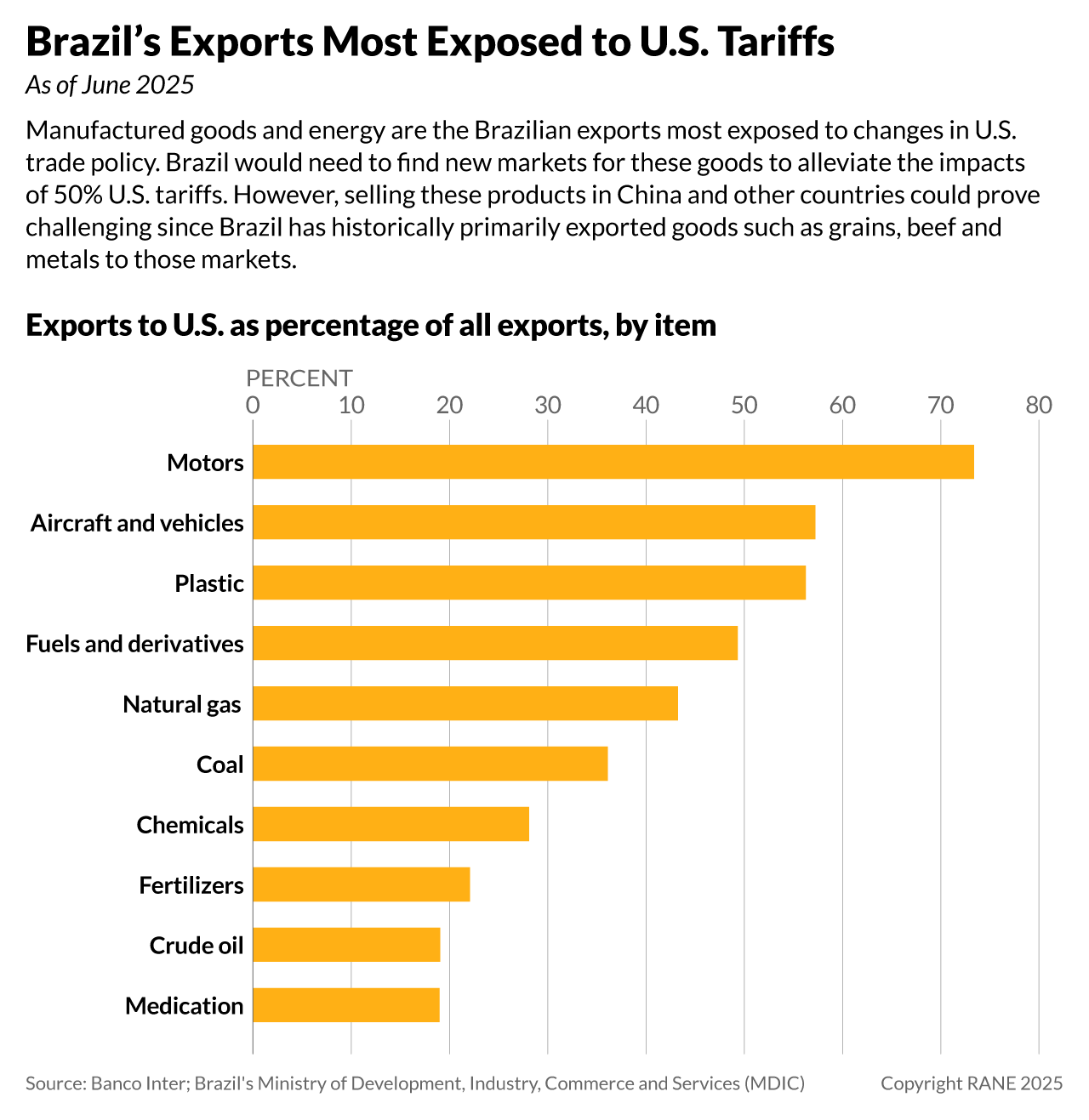
In the coming days, Brazil will likely threaten to impose mostly non-tariff trade restrictions in a bid to get the United States to the negotiating table. Brazil will initially avoid imposing similar tariffs on all U.S. goods, which would make consumer goods and manufacturers' inputs more expensive. Instead, the Lula administration will likely threaten to suspend intellectual property guarantees for U.S. exporters of pharmaceutical and agricultural goods, or impose taxes on both U.S. tech firms and U.S. companies' profit remittances. It could also threaten to restrict rare earth exports to the United States, though this would be largely symbolic, given the low volumes of rare earth materials extracted by Brazil. Brasilia will likely leverage these threats to try to get the White House to enter negotiations on matters only pertaining to bilateral trade, sidestepping issues related to Bolsonaro's lawsuits or content moderation rules for U.S. tech companies. But if the Trump administration declines negotiations, the Lula administration will likely follow through in enacting some of these measures in the coming months. This would only worsen U.S.-Brazil relations, likely resulting in additional tariffs or specific U.S. sanctions against Brazilian government or judiciary officials. In the coming months, Brazil will likely also seek to increase trade with China and other countries in Asia, the Middle East and Europe, to help mitigate the economic fallout from the U.S. tariffs. However, these markets are mostly inclined to buy Brazilian commodities, rather than the manufactured goods (such as motors, aircraft, plastics and chemicals) that the United States has historically purchased from Brazil.
- On April 2, the same day Trump announced the so-called ''Liberation Day'' tariffs, Brazil's Congress approved a bill that provides a legal framework for the government to respond to unilateral trade measures targeting its goods and services; potential countermeasures include tariffs and the suspension of intellectual property rights guarantees established in trade agreements. Lula mentioned this law in a July 9 social media post responding to Trump's first tariff threat against Brazil.
- In a July 24 meeting with private sector players, the U.S. Charge d'Affaires in Brasilia, Gabriel Escobar, said the United States has interests in Brazil's critical minerals; the country has the second-largest deposit of rare earths globally, even though the exploration of those resources is still incipient.
- Manufactured goods comprised 23% of Brazil's total exports in 2024, according to the World Bank.
Bolsonaro's ongoing trial and likely arrest will exacerbate U.S.-Brazil tensions, which will also fuel political polarization within Brazil ahead of its October 2026 presidential election. Despite Trump's pressure, Brazil's executive and judiciary branches will not interfere with ongoing lawsuits targeting Bolsonaro. The former president will thus almost certainly be sentenced to jail in the coming months. This could trigger more retaliatory measures from the White House, including sanctions against additional Brazilian Supreme Court justices or government officials. But while unprecedented in the context of U.S.-Brazil relations, such measures would unlikely pose spillover risks to Brazil's financial sector. The White House could also impose higher tariffs on Brazilian goods, or impose fines and additional duties for trading with Russia, as the Trump administration has threatened to do with India. Within Brazil, trade tensions with the United States will also fuel political polarization ahead of the October 2026 presidential race. Trump's threats have helped boost Lula's declining popularity in recent weeks by creating a rally-around-the-flag effect. However, the modest negative economic impacts of the tariffs could eventually offset this boost in the long term and become a challenge for his re-election bid. The implementation of the 50% U.S. tariffs will also weaken the electoral prospects of moderate right-wing contenders in the presidential race — particularly Sao Paulo Governor Tarcisio de Freitas, who initially backed Trump's tariffs despite Sao Paulo accounting for one-third of Brazil's exports to the United States. Even though Bolsonaro has been banned from running in 2026, Trump's support will reduce the former president's incentive to formally endorse another candidate. Instead, Bolsonaro will likely leverage this U.S. backing in attempts to avoid imprisonment, secure more lenient court decisions, or gain approval for an amnesty bill in the Brazilian Congress, which are all unlikely scenarios. Still, these actions will curb right-wing politicians' efforts to build a coalition and increase their popularity ahead of the March 2026 deadline for candidates to register for the ballot.
- Trump partially justified the tariffs on an alleged ''witch hunt'' against Bolsonaro, which has led to a split among right-wing politicians. Left-wing Brazilian politicians, meanwhile, have blamed Bolsonaro for the duties.
- Eduardo Bolsonaro, one of Jair Bolsonaro's sons, is a federal deputy who took a leave from his role as congressman to live in the United States in March and lobby for sanctions against Brazilian justices and government officials. He has posted several videos on social media, noting his meeting with White House officials and threatening to coordinate additional visa bans and other sanctions on Brazilian officials if his father's legal issues are not dropped.
- According to reports in Brazilian media, the White House plans for Brazil include potential visa bans for close allies of Lula, sparing only the Brazilian president and first lady. A suspension of diplomatic ties is reportedly also on the table, as is the removal of the Brazilian ambassador to the United States and threat of a comprehensive visa ban on Brazilian citizens, as Trump did to Colombia in January.
- On July 18, Brazil's Supreme Court ordered Bolsonaro to wear an ankle monitor and prohibited him from using social media, speaking to other individuals under investigation for an alleged 2022 coup plot, contacting diplomats, and going near embassies. Bolsonaro is also prohibited from leaving his home between 7 p.m. and 7 a.m. and over the weekends.
