
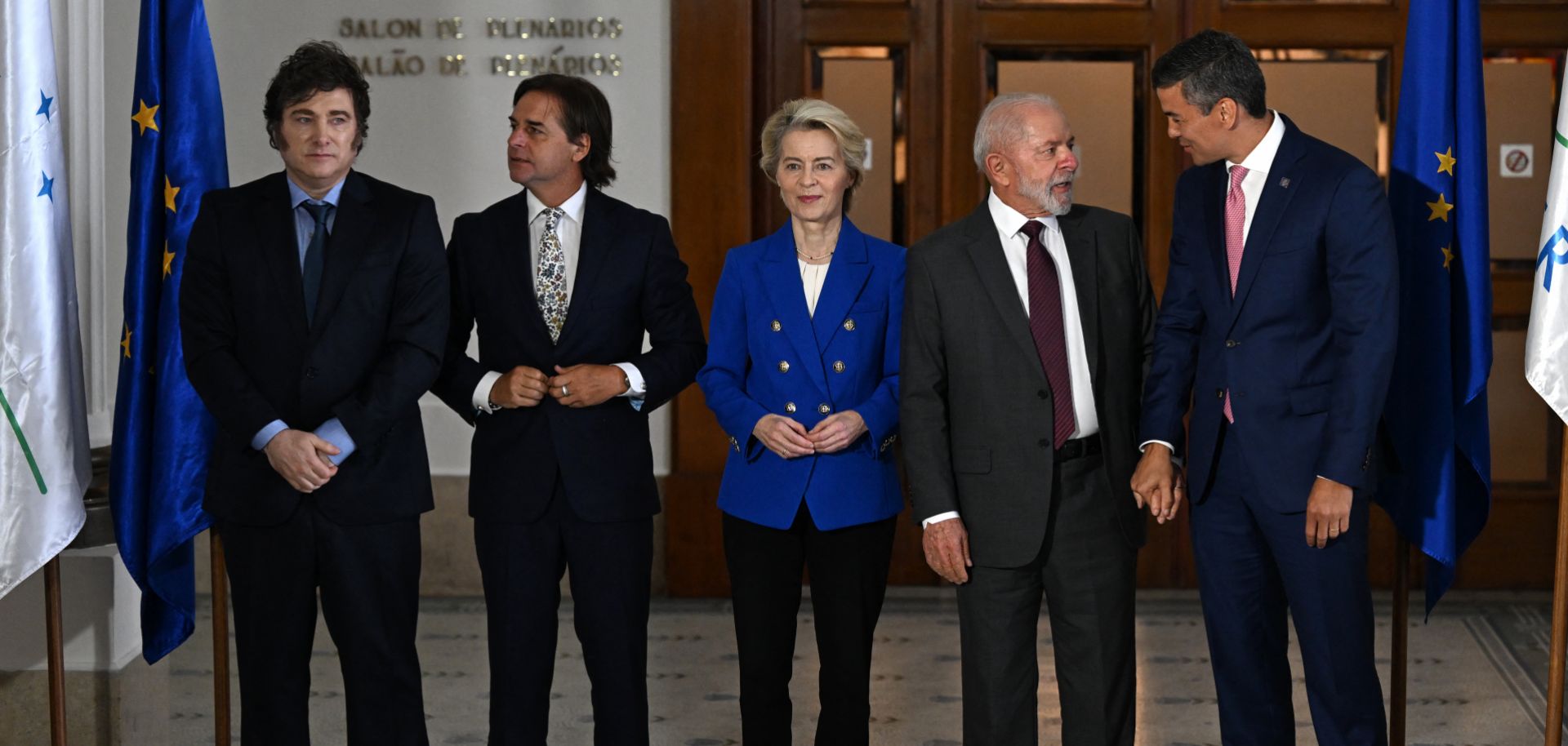
The EU-Mercosur trade agreement offers significant market access and diversification opportunities for both blocs amid rising global protectionism and geopolitical tensions, but it also faces a complex ratification process and potential political backlash in Europe, where concerns over agricultural competition will fuel euroscepticism and disruptive farmer protests. On Dec. 6, the South American trade bloc Mercosur — which includes Argentina, Bolivia, Brazil, Paraguay and Uruguay — and the European Union reached an agreement on the terms of a free trade deal they had been negotiating since 1999. The agreement eliminates over 90% of tariffs on goods traded between the two blocs, removes non-tariff barriers and discriminatory tax practices, and facilitates trade in services. Under the deal, European companies will gain access to most of Mercosur's public procurement markets, high-value service sectors and raw materials like lithium, while the European Union will lower tariffs on agricultural goods and invest 1.8 billion euros under its Global Gateway initiative to support Mercosur countries' green and digital transition. The agreement also includes provisions on sustainable development, labor standards and adherence to the Paris climate agreement, with specific measures to combat deforestation. These commitments aim to address key concerns raised by EU negotiators that had contributed to stalling the ratification of a preliminary deal the two blocs reached in 2019. Notably, the now finalized EU-Mercosur trade deal incorporates enforcement mechanisms, including clauses that allow for the partial or complete suspension of the deal if agreed-to environmental standards are violated, as well as for compensation if one side finds that new policy measures nullify or impair the benefits of the trade agreement.

- European cars, textiles and machinery currently face tariffs ranging from 14% to 35% in Mercosur markets, and their removal under the agreement is expected to save European exporters approximately 4 billion euros annually. Additionally, the deal safeguards 357 EU geographical indicators, boosting exports of specialty food products such as wines, spirits and cheeses.
- For certain products, such as cars, tariffs will be phased out gradually to give local industries time to adapt, with Argentina and Brazil — the largest Mercosur economies — maintaining higher tariff levels than Paraguay and Uruguay. Electric and hybrid vehicles will see faster reductions, starting at 29% upon implementation and reaching zero within 18 years, while traditional fossil fuel-powered cars will remain tariffed for six years with full removal taking 29 years.
- Brazil and Argentina will eliminate export taxes on raw materials like nickel, copper and lithium destined for the European Union. If the two countries impose taxes, the European Union will receive at least a 50% reduction, with duties capped at 25%. In return, Brazil and Argentina will gain preferential duties for their agricultural exports.
- Under the trade deal, Mercosur's agricultural and food exports to the European Union will benefit from a mix of immediate tariff removals, quotas and phased tariff reductions. Exports of coffee and seven kinds of fruits (e.g., avocado, lime, and melon) will enjoy tariff- and quota-free access, while products such as roasted coffee will have its 4% tariff eliminated over four years. Mercosur countries' beef exports will gain a 99,000-tonne quota (7.5% tariff) phased in over five years, and the existing so-called Hilton Quota for high-quality beef of 10,000 tonnes (20% tariff) will become duty-free. Poultry and sugar will both have 180,000-tonne duty-free quotas. Industrial ethanol will have a 450,000-tonne duty-free quota, while other ethanol uses will have a 200,000-tonne quota with phased tariff reductions. Rice will benefit from a 60,000-tonne duty-free quota, while corn will gain a one-million-tonne quota, phased in tariff-free over five years.
Shifting geopolitical dynamics, economic pressures and political developments have created new momentum for a deal, as the European Union seeks to diversify trade relations amid rising global tensions and protectionism while capitalizing on rare alignment within Mercosur and a political vacuum in France. After stalling for years, negotiations for the EU-Mercosur trade deal gained renewed momentum in recent months thanks to shifting geopolitical, economic and political factors. An increasingly fragmented and volatile geopolitical landscape, exacerbated by Russia's 2022 invasion of Ukraine and the growing U.S.-China geoeconomic competition, has compelled the European Union to seek new partnerships and pursue an economic security strategy that prioritizes trade diversification and securing the bloc's supply chains. Economically, the European Union is grappling with sluggish growth and declining global competitiveness. A deal with Mercosur, creating a potential market of 780 million people, offers significant opportunities to revitalize the bloc's trade and economic flows. This has been a key concern for Germany, which has championed the EU-Mercosur deal as a means to secure access to critical resources and new markets for the country's ailing industrial sector. Recent developments in the United States and China — the European Union's top two trade partners — have further accelerated progress. Donald Trump's victory in the U.S. presidential election and his pledge to impose sweeping tariffs on imports, coupled with China's economic slowdown, have added pressure on the European Union to diversify its trade relations and find new export markets. For Mercosur countries, a trade deal with the European Union would provide an opportunity to boost agricultural and critical mineral exports by improving access to key European markets while enhancing their appeal to attract greater European investment that would contribute to drive economic growth, job creation and industrial modernization. Political shifts on both sides have also paved the way for an agreement. The election of left-wing President Luiz Inacio Lula da Silva in Brazil and libertarian President Javier Milei in Argentina — both supportive of the EU agreement — created a rare alignment within Mercosur in support of a deal. Meanwhile, France's ongoing political crisis has also weakened its influence (and resistance to a deal) in the European Council.
- EU and Mercosur negotiators reached a preliminary agreement in 2019, but a final deal was never ratified amid skepticism from the then-protectionist governments in Brazil and Argentina, as well as EU demands for additional environmental commitments and political resistance from France and other EU member states, which fear an influx of cheaper agricultural imports would undercut European products.
- The trade disruptions from China's COVID-19 lockdowns and the energy crisis spurred by Russia's 2022 full-scale invasion of Ukraine exposed Europe's overreliance on trade with non-democratic countries like Russia and China, underscoring the urgency for Europe to diversify its trade relations with like-minded countries.
The agreement faces a complex ratification process in the European Union, with France seeking to muster a blocking minority among member states over concerns of unfair competition for the domestic agricultural sector. All four founding members of Mercosur — Argentina, Brazil, Paraguay and Uruguay — are expected to ratify the agreement through their respective national parliaments (the fifth member, Bolivia, just entered the bloc in August and still has four years to adopt Mercosur's norms before it can adhere to the deal with the European Union). In the European Union, however, the ratification process is more complex and faces stronger political resistance. To block the deal with Mercosur, opponents would need a minimum of four member states representing at least 35% of the bloc's population. France is seeking to form a blocking minority with Poland, Austria, Ireland and potentially the Netherlands. But to reach the 35% threshold, they still need another large country like Italy, which has expressed only lukewarm support for the trade deal and has voiced concerns about the impact on its agricultural sector. However, rather than join the opposition, Rome may instead seek concessions from Brussels (such as some form of compensation for farmers negatively impacted by the deal). If member states fail to block it, the agreement will then proceed to the European Parliament, where approval requires a simple majority. However, there will be challenges here as well due to opposition from the Greens and rising protectionist sentiment among conservative lawmakers. Finally, even if approved, this ratification would only apply to trade-related provisions that are under the European Union's exclusive competence. Non-trade aspects, such as investment protection and dispute settlement mechanisms, will require unanimous approval by all national parliaments, likely delaying full implementation for months or potentially years.
- To bypass the need for unanimous approval from national and regional parliaments across all 27 EU member states, the European Commission is expected to split the agreement with Mercosur into two parts: trade and non-trade measures. For the trade-specific section, which falls under Brussels' specific competencies, approval will only require a qualified majority vote by EU trade ministers in the European Council. This means at least 15 member states representing 65% of the European Union population must support it. At the same time, the ratification method chosen by Brussels to expedite the implementation of the agreement has been criticized by some member states for going beyond the European Commission's negotiating mandate, including France, which has threatened to launch legal action to challenge the deal.
- France and Poland, among others, firmly oppose the agreement, fearing that opening their domestic markets to competitive Latin American products would harm their agricultural sectors. Farmers in both countries have staged significant protests against an EU-Mercosur deal in recent years. In France, these concerns are particularly acute amid the country's volatile socio-political climate, as Paris worries the deal could further inflame tensions and spark widespread unrest. Meanwhile, 11 other EU countries — including Germany and Spain — had urged the European Commission to finalize the deal swiftly, with Germany in particular seeing Mercosur as a crucial market for its ailing auto exports.
If implemented, the agreement would provide both blocs with improved access to each other's markets, enabling the European Union to diversify export destinations as well as imports of critical raw materials, while Mercosur would benefit from increased agricultural and food exports, foreign investment and opportunities for industrial modernization. The agreement would grant EU companies preferential access to Mercosur's highly protected markets, offering a competitive edge over U.S. and Asian competitors. This will create significant opportunities for the European Union to boost exports in sectors such as automotive, pharmaceuticals, chemicals and specialty agricultural products like wine and cheese. Additionally, the agreement will enhance EU importers' access to critical raw materials essential for the energy transition like lithium, offering an opportunity to reduce dependency on supplies from China. For Mercosur, the deal will secure privileged access to European markets, bolstering exports of agricultural products, food and critical minerals. Companies in the agricultural and processed food sectors stand to benefit the most, despite relatively modest quotas for soybeans, corn, beef, sugar and ethanol compared with the region's total output. Furthermore, the agreement will lower costs for importing essential inputs and machinery while attracting increased European investment, fostering economic growth and job creation across Mercosur, while increased competition from EU manufacturers may push local industries to modernize, digitalize and improve efficiency.
- In 2023, Mercosur exported 53.7 billion euros ($56.7 billion) worth of goods to the European Union, while EU exports to Mercosur totaled 55.7 billion euros ($55.8 billion), reflecting a slight EU trade surplus. By expanding access to Mercosur markets, the agreement could significantly expand these trade volumes. Germany and France (despite the potential negative implications for their agricultural sectors) are well-positioned to benefit, with trade surpluses of 9 billion and 2 billion euros, respectively.
- The agreement could offer much-needed relief for Europe's struggling car industry. Current Mercosur tariffs, reaching up to 18% on auto parts and 35% on vehicles, limit export potential. In 2023, EU countries exported 1.1 billion euros worth of passenger cars to Brazil, Mercosur's largest market, with Germany contributing nearly 60% of these exports. Total EU automotive exports to Mercosur, including auto parts, reached 5 billion euros last year. High tariffs have led EU car manufacturers, like Germany's Volkswagen, to set up production facilities in South America. Lowering these tariffs could revitalize production in Europe, bringing back jobs to the Continent.
- The agreement has the potential to significantly increase trade volumes of critical raw materials between the two blocs. The European Union is seeking to reduce its heavy reliance on China for these minerals, of which countries like Argentina, Bolivia and Brazil boast substantial reserves. The European Union's demand for such resources is expected to surge in the coming years, with lithium battery needs projected to grow by more than 1000% by 2030 and rare earth metal demand for wind turbines and electric vehicles anticipated to rise by 400% to 500% within the same period.
- By expanding import quotas and reducing tariffs on items like beef, poultry, sugar and soybeans, the agreement is expected to boost the trade of food and agricultural products between the two blocs, which totaled 23 billion euros in 2023, accounting for 42% of overall EU imports from Mercosur. EU farmers fear this will hurt their competitiveness, as Mercosur producers' lower operating costs enable them to offer cheaper goods compared with their European counterparts. However, EU manufacturers in certain sectors, like confectionery and soft drinks, would still benefit from lower input costs, while European exporters of cheese, beer, wine and spirits would gain from improved access to the Mercosur market.
In Europe, the economic benefits of a deal with Mercosur risk being overshadowed by political backlash that will intensify eurosceptic sentiments, particularly in France, and likely spark a fresh wave of disruptive protests from farmers. If the deal is implemented, providing agricultural market access to Mercosur would provoke severe political backlash in Europe, especially in France. While some food sector companies may benefit from lower input costs or enhanced market access, farmers would face increased competition from cheaper Latin American products less constrained by the sustainability requirements imposed by the European Union for local producers (like restrictions on emissions and the use of fertilizer and pesticides). This perceived disparity would anger Europe's powerful agricultural lobbies, likely prompting farmers to resume protests similar to those that took place during the first half of 2024 and resulted in severe supply chain and localized transport and business disruptions. Politically, anti-establishment parties across the European Union would seek to capitalize on farmers' grievances, further stoking eurosceptic sentiment across influential member states like France, where the conclusion of the deal has heightened public mistrust in EU institutions, which will only benefit anti-establishment parties like the far-right National Rally. Meanwhile, on the Mercosur side, increased environmental and sustainability standards imposed by the European Union could pose challenges for local producers, especially small- and medium-sized ones, potentially offsetting some of the benefits that large South American companies and exporters are set to reap as part of the agreement.
- Only days after the Mercosur agreement's conclusion was announced on Dec. 6, farmers across Europe began staging protests, including outside the European Council building in Brussels on Dec. 9 during a meeting of the 27 EU agriculture ministers.
- In France, Brussels' decision to finalize the agreement despite explicit opposition from Paris has drawn criticism across the political spectrum and will likely fuel eurosceptic sentiment in the country. A November 2024 Ipsos survey conducted for Le Monde revealed a 12% decline in French citizens' trust in the European Union since 2022, with confidence now at a mere 38%.