
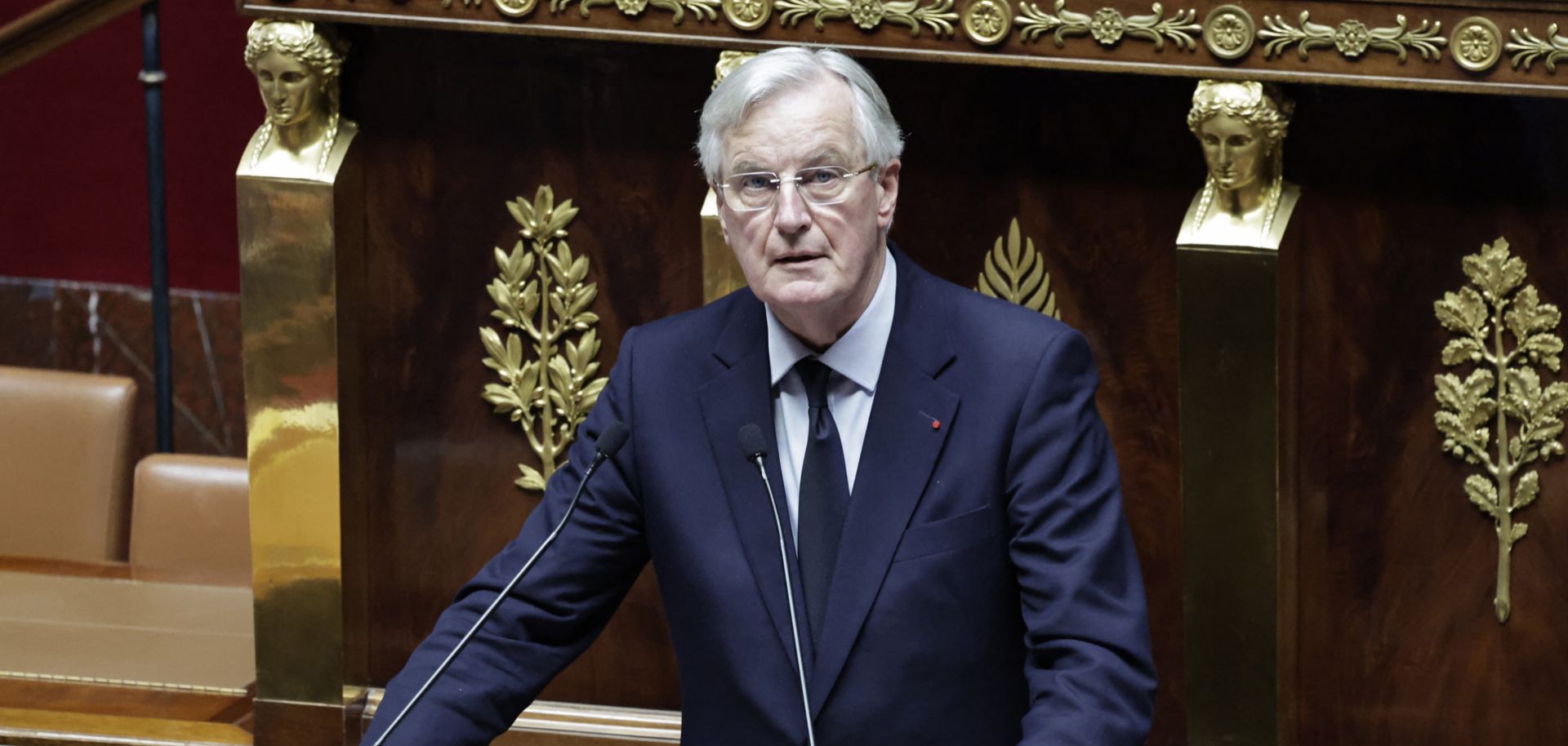
The likely collapse of France's government would exacerbate political instability and market pressures on the country, but a government shutdown or a financial crisis remains unlikely thanks to constitutional provisions that will allow the executive to continue making budgetary decisions. On Dec. 2, French Prime Minister Michel Barnier invoked Article 49.3 of the Constitution to pass the 2025 Social Security financing bill (a key component of the government's budget proposal) without a vote in the National Assembly. While this constitutional clause allows the government to pass laws without the need for parliamentary approval, it also allows lawmakers to table a no-confidence motion, which, if passed by a simple majority, rejects the bill and forces the government's resignation. Opposition parties from both the left and right filed two separate no-confidence motions on Dec. 2, opening the way for a vote of no-confidence to take place as soon as Dec. 4.
- For weeks, the left-wing New Popular Front coalition said it would table a no-confidence motion if Article 49.3 were invoked. While the far-right National Rally had been more ambiguous about the issue, it also announced on Dec. 2 its own motion of censure. A vote on a no-confidence motion can only occur 48 hours after its filing, making Dec. 4 the earliest possible date for the vote.
- France's early legislative elections in June and July produced a fragmented National Assembly with no clear majorities. In September, President Emmanuel Macron appointed Barnier as Prime Minister with the task of passing a budget for 2025 to reduce France's spiraling fiscal deficit amid growing pressures from financial markets and the European Commission. Barnier's budget proposal included a 60 billion euro package of tax increases (20 billion euros) and spending cuts (40 billion euros) aimed at reducing the government deficit from 6.1% of GDP in 2024 to 5% in 2025, which included measures deeply unpopular among opposition parties on both the left and right.
- Last week, Barnier held a series of meetings with opposition leaders in a bid to negotiate a compromise on the budget or at least dissuade them from joining a no-confidence vote should he opt for Art. 49.3, focusing in particular on the National Rally. However, the talks with National Rally leader Marine Le Pen ultimately failed, with Barnier only conceding two of the party's three key demands on the budget. Barnier agreed to cancel tax hikes on electricity bills and scrap cuts to medical reimbursements but reportedly refused to reverse a planned delay in adjusting state pensions for inflation. Moreover, in their joint motion of censure tabled on Dec. 2, Marine Le Pen and the former leader of Les Republicains, Eric Ciotti, denounced the government's failure to sufficiently cut expenses "on immigration or on France's contribution to the European Union."
The removal of Barnier's government would likely lead to the formation of another fragile minority government plagued by legislative gridlock and frequent risks of no-confidence votes. Barnier's minority government relies on support from French President Macron's Renaissance coalition, his own Les Republicains party and a host of smaller centrist parties collectively controlling just 213 seats in the National Assembly — well short of the 298 required for a majority. In contrast, the New Popular Front coalition and the National Rally and its allies hold 182 and 143 seats, respectively, giving them enough votes to oust the government should they join forces in a no-confidence motion. Against this backdrop, though Barnier will likely seek to negotiate his way out of the crisis, offering concessions to key opposition leaders to reject or abstain from a vote of no-confidence, the motion is ultimately likely to succeed. In the short term, Macron would then have three choices: reappoint Barnier, select a new prime minister supported by the existing centrist and center-right coalition, or choose a new prime minister backed by a broader coalition that includes center-left parties. However, the highly fragmented National Assembly makes it complicated to find a prime minister that a majority of lawmakers would unite behind. This means another minority government struggling to pass legislation and vulnerable to future no-confidence motions is likely, whether led by Barnier or someone else.
- The French Constitution prohibits Macron from calling for another legislative election for at least one year after early legislative elections in June and July, which deprives him of a potential tool to defuse political and social tensions until at least June 2025.
- In an extreme scenario, Macron could resign and call an early presidential election. However, with his second (and last) term ending only in mid-2027 and without the option of re-election, Macron is likely to explore other options, such as appointing successive prime ministers and making concessions to the opposition, before resorting to such a drastic measure.
- France's bond market has been volatile over the past two weeks, while the renewed financial strain on French and European assets on Dec. 2 underscores rising market concerns about France's political instability and fiscal outlook. Following Barnier's use of Art. 49.3, French 10-year bond yields rose by two basis points to 2.92%, while the spread with their German equivalents — Europe's benchmark — rose to a 12-year high of 88 basis points. The euro also weakened on the news, falling 0.8% against the dollar to $1.048.
Despite rising political instability and market pressures, France's constitutional provisions will likely prevent a government shutdown and a financial crisis. The likely successful vote of no-confidence in Barnier's government will further complicate the approval of a budget for next year, unsettling markets and driving up premiums on French assets and borrowing costs for the government. Yet a full-blown financial crisis or a U.S.-style government shutdown remains unlikely in France, as whichever government will succeed Barnier's still has several options to pass a budget even without parliamentary support, either through a special law that allows continued tax collection and essential spending by decree on a month-to-month basis until a new budget is passed (effectively allowing the government to roll-over the 2024 budget) or through special presidential powers allowing Macron to push through a budget without parliamentary approval. The latter option might prove necessary if Parliament denies the government emergency authorization to continue to collect taxes and maintain essential public spending. While France's constitutional provisions favoring the executive power would avert a financial crisis amid rising market pressures, they would likely trigger protests and strikes, with unions and opposition parties accusing Macron of sidelining the National Assembly to impose austerity measures. Though financial turbulence will continue in the coming weeks as markets worry about the prospects of Paris failing to reduce its fiscal deficit, a financial crisis remains unlikely thanks to the inherent strengths of the French economy. France maintains access to debt markets, supported by a still relatively strong credit rating (AA- by international rating agencies Fitch and S&P) and an advanced and diversified economy that continues to offer a relatively safe haven for investors. Moreover, while elevated, its 10-year bond yields remain manageable, as does the spread with their German equivalents (which is much lower than the 2011-2012 peaks during the eurozone crisis).
- French public debt increased from 97.4% of GDP in 2019 to 110.6% in 2023, and it is expected to increase to 112.4% in 2024 and 113.8% in 2025. Meanwhile, the fiscal deficit reached 5.5% of GDP last year, overshooting its original target of 4.9% of GDP due to a shortfall in tax revenues and rising spending, while the cost of debt financing has risen alongside interest rates and increased financial uncertainty, making it even more challenging for the government to meet fiscal consolidation targets.
- In the absence of a budget agreement, the government could invoke Article 47 to seek emergency parliamentary authorization for tax collection and issue decrees for essential monthly public spending until a new budget is enacted under Article 45 of the Loi Organique relative aux Lois de Finances. This would effectively allow the government to roll over this year's budget into next year, reducing the deficit thanks to inflation and already implemented cuts this year. However, the provisional budget would be only mildly restrictive, lacking substantial austerity measures. As a result, it would fall short of setting the public deficit on the desired downward trajectory, and debt levels would continue to rise, leaving the next government with an even greater challenge in restoring fiscal discipline. Nevertheless, despite the continued deterioration of public finances, markets would likely welcome some clarity on fiscal policy direction, reducing the likelihood of a financial crisis under this scenario.
- Should Parliament vote against the "special law" enabling continued tax collection and essential spending, France could face an unprecedented scenario where the government lacks clear legal mechanisms to fund the state starting Jan. 1. To avert a financial crisis, Macron would force through a budget without a vote in parliament, invoking Art. 16 of the French Constitution, which grants the French president exceptional powers under a state of emergency and when ''the regular functioning of the constitutional public authorities is interrupted."
