
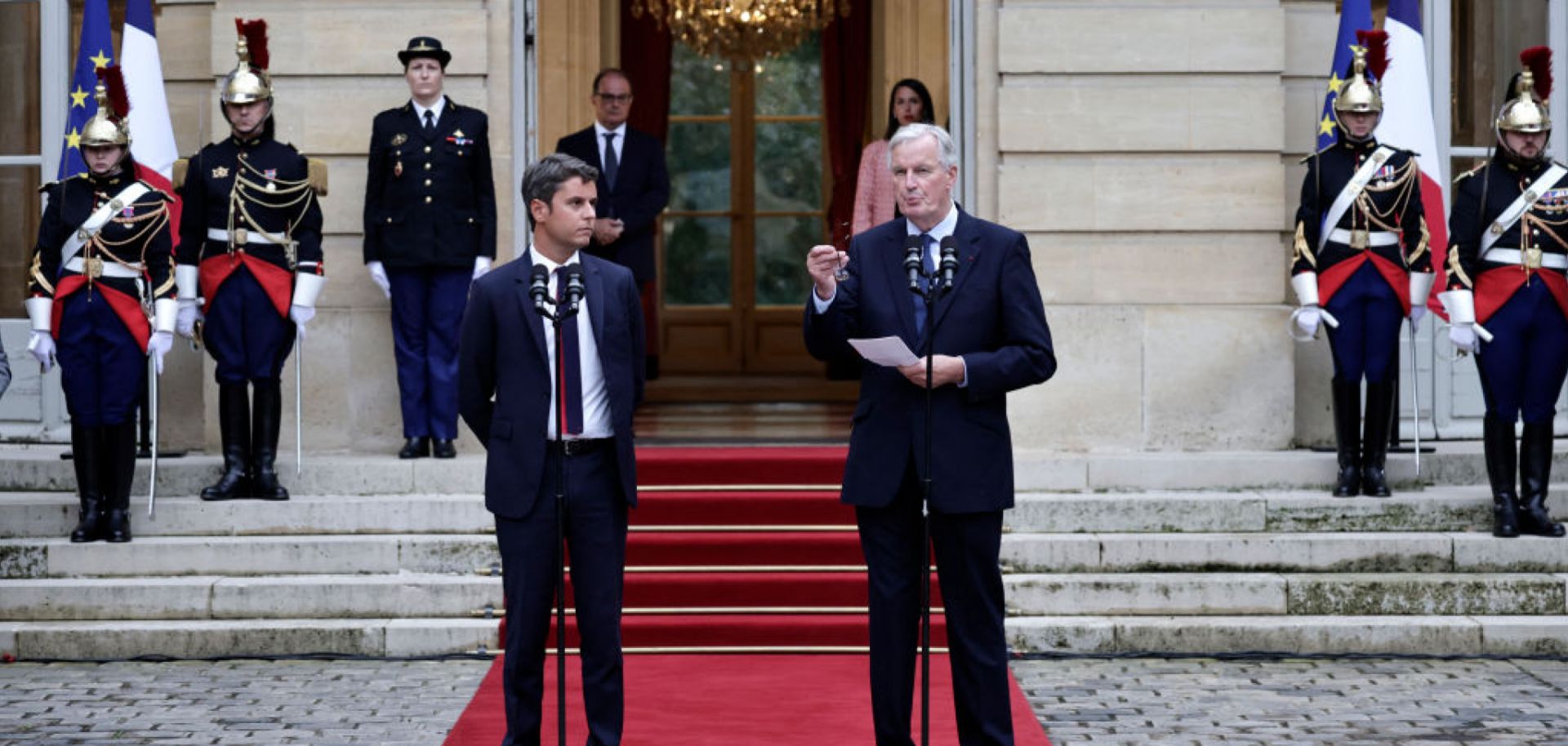
France's new prime minister will struggle to pass legislation in a highly fragmented National Assembly. While the government will still have options to reduce the country's fiscal deficit and avoid a financial crisis, these would come at the cost of severe social unrest and political volatility. On Sept. 5, French President Emmanuel Macron appointed former EU Brexit negotiator Michel Barnier as the country's prime minister. Barnier will succeed outgoing Prime Minister Gabriel Attal, who had been in office in a caretaker capacity since the inconclusive second round of early parliamentary elections July 7, which saw the New Popular Front coalition of left-wing parties winning 182 seats in the 577-seat National Assembly. Macron's centrist coalition won 163 seats and the far-right National Rally won 143 seats. The French president's decision came after weeks of consultations with parties in the National Assembly and after several other candidates were reportedly considered. While Macron probably expects the New Popular Front to oppose the new government, his appointment of Barnier is likely based on the assumption that the far-right National Rally will not immediately support a vote of no-confidence against the new prime minister, giving Barnier time to try to pass a budget.
- Barnier belongs to the center-right Les Republicains party, and has held several positions in France and the European Union over the past three decades. While Macron is not constitutionally required to pick a member of the largest parliamentary group, he has chosen someone he believes can withstand a no-confidence motion and pass legislation on an ad hoc basis by building consensus with opposition parties.
- Parliament is not required to approve the president's prime minister appointment, but opposition parties in the National Assembly can table no-confidence motions to bring the government down.
- On Sept. 5, RN leader Jordan Bardella indicated that his party would not automatically back a vote of no confidence against Barnier, unlike previous prospects such as Xavier Bertrand from the center right and Bernard Cazeneuve from the center left.
Even if Barnier's government managed to survive initial no-confidence votes, gathering enough support to pass a budget in such a fragmented Parliament and with limited fiscal space will prove a significant challenge. Barnier's first task will be forming a government able to survive eventual no-confidence motions likely to be put forward by left-wing opposition parties in the coming weeks. He will then have to present a medium-term fiscal adjustment plan in line with EU fiscal rules by Sept. 20, as requested by the European Commission in light of France's excessive deficit procedure. If Barnier manages to secure the National Rally's neutrality and survive the initial moves against it, his government's most important challenge will be to produce a 2025 draft budget law by Oct. 1, when the National Assembly will reconvene after the summer break. France's financial position has significantly deteriorated following the COVID-19 pandemic and the energy and inflation crises, and the country is now under growing pressure from both Brussels and markets to reduce its fiscal deficit. Attal's caretaker government has drafted a provisional budget for next year that would freeze spending at current levels in line with the goal of bringing the deficit below 3% by 2027. But the actual budget plans that the new government will present to the National Assembly will likely include less ambitious deficit reduction targets in a bid to accommodate center-left forces. Should Barnier succeed in passing a budget for next year, he would still likely fall short of significant fiscal consolidation. While leading to rising premiums on French assets, however, markets would at least welcome clarity over France's fiscal policy direction, preventing significant financial volatility.
- French public debt increased from 97.4% of gross domestic product in 2019 to 110.6% in 2023, and it is expected to increase to 112.4% in 2024 and 113.8% in 2025. Meanwhile, the cost of debt financing has risen alongside interest rates, with the interest burden on the debt expected to rise to 2.4% of GDP in 2027 for a total of more than 80 billion euros (about $89 billion), making it France's largest budget item.
- On Sept. 3, the French Finance Ministry said in a note to Parliament that the country's budget deficit could reach 5.6% of GDP this year (up from the previously estimated 5.1%). Last year, France's fiscal deficit reached 5.5% of GDP, overshooting its original target of 4.9% of GDP due to a shortfall in tax revenues and rising spending. This has made the outgoing government's target to reduce the deficit to 3% of GDP by 2027 increasingly unlikely, especially in light of the country's only modest growth projections.
- The European Commission has placed France and six other EU member states under a so-called excessive deficit procedure for breaching the bloc's spending limits.
- On May 31, international rating agency Standard & Poor's lowered France's sovereign credit rating from AA to AA-.
If the National Assembly fails to pass a new budget, Macron will likely use special constitutional powers to bypass the legislature, which would prevent a financial crisis but still cause significant financial pressures and social unrest. If Barnier fails to secure a parliamentary majority to approve a new budget, which seems likely in light of the profound political divisions in France's Parliament, his government would still have a few options. The government could theoretically use Article 49.3 or Article 47 of the French Constitution to pass the budget without a vote in Parliament. Using either option is unlikely, as the former would automatically expose the government to a vote of no-confidence that it would likely lose, and the latter would only be possible if the assembly has neither approved nor outright rejected a budget by mid-December. After a likely initial rejection of a budget proposal, the government could request emergency parliamentary authorization to continue collecting taxes and issue decrees for essential public spending on a month-to-month basis until a new budget is passed, which would effectively allow the government to roll over last year's budget (this way reducing the deficit thanks to inflation and already-implemented cuts). But if Parliament blocks this process as well, Macron might be forced to resort to special presidential powers under Article 16 of the constitution to pass a budget without any vote in Parliament. This would be a last-resort measure that would prevent a government shutdown and a potential financial crisis in France. But it would also likely trigger intense social unrest in the country, as many would see Macron as overstepping constitutional boundaries to undemocratically implement austerity measures.
- If the National Assembly refuses to allow continued tax collection and essential spending without an approved budget law, this will open the door to an unprecedented situation in France, as the government would lack clear legal mechanisms to fund itself starting Jan. 1, 2025. To avoid a crisis, Macron could argue that the use of Article 16 — which grants the French president exceptional powers under a state of emergency and when ''the regular functioning of the constitutional public authorities is interrupted" — is justified. The Constitutional Council could reject this argument, however, exposing Macron to legal risks (including a potential impeachment move) besides triggering intense demonstrations by opposition parties and the French public.
- Financial tensions are likely to escalate between late October and early November, when the European Commission is expected to publish its assessment of France's fiscal adjustment plans submitted in September and as there could be updates from major rating agencies. Markets would closely watch either development, which could accelerate financial instability.
- Budget negotiations will also be complicated by a proposal by LFI to repeal Macron's pensions reform, which will likely go before Parliament in October. The bill could receive enough votes in the National Assembly to pass should the left-wing NFP block remain vote alongside its archrival the National Rally in favor of the proposal. Should it win approval, budget negotiations would take place in an already tumultuous financial situation, making a budget enjoying broad support even less likely. Macron could also refuse to sign the proposal into law (something that occurred in 1986), seeking to delay its implementation indefinitely or at least until a budget is passed.
- In light of early legislative elections in June and July, Macron cannot call for another early election at least until June 2025, which will deprive him of a constitutional tool to defuse political and social tensions.
- On Sept. 5, far-left La France Insoumise party leader Jean-Luc Melenchon said Barnier's appointment meant Macron had "stolen" the election from the French, an unusually harsh attack in reaction to a government appointment in France that could signal the far left's willingness eventually to legitimize a violent response to the new government's actions.
