
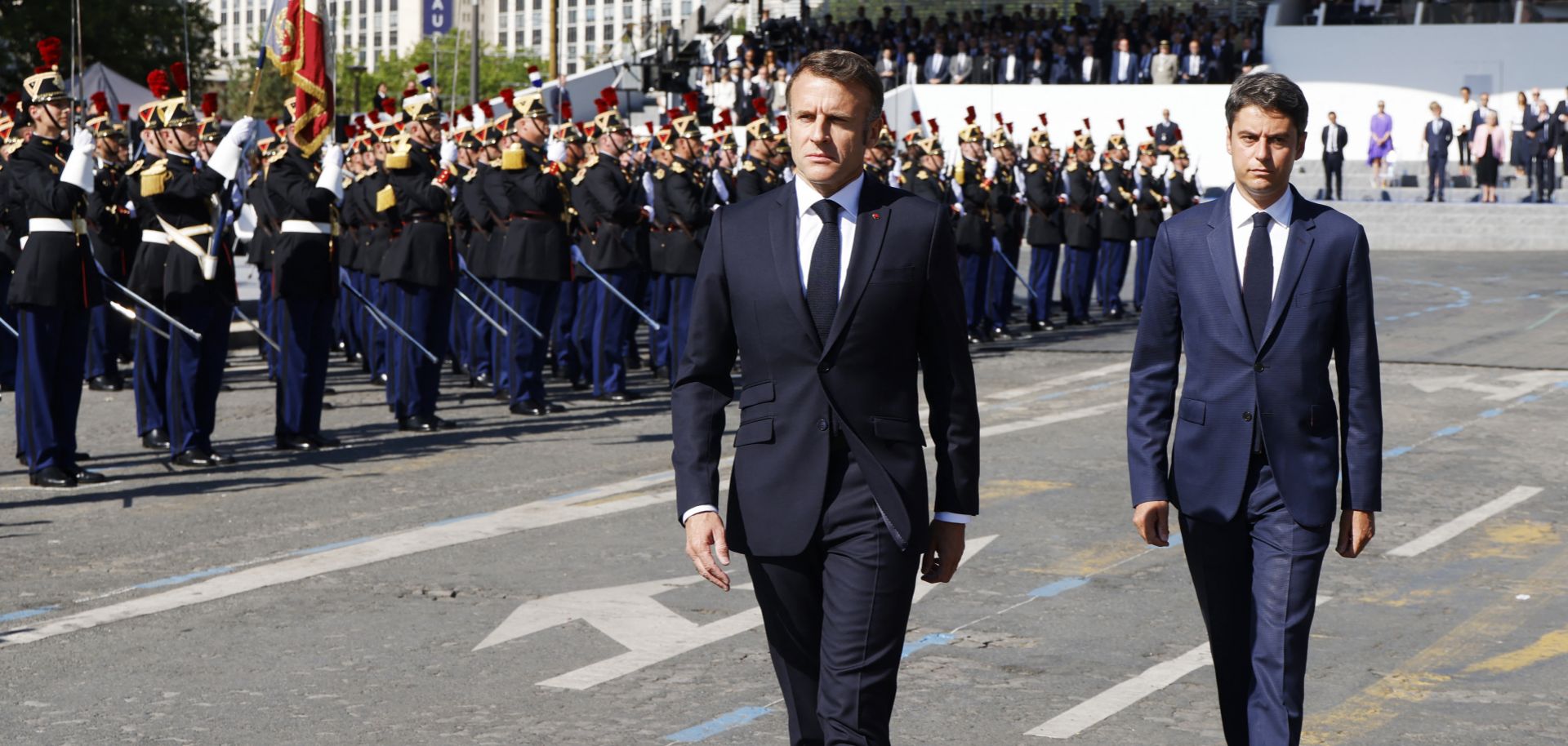
A caretaker government in France will guarantee the functioning of the state while complex government formation talks take place, but the appointment of a political government that is able to implement necessary fiscal adjustment measures will remain elusive amid a fragmented parliament and deep political divisions, possibly leading to financial and sociopolitical instability in France over the coming months. French President Emmanuel Macron accepted the resignation of Prime Minister Gabriel Attal on July 16, but asked him to stay on as head of a caretaker administration while negotiations for the formation of a new government in the aftermath of France's June-July early parliamentary elections continue. Early parliamentary elections yielded a hung parliament with three blocs similar in size, none of which is close to an outright majority. The New Popular Front (NPF) coalition of left-wing parties controls 182 seats in the 577-seat National Assembly, ahead of Macron's centrist coalition Ensemble with 163 seats and the far-right National Rally (RN) with 143 seats. This is complicating government formation talks. As evidence, on July 15, the NPF suspended talks amid internal divisions between its members over who to put forward as the alliance's candidate for prime minister, with the far-left France Unbowed (LFI) party accusing its more moderate allies of lack of coordination.
- Under the French constitution, there is no deadline for the president to appoint a new prime minister, and while Macron is not required to pick a member of the largest parliamentary group, he is expected to select someone with broad enough support to withstand a no-confidence motion and pass legislation on a case-to-case basis. Macron also legally cannot call fresh legislative elections for at least another year.
- On July 18, the French National Assembly held its inaugural session, with lawmakers expected to soon elect a new speaker of the house (President of the National Assembly).
- On July 10, in his first public statement since the parliamentary elections, Macron wrote in a public letter that ''no one won'' the ballot and called for all mainstream parties to build a broad coalition with a solid majority in parliament. Interpreting Macron's comments as an attempt to exclude the far-left La France Insoumise (LFI) party (the largest political force in the NFP coalition) from government, unions and far-left activists called for protests on July 18 and threatened further demonstrations during the upcoming Paris Olympic Games between July 26 and Aug. 11.
A caretaker administration will give France a government to manage day-to-day functions and handle eventual emergencies throughout the upcoming Paris Olympic Games and as lengthy and complex government formation talks advance. There are no specific French laws regulating the powers of a caretaker administration, nor are there time limits for how long it can remain in office (and no clear precedent in French recent history offering any indication in this sense). Still, according to French constitutional experts quoted in the French media, such a government should be a transitional one with very limited powers. Specifically, it would not be able to take measures of a political nature, that have a lasting change or legal status of a public body or service, that create new rights and duties for the population, or that are not already provided for by existing and promulgated laws. This means Attal's caretaker government should be able to issue decrees and orders to implement laws that have already been passed, authorize administrative measures, appoint personnel and secure public events (like those related to the Olympics), but it will not be able to present new bills, change regulations, adopt budget measures or initiate any policies with a financial impact on the state. In a crisis situation — like in the case of a terrorist attack — the caretaker government would also be allowed to declare a state of emergency and take all the necessary measures. This latter point is especially important in light of the upcoming Paris Olympic Games, which will take place amid significant global geopolitical tensions and a heightened terror threat in France and across Europe that will expose the event and the country to multiple security threats (from terrorism and cyber attacks, to social unrest and Russian hybrid tactics).
Political divisions will continue to complicate the formation of a functioning government and hinder the implementation of fiscal adjustments to reduce France's widening deficit and debt levels, likely leading to growing financial pressures and possibly resulting in Macron imposing drastic measures and socio-political tensions. Macron will be under increasing financial and political pressure to appoint a functioning political government over the coming weeks that is able to pass a budget for next year and present the European Commission with a medium-term fiscal adjustment path in line with EU rules in the fall. Possible scenarios include a minority government that is able to secure parliamentary majorities to pass legislation on a case-by-case basis, a broad coalition of center-left and -right forces, and a technocratic government. Should the political gridlock persist, Macron may also consider keeping Attal's caretaker government in place for months. Under any of these scenarios, however, it would still be challenging for French parties to achieve consensus on politically painful budget cuts amid opposing policy priorities, increasingly polarized politics, and a general aversion to large coalitions and compromise. This means that, whichever government (if any) is in office in the fall, it will struggle to secure parliamentary approval for the spending cuts and could face a no-confidence motion over the budget. Such an impasse might result in a roll-over of this year's budget for 2025, by decree, until a new budget is passed. While, on the one hand, this would avert a ''government shutdown'' and reassure markets that Paris would at least not pursue expansionary fiscal policies, it would also delay necessary fiscal consolidation measures. If the policy paralysis continues, investors would then demand higher premiums to hold French debt, increasing pressure on the French financial system and possibly leading to a spiral of increasingly strict and deteriorating refinancing conditions for the French government. Should a sovereign debt crisis in France look increasingly likely, and should political parties remain unwilling or unable to agree to the necessary fiscal adjustments, Macron could decide to force through spending cuts or other economic emergency measures without parliamentary approval using special presidential powers. This, however, may result in significant social unrest from unions and political activists in France.
- The Cour des Comptes, France's national auditor, warned on July 15 that the country was ''dangerously exposed'' to a new economic shock due to its growing budget deficit, which stood at 5.5% of GDP in 2023, up from 0.7% in 2022 and 0.6% higher than government targets last year. Meanwhile, government debt reached 110.6% of GDP in 2023 and it is expected to further increase to 112.4% in 2024 and 113.8% in 2025.
- Prime Minister Attal's outgoing government was committed to reducing France's deficit to 3% of GDP by 2027, a target that was already widely regarded as overly ambitious amid the country's only modest economic growth prospects.
- The European Commission has already placed France, alongside other six EU member states, under a so-called excessive deficit procedure for breaching the bloc's spending limits.
- On May 31, international rating agency Standard & Poor's lowered France's sovereign credit rating from AA to AA-.
- Eventual negative market impacts in France may be magnified by the fact that the European Central Bank (ECB) would not be able to make use of its various stabilization tools. This also applies to the ECB's Transmission Protection Instrument (TPI) introduced in 2022, which would allow the bank to counter risk premiums on the bond yields of a member state through bond purchases. But the TPI is intended to be used when the rise in bond yields is caused by the tightening of financial conditions and is not justified by economic fundamentals, which would not be the case for France, as a financial crisis would stem from the government's inability or unwillingness to consolidate public finances.
- Macron would have the ability to implement spending cuts without prior parliamentary approval in exceptional circumstances, such as arguably a debt crisis, through the use of Article 16 of the French Constitution. Article 16 grants the French president exceptional powers under a state of emergency and when ''the regular functioning of the constitutional public authorities is interrupted.'' However, the implementation of austerity measures bypassing the National Assembly, even if to avert a financial crisis, would still likely result in significant opposition by unions and the French public.
