
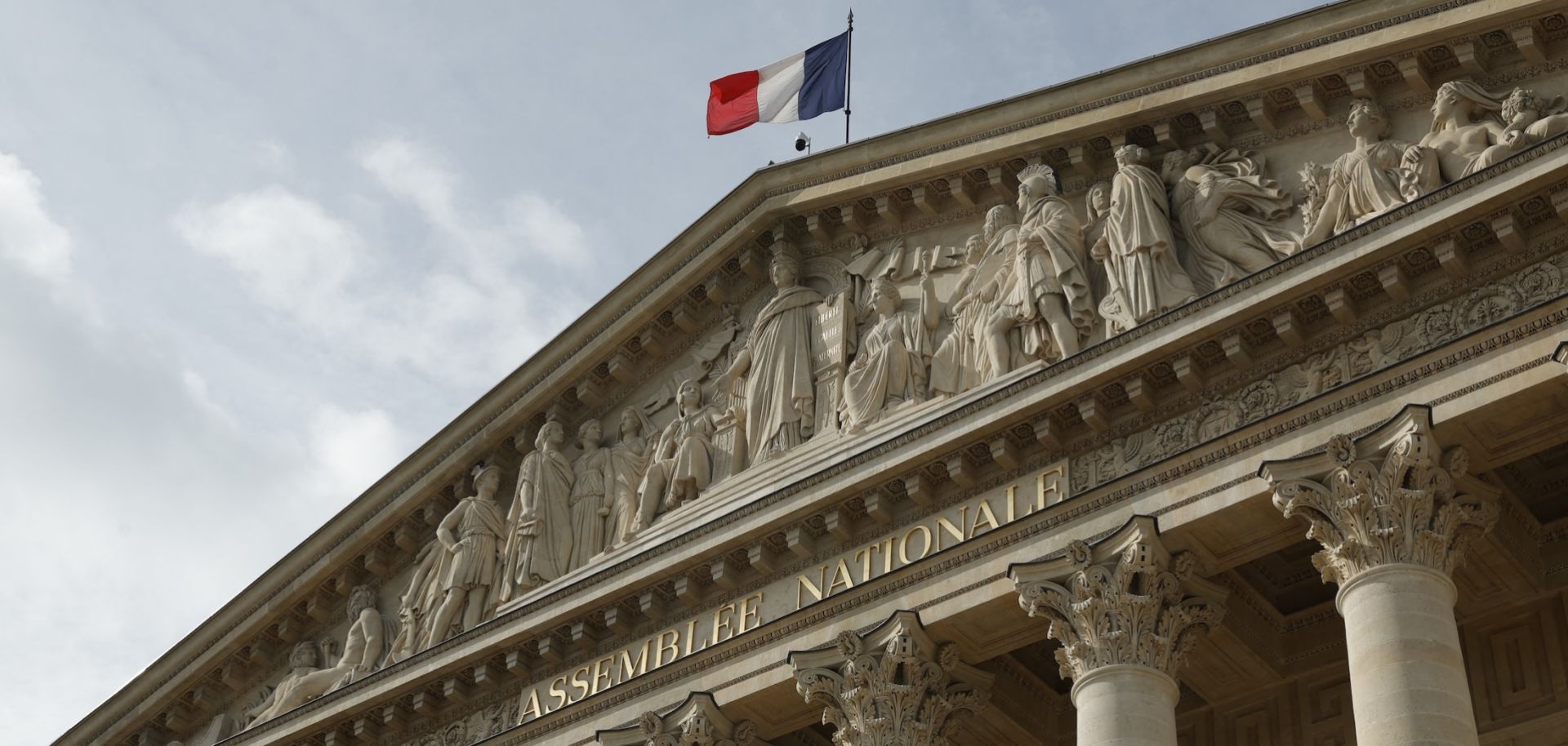
While French President Emmanuel Macron's decision to hold an early legislative election is meant to weaken the right-wing National Rally, the most likely outcome is prolonged policy paralysis either through a hung parliament or through complex cohabitation between a president and prime minister from different parties. Macron on June 9 announced the dissolution of the National Assembly and a legislative election June 30, with a second round on July 7. Macron's announcement came shortly after the right-wing National Rally won 31.5% of the vote in the election for the European Parliament, while Macron's party Renaissance and its allies won only 14.5%. Macron justified his decision by claiming that "France needs a clear majority in serenity and harmony." According to Macron "The rise of nationalists and demagogues is a danger not only for our nation, but also for our Europe, and for France's place in Europe and the world."
- Macron won the French presidency in May 2017 with 66% of the vote, and his party obtained a majority in the National Assembly in the June 2017 legislative election. Macron was reelected for a second and final term in May 2022 with 58% of the vote, but his party lost a parliamentary majority in June 2022 legislative elections. Since then, Macron's government has struggled to pass legislation in a hung parliament. In January 2024, Macron appointed former Education Minister Gabriel Attal as prime minister in an attempt to relaunch the government. But this was not enough to reverse opinion polls showing that Macron and his government are unpopular.
- On June 11, the National Rally announced that, should the party win the legislative election, it will push to appoint its leading candidate in the European Parliament election, Jordan Bardella, as prime minister. While Marine Le Pen remains the National Rally's leader, she aspires for the French presidency in 2027, not for the premiership this year.
The early election seeks to mobilize voters against the National Rally, but could result in another hung parliament that struggles to pass legislation. Macron's decision to call for an early legislative election is meant to mobilize voters who are worried about the far-right National Rally winning enough seats in the National Assembly to appoint a prime minister. Unlike the elections for the European Parliament, which take place in one round, elections for the National Assembly happen in two rounds, which means that parties need to win more than 50% of the vote in the runoff to obtain a seat in the legislature. While the National Rally is becoming increasingly popular, the party is currently below the 50% threshold in most French voting districts (though this could change in the coming weeks if it attracts voters from other far-right forces or from the center right). Moreover, Macron is counting on the fact that French voters tend to use the European Parliament elections as a low-cost opportunity to punish the incumbent government, as the vote does not directly impact the National Assembly. Against this backdrop, Macron hopes that the National Rally will not perform as well in the legislative elections as it did in the European Parliament elections. But while this strategy could prevent the National Rally from obtaining enough seats to appoint Bardella as prime minister, it will probably not result in Renaissance regaining the legislative majority it lost in 2022, as support for the party is lower than it was before the last legislative election. As a result, the election could result in another hung parliament that struggles to pass legislation at a time when France is dealing with high levels of public debt and a deep fiscal deficit.
- The National Rally tends to perform much better in European Parliament elections than in National Assembly elections. For example, it won 24.9% in the 2014 European Parliament election and 23.% in the 2019 European Parliament election; but only 13.2% in the National Assembly election in 2017 and 18.7% in the National Assembly election in 2022. This is the result of multiple factors including the two-round voting system in the National Assembly elections and the fact that French voters tend to establish a more direct connection between the National Assembly and domestic policymaking than with the European Parliament election.
- Turnout for the European Parliament elections in France was around 52%, compared to 72% in the last presidential elections. While Macron has largely failed to mobilize moderate voters against a potential National Rally victory in the European elections, he may be betting on a much larger participation in a national vote.
- The National Rally also tends to struggle to find partners in the National Assembly. While far-left groups like La France Insoumise are very critical of Macron and have occasionally cooperated with the National Rally tactically, they are unlikely to formally support a prime minister from the National Rally.
- On June 11, French Finance Minister Bruno Le Maire said "Let's not think this is an election like any other — it's an election with unprecedented grave consequences for our nation." This highlights how the French government will present the legislative election as a crucial showdown between centrists and extremists, hoping to mobilize voters against the National Rally.
If the National Rally appoints a prime minister, the result will be severe policy paralysis and greater political uncertainty. If the National Rally obtains enough support to appoint a prime minister, the result will be a complex cohabitation between a president and a prime minister from two different parties. Under the French Constitution, presidents focus primarily on foreign policy and defense, while prime ministers focus primarily on domestic policy and day-to-day administration. These lines are often blurred in practice, as when the president and the prime minister belong to the same party (as has been the case since 2002), the former tends to control the general direction of the country. This means that the potential cohabitation between Macron and Bardella could severely disrupt policymaking in France, as the head of state and the head of government could push in different directions on issues ranging from fiscal policy (the National Rally opposes Macron's fiscal consolidation plans) to relations with the European Union and NATO (the National Rally wants to weaken Paris' engagement with both entities). While Macron would be unable to veto legislation approved by an opposition-controlled National Assembly, he would have the power to delay bills (by, for example, referring them to the Constitutional Council for a review or sending them back to parliament for reconsideration), which would slow policymaking. Should the cohabitation become too problematic, Macron will have the option to dissolve the National Assembly again, but this would do little to mitigate political paralysis in an increasingly fragmented country. A difficult cohabitation between Renaissance and the National Rally could also increase French voters' frustration with both parties, opening the door for new political forces to emerge ahead of the 2027 presidential election.
- While the National Rally is France's main far-right party, the far-right Reconquete party (led by former TV personality Eric Zemmour) obtained 5.5% of the vote in the European Parliament elections. Most of these votes are likely to go to the National Rally in the second round of the legislative elections. Supporters of the conservative Les Republicains party (who are critical of Macron and also share some of the National Rally's views on issues like immigration) could also help the National Rally win a majority in the National Assembly.
- In May, Standard & Poor's downgraded France's sovereign credit rating to AA- from AA, citing concerns that the country's general government debt as a share of gross domestic product will increase because of larger than expected budget deficits between 2023 and 2027. According to S&P, France's debt-to-GDP will reach 112.1% in 2027, up from 109.0% in 2023. Both a scenario of a hung parliament and cohabitation will make it harder for France to implement a coherent plan of fiscal consolidation, which over time could result in additional downgrades and higher borrowing costs for France.
