
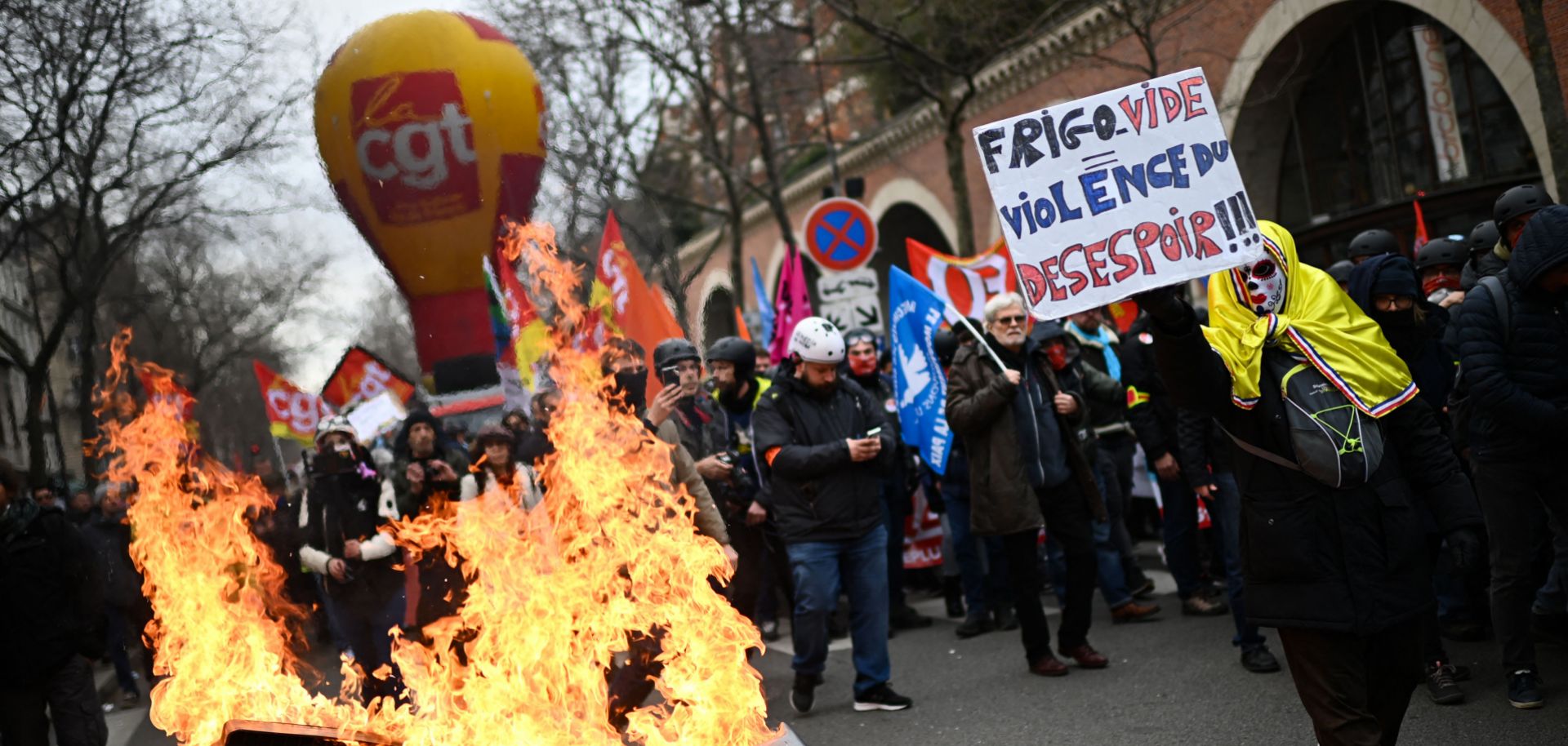
A protestor holds a placard that reads ''Empty Fridge Equals Violence of Dispair'' near a pile of burning trash during a demonstration in Paris, France, against the government's proposed pension reform on March 11, 2023.
The French government's decision to pass its controversial pension reform without a vote in the National Assembly will limit Paris' ability to implement future reforms and maintain a significant risk of protests and the possibility of an early legislative election. On March 16, the French government announced it would pass a controversial pension reform using article 49.3 of the French constitution, which allows it to adopt legislation without a vote in the National Assembly. The government made this decision after weeks of speculation over whether President Emmanuel Macron and Prime Minister Elizabeth Borne had enough support in the legislature to pass the reform, given that their centrist Renaissance (RE) party and its allies do not control a majority in the lower chamber. While the leaders of the conservative The Republicans (LR) party had officially vowed to support the reform, many of its lawmakers in the National Assembly were skeptical about it, which likely explains why the government concluded there was not a majority to pass it through the ordinary parliamentary procedure on March 16.
- Among other things, the pension reform seeks to raise France's retirement age from 62 to 64. According to the French government, this change is vital to ensuring the pension system is sustainable in the long term. On March 16, Macron warned of the ''high financial risks'' of not approving the reform.
- However, opinion polls show that a large majority of French voters oppose the reform, and the country's main trade unions held several strikes and protests against it between January and March.
The decision to circumvent the National Assembly confirmed that the French government does not have enough legislative support to pass significant reforms, which will complicate its policy agenda in the future. In the short term, the March 16 developments mean that Borne could resign, be replaced with another prime minister chosen by Macron or lose a no-confidence motion by the opposition. Macron may seek to appoint a new prime minister as a way to regain political initiative under a new government. Macron may also move his policy agenda further to the right (by, for example, pushing for tax cuts and taking a tougher position on issues like security and immigration), to garner more permanent support from LR. But this could prove complicated, especially as LR will be skeptical of supporting a weakened president. Should these attempts fail, Macron will have the option to dissolve the National Assembly and hold an early legislative election, hoping that his RE party will regain a majority. But considering the current political environment in France, an early legislative election would likely result in even more seats for far-right and far-left parties, and even fewer seats for Macron's party. This means that an early legislative election is likely a last-resort decision for Macron if his other political options fail or in the face of sustained protests. Regardless of the future evolution of events, the pension reform will probably be the last major reform Macron adopts for a long time, as the current political environment is not conducive to structural reforms.
- In France's semi-presidential system, presidents and prime ministers share executive powers. French presidents have often replaced prime ministers during times of crisis to inject new life into governments. Presidents also have the power to dissolve the National Assembly and hold early legislative elections.
- In the 2022 election for the National Assembly, Macron's party (then called La Republique En Marche, or LREM) won only 245 seats, down from 346 in the previous legislature. The far-left NUPES alliance won 151 votes (it did not run as such in the previous election) and the far-right National Rally won 89 seats (up from 7 in the previous legislature).
Paris' decision not to give lawmakers a say on the controversial pension reform will fuel anti-government sentiments in France, creating fertile ground for further social unrest and support for anti-establishment political forces. While the use of article 49.3 is constitutionally valid, it will politically be costly for Macron because his opponents will label the move as undemocratic. This means that trade unions will likely escalate their heavily disruptive strikes, while far-right and far-left groups are likely to organize more anti-government protests. More structurally, the March 16 decision will reduce some French citizens' faith in their country's parliamentary democracy and fuel sentiments that the government has lost touch with voters. This could trigger the emergence of grassroots movements such as the Yellow Vests, which paralyzed France between 2018 and 2020 with a series of disruptive protests and strikes. While France's next presidential election will only take place in 2027, the narrative of an undemocratic government could strengthen anti-establishment political groups in the far-right and the far-left in the interim. This trend could become visible as early as mid-2024, when France will hold elections for the European Parliament.
- Jean-Luch Melenchon, the leader of the left-wing NUPES alliance, said on March 16 that the pension reform does not have legitimacy ''for most of the French, for the National Assembly, for unions or for workers' associations.''
