
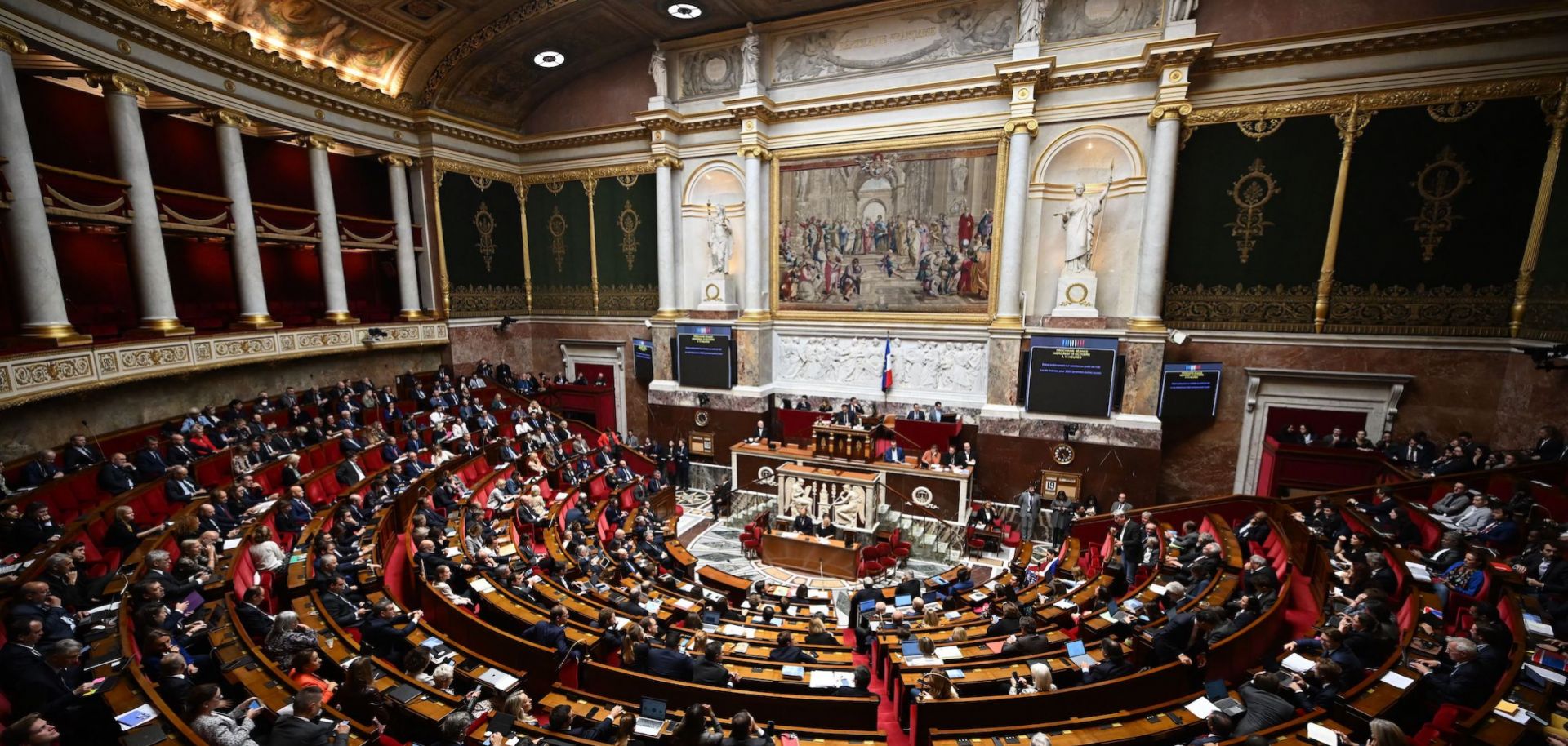
A photo taken on Oct. 19, 2022, shows a general view of France's National Assembly during the reading of the government's 2023 budget.
France's political fragmentation is increasing the risk of policymaking paralysis and social discontent that, if left unresolved, could lead to an unpredictable early legislative election. On Oct. 19, the French government used special constitutional powers to approve the budget for 2023 without a vote in the National Assembly. The budget includes measures such as indexing income tax to inflation, removing corporate value-added tax (VAT) for two years, imposing windfall taxes for energy companies, and extending billions of euros in emergency aid for households dealing with rising energy prices. While Prime Minister Elisabeth Borne promised opposition lawmakers that many of their proposed amendments to the budget bill would be incorporated, the budget law mostly includes amendments suggested by government lawmakers.
- French President Emmanuel Macron lost his majority in the National Assembly after the legislative election in June. Since then, Ensemble Citoyens (the coalition of moderate forces that backs him) controls 250 of the 577 seats in the National Assembly, which means that the government needs support from the opposition to pass legislation. While the French government has been able to pass some legislation this way in recent months, it refused to make meaningful concessions to opposition parties to approve the budget for 2023.
- Against this backdrop, the government decided to pass the budget using Article 49.3 of the French Constitution, which allows governments to adopt laws without a vote in the National Assembly. French governments can only use Article 49.3 to pass one bill per parliamentary session, excluding the budget and social security. This means that Macron is constitutionally allowed to use this article for a regular bill before the end of the current legislative season in June 2023.
The government's decision to bypass lawmakers highlights how the fragmentation in the National Assembly will complicate the implementation of Macron's policy agenda. Even if there are limits to the use of Article 49.3, the more the government seeks to bypass the National Assembly, the harder it will be to compromise on legislation with the opposition, which in turn will delay or even halt the legislative process and make it increasingly difficult for the government to implement its policy agenda. In addition, every time the French government uses Article 49.3, it allows opposition forces to trigger a vote of no confidence against the prime minister. In fact, the far-left New Ecological and Social People's Union (NUPES) filed a no-confidence vote against Borne on Oct. 20, which the far-right National Rally (NR) supported. While the motion failed on Oct. 24 because NUPES and NR lacked the votes to pass it, it marked a rare case of cooperation between the two ideological rivals that will create future problems for the government. As long as the opposition remains disunited, the French government will be able to stay in power. In a low-probability but high-risk scenario, the ideologically heterogeneous opposition could eventually join forces to support a no-confidence motion against the government. As the cost of living crisis worsens in France, NUPES, the NR and the conservative Republicans may decide that the political cost of cooperation is lower than the cost of allowing an unpopular government to remain in office. While at this point a joint push by the opposition to depose Borne is unlikely, their calculations could change in the future if the socio-economic situation in France continues to deteriorate, especially if Macron moves forward with controversial reforms that would upset both sides (such as his plans to increase the retirement age).
- It would take support from 289 of the 577 members of the National Assembly to pass a no-confidence vote against the government. This means that NUPES (151 seats), the RN (89 seats) and the Republicans (62 seats) would need to get together to approve the motion. This is currently improbable given the severe ideological differences between the three parties, and even within parties.
- In late September, workers at several oil refineries and depots operated by the French energy giant TotalEnergies began strikes to demand higher wages. Their actions disrupted fuel distribution across France, and the government used requisitioning powers to force some workers back to fuel depots.
- On Oct. 18, the left-leaning General Confederation of Labour (CGT) and other smaller unions launched strikes and demonstrations across the country that led to minor disruptions in public transportation.
- France's largest unions — which include the CGT, the French Democratic Confederation of Labour (CFDT), the French Confederation of Management - General Confederation of Executives (CFE-CGC), Workers' Force (FO) and the French Confederation of Christian Workers (CFTC) — are divided and often fail to cooperate with each other. The French government has benefited from this situation in recent years. But if economic conditions in France significantly worsen or if the government raises the national retirement age, the universal impact on their members could galvanize greater cooperation between the unions and enable them to organize highly disruptive strikes.
Continued legislative paralysis could result in an early legislative election, which would increase political uncertainty. If the legislative process grinds to a halt because of the National Assembly's fragmentation, or (much less likely) if Macron fears that an anti-government alliance between the far-right, the far-left and the conservatives is probable, he may decide to dissolve parliament and hold an early legislative election. But this would be a very risky strategy since the process would be time-consuming and would severely reduce policymaking at a time of high inflation, slow economic growth and geopolitical tensions with Russia. Additionally, holding an early legislative election against the backdrop of rising social discontent could result in an even weaker performance by Macron's Ensemble Citoyens coalition than the June election and open the door to an even larger presence of opposition forces in the National Assembly. Alternatively, if Macron does not dissolve parliament and opposition parties reach a deal to oust Borne, the opposition would still struggle to agree on a new prime minister who they can all accept. A successful opposition plot to depose the government would thus likely also result in an early legislative election due to insufficient support for a replacement prime minister.
- While a scenario of case-by-case compromises between Ensemble Citoyens and opposition parties would prevent the collapse of the government and an early legislative election, it could come at a high fiscal cost for France, especially if the compromises involve higher fiscal spending. This could prove problematic at a time when borrowing costs for governments across the world are increasing because of tighter monetary policies by major central banks.
- According to a BVA survey published on Oct. 21, only 36% of French voters said they still supported Macron, with a little more (41%) saying they still supported Borne.
