
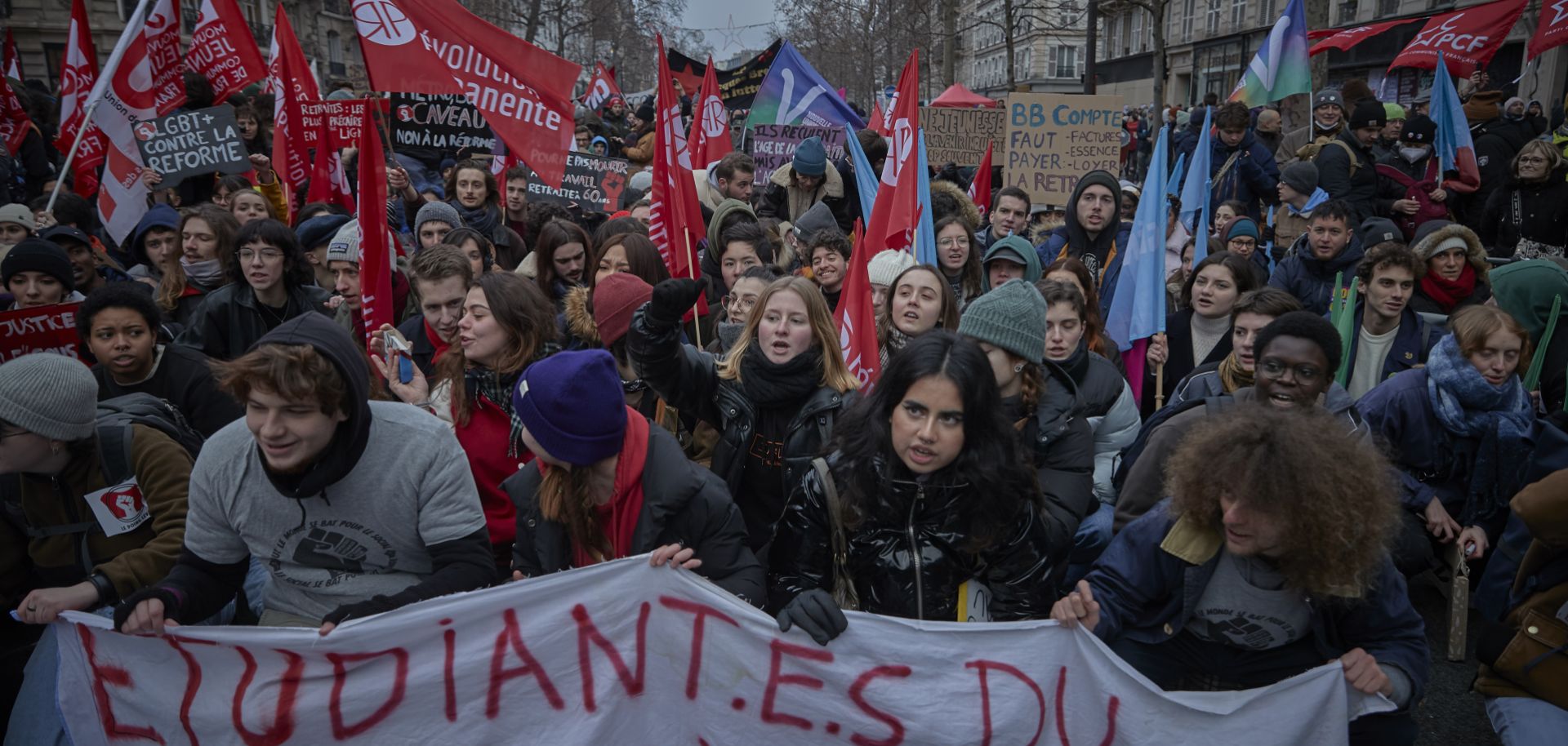
People march in the streets of Paris, France, to protest against President Emmanuel Macron's pension reform plans as part of a nationwide strike on Jan. 19, 2023.
The French government will likely pass its controversial pension reform, but unions' continued resistance will result in heavily disruptive labor action in the coming weeks that will undermine economic activity and threaten political stability in France. French trade unions have maintained their resistance to the government's plan to overhaul the country's pension system, with workers from multiple sectors of the economy scheduled to go on strike in the coming weeks. France's largest trade unions, including the General Confederation of Labour (CGT), the French Democratic Confederation of Labour (CFDT) and the General Confederation of Labor - Workers' Force (FO), will hold a general strike across the country on Jan. 31 — the second such labor action after a general strike on Jan. 19 brought more than a million workers onto the streets of France and severely disrupted activity in sectors ranging from public transport to schools. In addition, specific sectors have announced plans to go on strike at different times throughout February, including rail workers (on Feb. 7 and 8) and workers in the energy sector (Feb. 6). Workers in ski resorts and other tourism-oriented activities have also pledged to strike during the winter school holidays in February.
- Reforming France's pension system to make it sustainable was one of the central promises of French President Emmanuel Macron's re-election campaign in 2022. Macron's original proposal was to raise the retirement age from 62 to 65. But because his Renaissance (RE) political party and its centrist allies do not control a majority of seats in the National Assembly, he chose to make concessions to smaller parties in the opposition (such as taking the retirement age to 64 and raising the minimum pension payments) to secure enough support.
- The opposition Republican Party has officially expressed its support for the government's reform plan, which means the plan stands a relatively strong chance of being approved by the National Assembly during the first half of the year. However, the party is internally divided and some Republican lawmakers will likely vote against the reform.
The French government is willing to tolerate several months of labor action, but an intensification and diversification of the protests could derail the project and severely weaken Macron. Provided that it has enough support for the pension reform in the National Assembly, the French government is willing to endure several months of labor action. This means that while protests will likely continue during the first half of the year, the reform will probably pass before the summer recess. However, two factors could torpedo the reform. The first is an intensification of the strikes to the point that the French economy is paralyzed for long periods (i.e. several weeks) as opposed to the current strikes, which have mostly taken place over short periods (i.e. a day or two). This scenario is particularly likely to materialize if protests expand from unions to grassroots movements, similar to the Yellow Vest movement that severely disrupted activity in France between 2018 and 2020. Unlike unions, grassroots movements lack clear leadership and demands, which makes them more volatile and also more difficult to negotiate with. Under these circumstances, the government may decide to abandon the reform plan or water it down so much that it fails to achieve its main goal of making France's pension system more financially sustainable.
Macron could also be forced to abort the reform if a significant number of lawmakers in the opposition Republican Party (and even some of the centrist allies of Macron's RE party) reject the legislation and make it unviable in the National Assembly. If this happens, Macron could still use a constitutional clause that allows governments to pass legislation without consent from the National Assembly. But this would trigger a no-confidence vote from the opposition that Macron's government would not survive if at least 289 of the 318 opposition lawmakers in parliament support the motion. Deposing Macron's government would require cooperation between virtually all of the ideologically diverse parties that make up the opposition, which would be difficult but cannot be ruled out entirely if political opportunism drives enough members of parliament to vote against the government.
- According to Article 49.3 of the French constitution, French prime ministers have the power to approve laws without a vote in the National Assembly. However, using this article also gives the opposition the opportunity for triggering a no-confidence vote against the prime minister and his or her government. If a no-confidence vote is successful, the legislation is rejected and the government collapses. In such a scenario, the dissolution of the National Assembly and an early legislative election is the most likely outcome.
- French Prime Minister Elisabeth Borne used Article 49.3 in October 2022 to pass France's budget for 2023. This resulted in the far-right and the far-left opposition parties issuing no-confidence votes against Borne, which she won by a narrow margin. Notably, far-right leader Marine Le Pen supported the no-confidence vote proposed by the far-left NUPES alliance in a very rare episode of cooperation, showing that temporary alliances between ideological rivals are not impossible.
If the pension reform is delayed or scrapped, the political fallout could generate a crisis that forces Macron to hold an early legislative election or significantly pare down his policy ambitions. Should events force Macron to abandon or severely water down his plans for updating France's pension system, he will face two options. The first is dissolving the National Assembly and holding an early legislative election to try to break the political deadlock. However, such an action would likely result in yet another fragmented National Assembly that struggles to pass legislation. Macron's RE party lost its majority in the National Assembly in 2022, and opinion polls suggest that an early legislative election is unlikely to restore it. Moreover, holding a legislative election in the middle of a cost-of-living crisis and social discontent over the government's plans for pension reform may actually weaken RE further and strengthen the far-right and far-left opposition groups, making it even harder for Macron's government to function. The French president's second option (and the most likely outcome if the pension reform is aborted) is focusing on policies that can generate enough support in the National Assembly, such as measures to help households and businesses cope with inflation. This would result in a government with modest goals that stays in power but avoids enacting the structural reforms needed to make the French economy more sustainable and competitive, opening the door to future economic and financial crises.
- France's next legislative election is scheduled for 2027, which means that there are not many opinion polls at this moment. However, a Cluster17 opinion poll conducted in November 2022 showed that Macron's centrist alliance and the far-left NUPES alliance would receive roughly 25% of the vote each in the case of an early election, with the far-right National Rally receiving 20% of the vote. This confirmed that the French electorate is fragmented in three sectors of roughly the same size.
- According to an Elabe poll for the French broadcaster BFMTV released on Jan. 26, 72% of French people are opposed to Macron's pension reform, an increase of six points from the previous week.
