
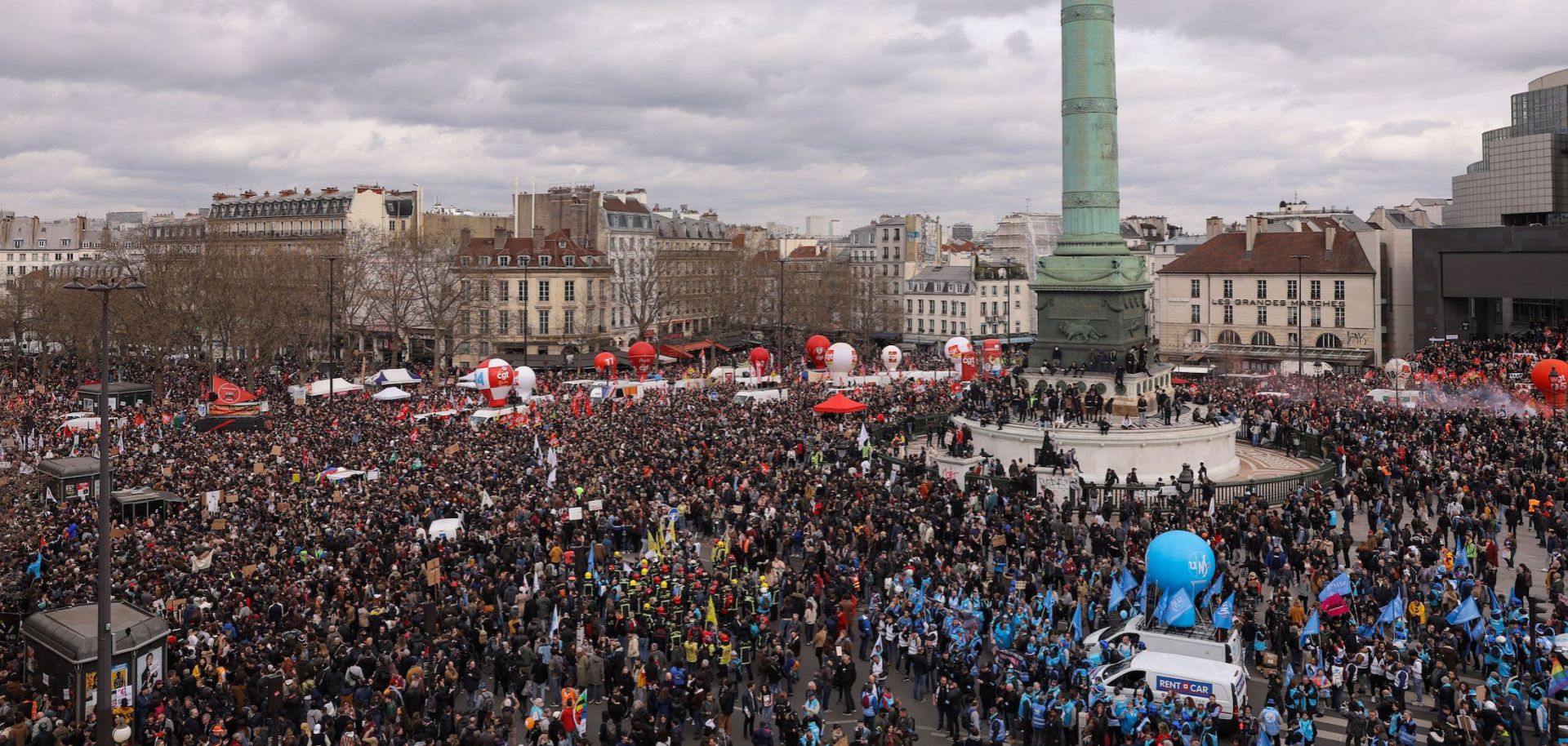
Protesters gather on Place de la Bastille in Paris, France, on March 23, 2023, to attend a demonstration a week after the government pushed a pension reform through Parliament without a vote.
French President Emmanuel Macron's decision to ram his pension reform through the National Assembly has triggered a political crisis that will likely fuel a protracted protest movement. While this crisis could bring the country's policy agenda to a standstill, it may only be the first symptom of chronic political instability resulting from the reconfiguration of France's political scene. On March 20, French Prime Minister Elisabeth Borne survived two no-confidence motions that opposition parties triggered after her government enacted a controversial pension reform without holding a vote in the National Assembly, France's lower house of Parliament. The reform aims to make France's pension system more sustainable amid an aging population by raising the retirement age from 62 to 64. Then on March 22, President Macron defended the constitutional legitimacy of his government's use of this constitutional bypass and outlined his ambition to reform employees' working conditions. Despite these attempts at shifting the debate away from the pension reform, a large majority of the French public perceived the move to bypass the National Assembly as a breach of the social contract, leading to sporadic yet violent protests across France's major cities for seven consecutive days. Furthermore, the move has come at a great personal cost for Prime Minister Borne, who finds herself politically weakened and under intensifying calls from opposition parties to resign.
- The constitutional bypass triggered by the French government to secure its pension reform, known as Article 49.3, enables a prime minister to ensure that a bill is adopted without a vote unless a majority of lawmakers in the National Assembly backs a vote of no-confidence. Singular among European countries, this constitutional feature was incorporated into France's 1958 constitution due to chronic instability under the Fourth Republic (1946-1958).
- While the government lacks a majority in the National Assembly, it was strongly intent on securing its pension reform through a vote by relying on the support of center-right lawmakers from The Republicans party (known by its French acronym, LR). But while LR's leadership backed the pension reform following amendments to the bill, a significant number of LR lawmakers still refused to back it, leading the government to resort to Article 49.3.
- According to polling from French research laboratory Cluster 17 that was published on March 19, 79% of the public found Macron's use of Article 49.3 "unacceptable," while 74% wanted the vote of no-confidence against Borne to succeed.
- The cross-opposition motion of no-confidence gathered 278 votes, nine votes short of the 287-vote threshold currently needed to reach a majority in the National Assembly and topple the government. The other vote of no-confidence was triggered by the far-right National Rally (NR) party and only garnered 94 votes.
The government's use of this constitutional bypass has broadened France's protest movement beyond the issue of pension reform to encompass Macron's wider governing style, setting the stage for protracted demonstrations that could turn violent. While unions have called for continued protests to force the president to withdraw the pension reform, Macron is unlikely to do so in the immediate term considering Article 49.3's constitutional legitimacy, the fact that his presidential authority is at stake, and the fiscal need to tackle France's structural aging problem. Regardless, the government's use of this constitutional bypass has shifted the nature of the protest movement beyond mere opposition to the pension reform toward key notions of governance and democratic accountability. This shift is catalyzing the youth's participation in those protests, which is compounded by emerging controversies regarding alleged police brutality. As demonstrators failed to secure meaningful concessions during the large-scale and relatively peaceful protests that took place during the first months of 2023, this new round of protests is likely to turn increasingly violent. France could thus witness small-scale yet violent protests occurring on a quasi-daily basis for the next several weeks, punctuated by large demonstrations organized by unions and left-wing political parties. In addition to heavy disruptions to transport, France will likely face fuel shortages — at least locally — as unions have begun shutting down the country's main refineries.
- While the government could force refinery employees back to work, ministers will likely use these measures on a case-by-case basis to avoid inflaming the political situation, which will limit these measures' effectiveness. For example, a requisition order at France's largest refinery in Normandy failed on March 22 following calls by unions to block the site.
The government's pension reform could still face legal challenges from France's Constitutional Council, and Macron may be compelled to call a referendum on the issue if a legislative motion from the opposition succeeds. Following the failure of the March 20 votes of no-confidence, both Borne and opposition parties called on France's Constitutional Council to assess the constitutionality of the legislative track employed by the government to adopt its pension reform. While the council could reject the reform in its entirety due to the use of a questionable legislative vehicle, it remains unlikely to do so due to the political nature of such a decision — something that the Constitutional Council has often shied away from in the past. However, the council's decision to reject the reform in its entirety would enable the government to decompress the political crisis, albeit at a high political cost. In the meantime, the Constitutional Council will also assess a request by opposition parliamentarians to hold a referendum on the extension of the retirement age beyond 62.
- France's Referendum d'Initiative Partagee (RIP) — or shared-initiative referendum — enables a group of 185 parliamentarians to propose a referendum to the Constitutional Council. If the council deems the demand lawful, the initiative must garner support from one-tenth of registered voters (about 4.8 million people) over a nine-month period. If enough people support the demand, both legislative assemblies must review the initiative within six months or the president must submit it to a referendum.
- A group of 250 opposition parliamentarians submitted a proposal for a referendum on the pension reform on March 20, which the Constitutional Council will rule on in the coming weeks. As there cannot be referendums on bills that have been enacted for less than a year, the government is looking to make this referendum request fail by enacting the pension reform as soon as possible.
- If the Constitutional Council approves the referendum proposal before the government enacts the reform, the organizers will need to collect signatures from 4.8 million voters, and the high level of anger triggered by Macron's use of Article 49.3 means this effort may succeed. In this scenario, Macron could either press ahead with the referendum and face a heavy electoral defeat, call on loyal lawmakers to reject the referendum proposal and risk causing a fresh political crisis, or scrap the pension reform altogether.
Even if the pension reform survives, the political crisis will severely constrain Macron's room to adopt structural reforms in the short-to-medium term. In the more likely scenario that the pension reform is for the most part adopted by the Constitutional Council and the referendum proposal fails to be considered in due course, Macron will likely look to regain the initiative by pressing ahead with new legislative proposals, including reforms to employee's working conditions, immigration and healthcare. But as demonstrated with the pension reform, his minority government will continue to struggle to pass key pieces of legislation if it does not strike a more solid agreement with LR. Reaching such an agreement will prove challenging, as LR has shown itself to be an unreliable partner for this government and is riven by internal divisions. Therefore, a formal agreement between this government and LR's 61 lawmakers appears unlikely in the medium term, which will severely hinder the passing of any structural economic reforms such as spending cuts and labor reforms.
- While Borne will likely be pushed out of office in the medium term, her status as France's second female prime minister means that Macron will look to ensure that her term comfortably exceeds that of France's first female prime minister, Edith Cresson, who served for 10 months and 18 days. Borne will pass this milestone on April 3.
- The March 20 votes of no-confidence highlighted the severe divisions that run within LR, as 19 of the party's 61 lawmakers backed the cross-opposition vote of no-confidence against the instruction of LR's leadership. While the government may reach a more comprehensive agreement with LR's leadership in the long term, such a move would likely split the party — and thus not guarantee that the new government secures a majority in the National Assembly.
France's current political crisis may only be the first symptom of chronic political instability in the country, as France's institutional framework will struggle to find balance amid the transition from a bipolar parliamentary setting to a tripolar one. France's current institutional framework has, since its emergence in 1958, heavily relied on the two-way split of Parliament between a parliamentary majority and a coherent opposition bloc to function effectively. However, the collapse of the left-right political structure over the course of the 2010s has led to the emergence of three major political blocs in Parliament: a left-wing bloc that is skeptical of the European Union but committed to democratic socialism; a centrist bloc strongly committed to European integration and with free-market tendencies; and a nationalist right that is critical of European integration, economic liberalism and immigration. In this parliamentary framework, all three political blocs will struggle to reach a majority in Parliament, potentially for decades, while the creation of coalition agreements with smaller parties will remain problematic because of their fragility and unpredictability. Therefore, France faces a concrete possibility of recurring political deadlock that will run beyond Macron's time in office. In the short term, this means that even if Macron calls for an early legislative election to decompress the political crisis, the resulting National Assembly is likely to be at least as fragmented as the current one, which means any government emerging from an early legislative election will probably be equally weak. In the long term, Macron's failure to secure a majority in Parliament suggests that similar political crises could occur later during his second term, while the seemingly lasting changes to the balance of power within the National Assembly — together with the inherent political instability they bring — will lead to growing calls for profound changes to France's institutions that may cause the country's leadership to be less proactive on the international scene.
- Even if opposition parties had won the vote of no-confidence against Borne, they would not have been able to form an alternative government due to profound ideological divergences on key topics including immigration, secularism and energy policy. This situation is likely to continue even if there is an early legislative election that appoints a new National Assembly.
