
In France, bringing public finances back on a sustainable path following years of spending increases would require the government to adopt politically painful measures that may ultimately lead to a government collapse and early elections. On April 10, the French government unveiled new annual budgetary objectives through 2027 in response to a rapid deterioration of the country's public finances, raising its deficit target for 2024 to 5.1% of gross domestic product from the originally planned 4.4%. Meanwhile, the government maintained its goal of bringing the deficit below 3% in 2027. Achieving this target will require additional spending cuts worth 10 billion euros ($10.85 billion) this year, on top of the 10 billion euros of cuts already announced in February, and even stricter measures for the 2025 budget, with the Finance Ministry working on a further 20 billion euro cut for 2025 to bring the fiscal deficit back on a downward path. Paris will have to submit its revised deficit reduction plan to the European Commission in time for the European Council to discuss it during a meeting on April 17.
- The 10 billion euros in savings (roughly 0.37% of French nominal GDP) announced by Finance Minister Bruno Le Maire in February was the maximum amount the French government could cut from the budget by decree. Any further cut will require Parliament to pass an amending finance law.
- While the Finance Ministry is preparing 20 billion euros in cuts to compensate for lower projected growth and tax revenues next year, France's Court of Auditors said at least 50 billion euros in budget cuts would be needed just in 2025 to put the country on track to meet its 3% of GDP deficit target by 2027.
- Data by France's National Institute of Statistics and Economic Studies published on March 26 showed that France's public deficit stood at 5.5% of GDP in 2023, up from 4.8% in 2022 and above the 4.9% the government forecast in its 2024 budget approved at the end of last year. Le Maire said the larger-than-expected deficit in 2023 was due to lower tax revenues amid slowing growth and falling inflation.
- Years of rising spending following the COVID-19 pandemic and the energy and inflation crises led to a significant deterioration in public finances in France. French public debt increased from 97.4% of GDP in 2019 to 111.9% in 2022, surpassing 3 trillion euros for the first time in 2023 despite slightly falling to 110.6% in GDP terms. Meanwhile, the cost of financing the debt has risen alongside interest rates, with the interest burden on the debt expected to rise to 2.4% of GDP in 2027 and total over 80 billion euros, making it France's largest budget item.
Budgetary measures such as spending cuts and tax hikes may hurt public services and affect financing for key, longer-term policy goals such as support for Ukraine, rearmament plans and the energy transition. While the French government would prefer to make any unpopular announcements after the June European Parliament elections, it may be compelled to announce fiscal consolidation measures ahead of new assessments of the country's budgetary situation by rating agencies Moody and Fitch — expected on April 26 and May 31, respectively. Not doing so could result in new downgrades to the country's credit score that increase already high borrowing costs and further deteriorate public finances. Possible measures may include tax hikes — likely targeting companies rather than individual taxpayers to remain less politically problematic — and spending cuts. Cuts may trim social spending and take additional resources away from energy transition projects like home renovations, electric vehicle purchasing schemes and industry decarbonization, possibly slowing the country's transition to net-zero emissions. Moreover, growing budgetary pressure may force the government to walk back on pledges to significantly increase military support for Ukraine, raising doubts over a promised 3 billion euro package for 2024 (which is yet to be budgeted) and French contributions to a Czech-led initiative to provide Kyiv with ammunition purchased from non-European suppliers. More broadly, a significantly more conservative fiscal stance in the coming years may have longer-term effects on growth following years of expansionary fiscal policies and negatively impact important policy objectives for France such as rearmament and the green energy transition.
- Credit rating agency Fitch downgraded France's debt worthiness from "AA" to "AA-" in April 2023, claiming the country's fiscal metrics are weaker than those of similarly rated sovereign borrowers. Further downgrades to French credit ratings would be unlikely to trigger a financial crisis, as markets seem to have already absorbed news of higher deficits without fearing that the French government will be unable to put the budget back on a sustainable path; the spread between French and German 10-year government bonds only slightly widened since new deficit figures were released in March. Even so, another downgrade would result in higher interest rates and thus higher borrowing costs for Paris, which means adjusting spending would become even harder.
- France already has one of the highest tax burdens in the European Union with a tax-to-GDP ratio of 48.4% compared with the bloc's average of 40.3%.
- French Defense Minister Sebastien Lecornu promised France's multi-annual defense spending plans would not affect aid packages for Ukraine. However, eventual further deteriorations in public finances that would require additional spending cuts could cast doubts over these commitments, especially in case of sudden political changes in France as a result of the budget crisis.
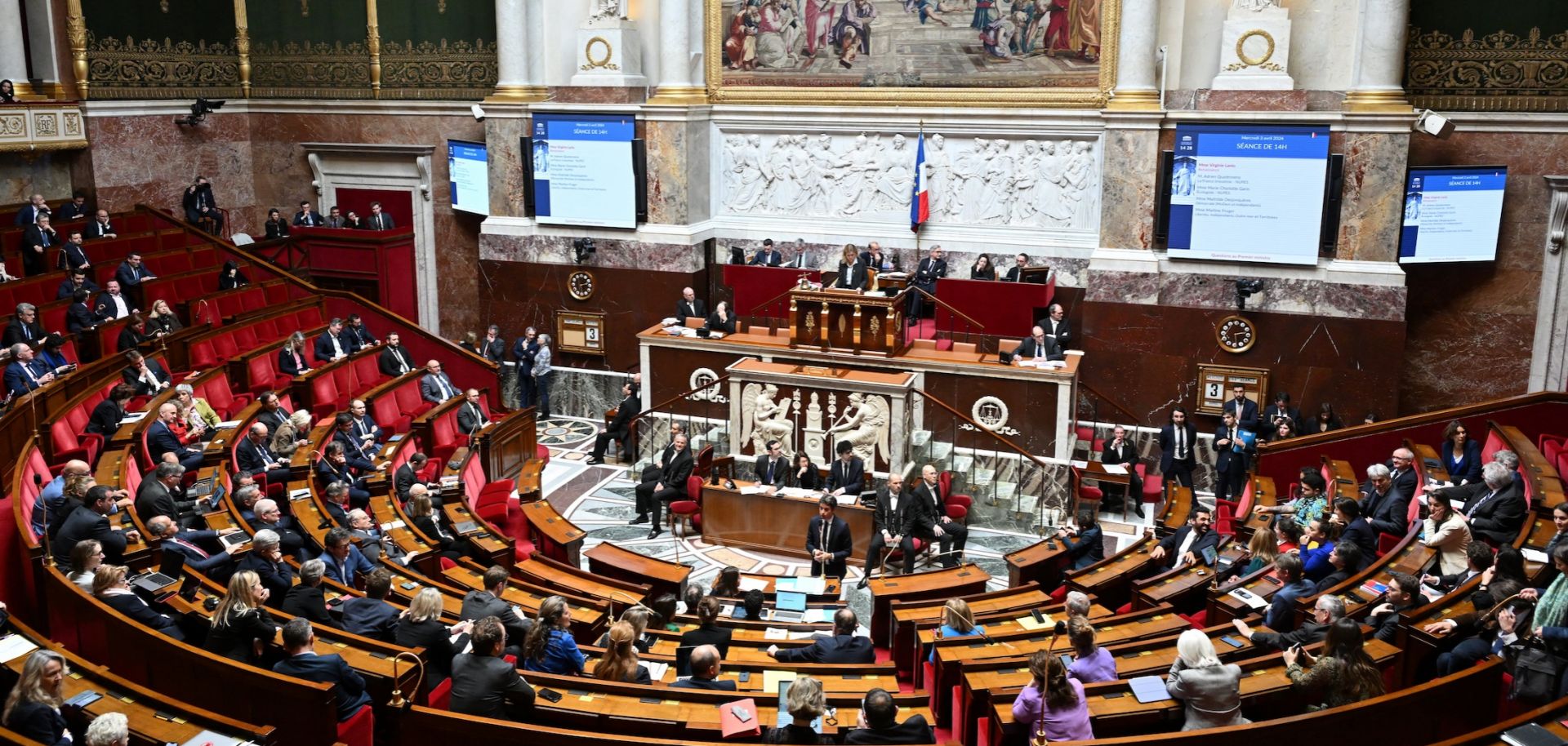
Budget constraints could hurt the electoral hopes of President Emmanuel Macron's centrist Ensemble coalition in upcoming European Parliament elections, trigger social unrest, and even lead to a government collapse and early parliamentary elections. The government may be forced to make politically painful decisions such as cutting public services or increasing taxes only two months before the European Parliament elections in June, which would likely widen the gap between Macron's centrist Ensemble coalition and the far-right National Rally party. Should cuts include spending reductions on social security, healthcare or education, this would also increase the likelihood of large strikes and demonstrations by opposition parties and labor unions over the coming months, which the government would struggle to contain given a reduced capacity to quell unrest and industrial action through economic incentives. Moreover, since the government does not have a majority in the National Assembly, the budget troubles may quickly transform into a political crisis. The center-right Les Republicains party threatened in March to introduce a no-confidence motion against the government for its "disastrous management of public finances," a threat that has attracted the support of other opposition parties across the ideological spectrum, suggesting an eventual no-confidence vote would likely be successful. However, whether Les Republicains will ultimately decide to take down the government by tabling a motion of censure will depend on what plan the government proposes to shore up public finances and/or concessions the government offers to Les Republicains. In case of a successful no-confidence vote, Macron would be forced to remove Prime Minister Gabriel Attal and could seek to make a deal with Les Republicains to appoint a new government, perhaps by offering the party senior Cabinet positions or making spending cuts an explicit mandate for a new minority government; both of these concessions would likely result in stronger fiscal consolidation. Alternatively, Macron could dissolve Parliament and call for early legislative elections. However, Macron's centrist coalition would likely lose even more seats in the National Assembly with an early vote, so the president would likely pursue the former option even though a partnership with Les Republicains coupled with an even more entrenched opposition in Parliament would make governing increasingly challenging, possibly leading to policy paralysis.
- Social unrest could also pose a significant threat to the Summer Olympic Games that Paris will host between July and August, possibly causing significant disruptions to the event. The high visibility of the Games may provide an incentive for unions and opposition parties to stage industrial actions and demonstrations in case of particularly controversial cuts to public services that could result in transportation disruptions, property damage and sporadic violence.
- Since the government does not have a majority in the National Assembly, it will likely have to rely again on Article 49.3 of the constitution to pass the necessary budgetary measures without a vote in Parliament. However, doing so would expose it to a no-confidence motion by opposition parties, which means the risk of a no-confidence vote remains even if the Les Republicains party does not table a motion of censure.
- Both the far-right National Rally and the far-left La France Insoumise (France Unbowed) parties have said they would support a no-confidence motion tabled by Les Republicains.
- Macron's Ensemble coalition is trailing the far-right National Rally party by 10-14 points in most polls.
- The opposition has brought four no-confidence motions against the government since the last elections in 2022, after which Macron's coalition lost its outright majority in the National Assembly. However, none of the motions succeeded, as they were tabled by either the far-right or the far-left, which are too divisive to gather cross-party support in Parliament. By contrast, a no-confidence motion by Les Republicains would have more chances to gain support across the ideological spectrum, particularly if the motion is motivated by a supposedly apolitical issue such as the mismanagement of public finances.
