
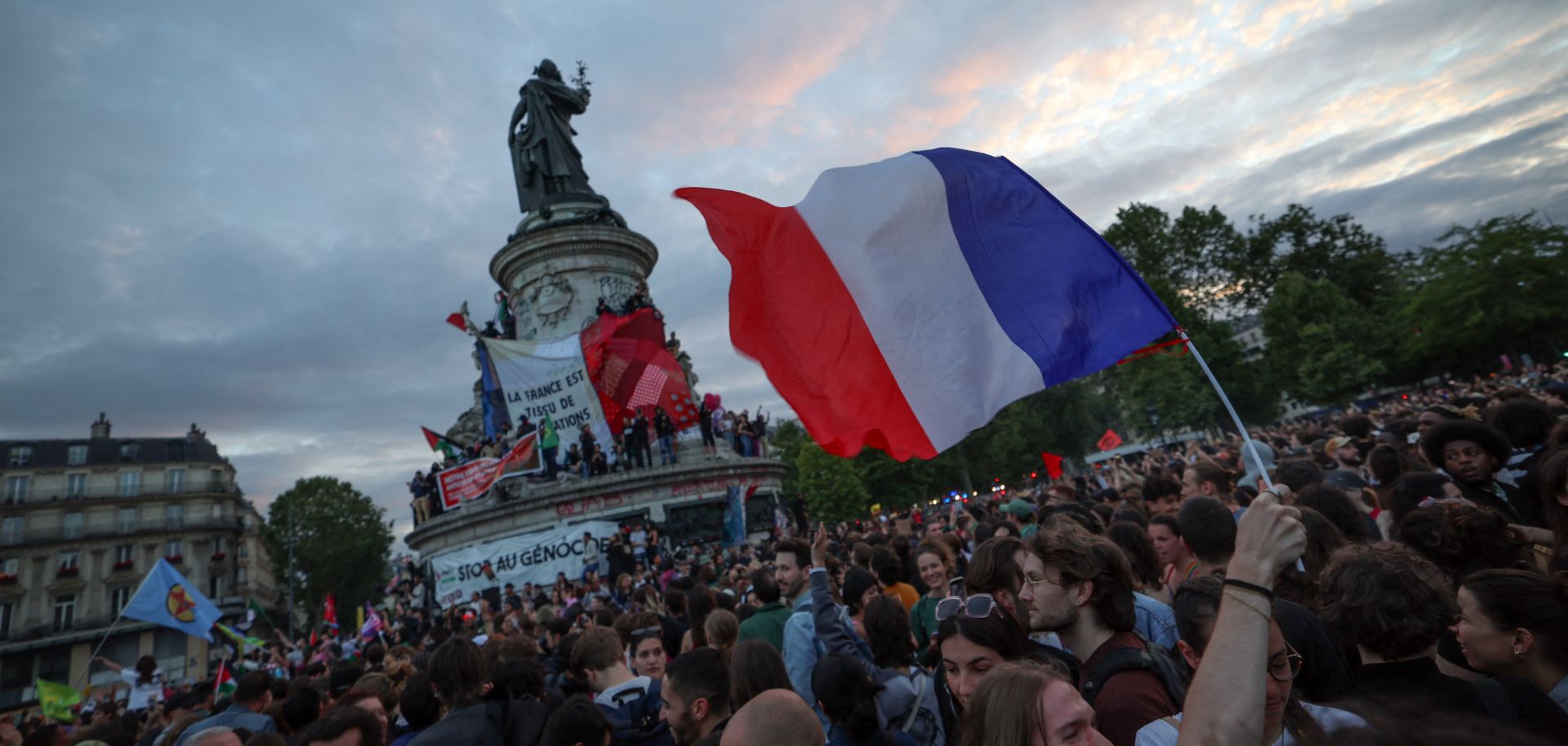
France's hung parliament means that even if a new government is formed, it will be fragile and constantly at risk of collapse, which will fuel lingering questions about Paris' ability to pass meaningful economic reforms and maintain the possibility of new elections after mid-2025. The New Popular Front (NPF) coalition of left-wing parties won 182 seats in the 577-seat National Assembly in the second round of France's legislative election on July 7. President Emmanuel Macron's centrist coalition Ensemble ended in the second position with 163 seats, followed by the far-right National Rally (RN) and its allies with 143 seats. While the RN came away with the most seats in the first round held on June 29, it was ultimately held back by tactical voting in the second round, as left-wing and centrist parties instructed their third-place candidates to drop out in order to consolidate votes against the far right and allow for other non-RN candidates to gain as many votes as possible, regardless of those candidates' party affiliation.
- The tactical voting strategy deployed by left-wing and centrist parties ahead of the July 7 vote saw at least one candidate drop their bid in 98% of the constituencies where the RN was leading the race, with a total of 221 candidates dropping out. This strategy was successful in not only preventing the RN from winning an outright majority but also relegating it to third place. Still, the far-right party managed to increase its presence in the National Assembly by 53 seats.
Centrist and moderate left-wing parties will likely reach a compromise to form a functional minority government, grand coalition or technocratic administration that excludes both far-right and far-left parties. France's legislative election has produced a hung parliament with three blocs largely equal in size, none of which is close to an outright majority or particularly willing to cooperate with each other. This will likely result in weeks or even months of political uncertainty and policy paralysis until a new government is appointed. Under the French constitution, there is no deadline for appointing a new prime minister, and Macron cannot call fresh legislative elections for another year. This means, short of a complete deadlock, three scenarios are possible between now and June 2025, when another parliamentary ballot could theoretically take place. In the first scenario, Macron could appoint a minority government that attempts to secure parliamentary majorities to pass legislation on a case-by-case basis. But forming such a government would prove complicated. A left-wing minority government that includes Jean-Luc Melenchon's far-left La France Insoumise (LFI) party is unlikely given the party's uncompromising stance. A centrist minority government led by Ensemble would require compromises with multiple other parties on controversial issues like fiscal spending and Macron's pension reform. A right-wing minority government led by the RN would be very unlikely to receive the backing of any other opposition lawmakers in the National Assembly. In a second scenario, Macron could appoint a coalition government between his centrist Ensemble coalition, moderate leftist parties (like the Socialists and the Greens), and a limited number of center-right lawmakers. But even with the exclusion of the far-left LFI, such an agreement would still be extremely challenging to achieve and very unlikely to last, given Macron's unpopularity and the ideological differences between Ensemble and the center-left. Finally, in a third scenario, Macron could appoint a technocratic government headed by a non-partisan, consensual leader tasked with passing the 2025 budget and managing day-to-day matters, as well as reassuring markets and France's allies of the country's stability. But while technocratic governments are frequent in Italy, there are no precedents for it in France. More importantly, similar to a coalition between Ensemble and the center-left, it would require compromises on myriad controversial policy issues and would be subject to potential no-confidence votes.
- On July 8, French Prime Minister Gabriel Attal said he would resign in light of the election outcome, though Macron has asked him to stay on in a caretaker capacity until a new government is formed.
- LFI leader Melenchon has ruled out any alliance with Macron's centrist Ensemble coalition, while Ensemble has likewise ruled out any collaboration with the far-left LFI. To secure enough support to form a government, an alliance between the centrists and leftists would thus have to include moderate sides of the Socialists, the Greens and the Communists, along with center-right parties (such as Horizons, led by Macron's former ally Edouard Philippe) and potentially some lawmakers from the conservative Republicans party.
- The RN and the LFI will remain isolated in the National Assembly and will be excluded from any eventual coalitions, but the far-right and -left parties will continue to pose a threat to any new government if they choose to support no-confidence votes.
France's hung parliament will heighten policy uncertainty and likely negate the possibility of any significant fiscal consolidation and growth-enhancing in the coming months. While markets reacted relatively positively to the RN's large initial lead following the first round of the legislative ballot, the left's surprise victory in the second round and the election of a hung parliament have complicated France's political outlook at a time when the country's financial position is worsening. This will likely continue to unnerve investors, who will be closely monitoring government formational talks in the coming weeks. If those talks stall or eventually break down, the consequent prolonged policy paralysis could severely rattle bond and equity markets and potentially prompt investors to demand a higher premium on French sovereign assets, thus resulting in higher interest rates for Paris. Even after a new prime minister is appointed, a moderate minority government or a broad-based coalition government would likely struggle to approve a medium-term fiscal adjustment path that France needs to submit to the European Union by Sept. 20, as well as a budget proposal that the government needs to submit to the French parliament by mid-October — significantly complicating fiscal consolidation efforts and likely maintaining elevated pressure on French assets. More broadly, the centrists will likely have to scale back some of Macron's economic reforms (such as a controversial increase in the retirement age) and implement some form of tax hikes. A technocratic government, on the other hand, would prioritize passing next year's budget in a bid to reassure markets, but it would still struggle to secure parliamentary approval for the spending cuts needed to significantly reduce France's public debt. In the medium term, a hung parliament significantly reduces the likelihood of Paris pursuing deficit-financed spending increases that would put it on a collision course with Brussels, spook investors and further roil markets, as the next French government will likely lack the support in parliament and internal cohesiveness to implement expansionary fiscal policies. But this also severely dims the prospect of any significant fiscal consolidation and growth-enhancing structural reform until the country holds its next presidential election in 2027.
- French government debt increased from 85% of GDP in 2010 to 110% of GDP in 2023. Meanwhile, France's fiscal deficit reached 5.5% of GDP in 2023, above its original target of 4.9% of GDP, due to a shortfall of tax revenues and continued high government expenditures following the COVID-19 pandemic. Prime Minister Gabriel Attal's outgoing government was committed to reducing France's deficit to 3% of GDP by 2027, a target that was already widely regarded as overly ambitious amid the country's only modest economic growth prospects. On May 31, international rating agency Standard & Poor's lowered France's sovereign credit rating from AA to AA-.
- In a low-probability but high-impact scenario, Macron could resign after a prolonged period of political paralysis and rising social unrest. However, the president would likely seek to first exhaust all other options (such as holding another early legislative election, which will be legally possible after June 2025) before taking such a drastic decision. Macron is in his second term and thus cannot run for reelection, which means that it would take severe policy paralysis, a critical economic situation and/or significant social unrest for him to resign before his term ends in 2027.
