
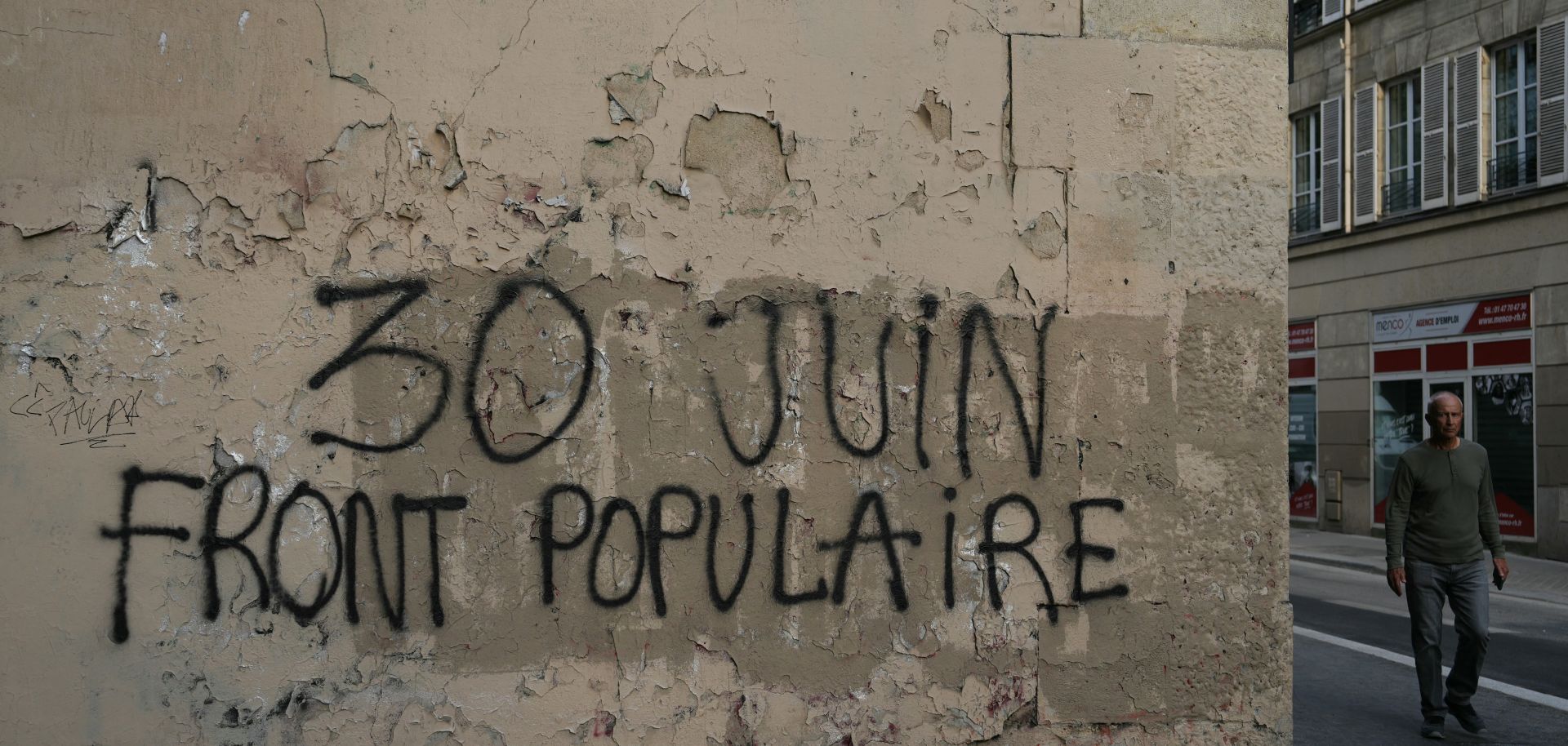
The first round of France's legislative election confirmed that the country is moving toward severe policy uncertainty as a hung parliament or a far-right government emerge as the two likeliest scenarios for the second round. The far-right National Rally and its allies won 33% of the vote in the first round of France's June 30 legislative election. The New Popular Front, a coalition of left-wing parties, ended in the second position with 28%, followed by Ensemble, a centrist coalition that backs President Emmanuel Macron, with 20%. While tens of seats were already decided in the first round, most of the 577 seats in the National Assembly will be allocated in the second round of the election, which will take place July 7. According to France's electoral system, in some constituencies, the top two candidates will compete for seats July 7, while in others it will be a race between the top three and top four candidates.
- Macron called for the early legislative election June 9, after Ensemble's weak performance in the European Parliament election (when it received 15% of the vote versus the National Rally's 31%). Ensemble had already lost its National Assembly majority in the 2022 legislative elections, which greatly complicated policymaking for the French government. The early legislative election was a high stakes gamble by Macron, who sought to mobilize the French electorate against the National Rally while also addressing growing public frustrations through fresh elections.
- In France, if a candidate receives more than 50% of the vote and 25% of votes from the registered electorate in the first round of legislative elections, they are elected outright. If no candidate receives more than 50% of the vote, a second round is held with the candidates who received at least 12.5% of registered voters. Some seats were already decided June 30 because of particularly strong performances by the parties in those constituencies. As a result, the National Rally has already won 38 seats, while the New Popular Front won 32 seats and Ensemble won two seats. The rest of the seats will be decided in two-way, three-way and four-way races.
The second round's results will depend on a complex combination of electoral strategies involving the New Popular Front and Ensemble that may prevent a far-right government but are unlikely to produce a working majority. A majority in the National Assembly, and therefore the power to appoint a prime minister, requires a party or coalition to control at least 289 seats. According to a study by Ifop, Ipsos and Elabe released June 30, the National Rally will win between 230 and 310 seats, while other surveys put the National Rally at between 230 and 280 seats. In the hours after the election results were announced, several members of the New Popular Front and Ensemble called voters to prevent the National Rally from winning a majority of seats. In three- and four-way races, this would involve the Ensemble or the New Popular Front candidate with the lower popularity withdrawing from the election to increase the odds of defeating the National Rally candidate. In two-way races, this would involve Ensemble or the New Popular Front voters supporting anyone competing against the National Rally. Considering the high animosity between the New Popular Front and Ensemble (which are extremely critical of each other), however, it is not a given that this strategy will take effect in races. Candidates have until the end of the day July 2 to withdraw from the second round, which means that the next few hours will involve frenetic negotiations in hundreds of constituencies about the strategy to follow to defeat the National Rally. But even if this strategy works and the National Rally fails to obtain a majority, projections suggest that it will not lead to the New Popular Front winning a majority, but rather to a hung parliament.
- On June 30, French Prime Minister Gabriel Attal warned that the far right was now at the "gates of power" and said that "not one single vote" should go to the National Rally in the second round, but did not explicitly call for an alliance with the New Popular Front. Similarly, New Popular Front leader Jean-Luc Melenchon said, "Our guideline is simple and clear: not a single more vote for the National Rally." In the meantime, National Rally president Jordan Bardella said that he was ready to become prime minister and enter a so-called "cohabitation" with Macron (a term used in France to describe a situation when the president and the prime minister belong to different parties).
While a hung parliament would result in policy paralysis and the delay of much-needed policies to reduce France's fiscal deficit, financial markets and the European Commission will be more welcoming of this situation than of a National Rally-led government. If no party or coalition controls a majority in the National Assembly, the legislative body will struggle to appoint a prime minister. There is no deadline for presidents to appoint prime ministers after French legislative elections, meaning Attal and his government may continue to manage day-to-day affairs in a caretaker capacity until a new prime minister is appointed and gains the assembly's confidence (which may not happen for months, or at all). Complicating matters, under the French Constitution, Macron cannot dissolve the National Assembly again and call for another early legislative election for one year. This means that there is a high chance of severe policy paralysis (at least for one year) during which a caretaker prime minister fails to get any legislation passed by the National Assembly while an early election to end the deadlock is not possible. While this means that France will be unable to pass much-needed reforms to reduce the country's fiscal deficit (which reached 5.5% of gross domestic product in 2023), the risk of severe pressure from financial markets is lower than under a National Rally government (which is campaigning on a populist, expansionary fiscal policy platform). A hung parliament scenario is also likely to prevent the European Commission from punishing France for not reducing its deficit, as Brussels will likely seek to protect the pro-EU Macron and prevent the euroskeptic National Rally from becoming even more popular in the future. If, on the contrary, Bardella becomes prime minister, he is likely to water down some of the National Rally's expansive fiscal policies. But this could still result in both uncertainty in financial markets about the sustainability of France's fiscal policies and clashes with Brussels over Paris' fiscal deficit. A high degree of political and policy volatility is also likely, as Macron would have mechanisms to delay (but not veto) National Rally-promoted legislation, leading to greater regulatory and legislative uncertainty that would weaken France's business environment.
- In recent years, the National Rally has walked away from some of its most radical policy proposals, such as exiting the eurozone. In recent weeks, the party has also been ambiguous about previous proposals to abolish Macron's controversial 2023 pensions reform that sought to make the system more sustainable. Pledges such as cutting the value-added tax on energy from 20% to 5.5% or nationalizing French motorways to eliminate high road tolls, however, still raise questions about the impact on France's fiscal deficit. Other policy proposals, such as establishing a national preference for public procurement, violate the rules of the EU single market and would result in legal disputes with Brussels.
- On July 1, the euro rose to a two-week high against the dollar, the benchmark French CAC 40 stock index jumped more than 2.5% at the opening, and the 10-year spread on French-German debt narrowed to a two-week low. These modest gains suggest that investors are somewhat optimistic about a potential hung parliament in France after July 7.
